about some of its major assumptions, even as I support it many of its goals. Thus my response to most articles and lectures advocating green design begins with the phrase "...yeah, but..." when impractical ideas turn up and concludes with multiple eye-rolls when the tone becomes alarmist. So it was with actual relief when I sat though a seminar on green design at an architects' conference where the main lesson was practical and modest about our understanding about the issue. No less surprising was that it was given by Peter Pfeiffer of the Autin architecture firm
, who are regarded as pioneers of a sort in popularizing green design in Texas decades ago (and who also happened to be the first visiting critic when I was a mere naive beginner student). What appealed to me in Pfeiffer's presentation was its emphasis on maximizing performance with sensible detailing of the building envelope and using of age-old devices for shading, ventilation, and moisture protection. The priority should be on minimizing a building's energy load before adding fancy devices that tend to add tremendous inital costs and may operate with compromised efficiency.
Despite the technological advances that constitute much of green design, there is nothing exceptionally high-tech about Barley + Pfeiffer's architecture. If anything there is much that is traditional. Much of Mr. Pfeiffer's presentation cited pictures of other people's buildings that were featured in lifestyle magazines like Dwell that exhibited common 'green' techniques but failed to perform the most basic function of keeping water out and properly shading the building. It reminds me of what a good architect friend once told me: "to say that I can design a green building is really saying that I can design a structure that won't fall." Much of what is considered responsible design is already green and has been so for the last 3,000 years. Siting the building to maximize natural daylighting and breezes while reliably sheltering occupants from the elements was fundamental since not doing so would make life indoors extremely unbearable and a threat to health. Stale air, excessive heat, mold, water-borne diseases, and smoke inhalation from cooking fires were the consequences of from a failure to design according to traditional 'green' principles.

If designing green is nothing new, how come is it seen as the next big thing? First, beyond being a
marketing gimick that endows a building with virtue, it's important to understand what buildings were expected to do before and after the machine age. Before the 19th century, the performance goals for buildings were limited by scarce resources that were readily available and the brute energy available from human and animal labor. Given this reality, it was important to concentrate the energy expended in a home to sensible and durable construction that required low maintenance and wielding natural forces for a minimal level of human comfort. The result was an extremely sustainable model of architecture by today's standards, yet driven by necessity rather than choice (the late Egyptian architect
Hassan Fathy worked in this mode, with interesting
results). The value of ornamentation in pre-machine era design was a testament to the triumph of the human spirit of frivolity and waste over a daily life that was mostly "...nasty, brutish and short." The act building was tremendous human endeavor, requiring enourmous amounts of manpower with the crudest means and most inefficient methods. But once a building was finished it used little to no energy, was passively cooled, and was made of non-toxic materials. Still, the buildings remained too dark more than half the time and still too cold (or too hot, depending one one's latitude).

Machines changed everything. They completely altered our expectation of what buildings could do in previously unimaginable ways. In addition to providing shelter from the elements, a building with the help of machines was capable of much more: providing a precise level of comfort, adequate lighting regardless of the time of day, clean our laundry, wash our dishes, rid waste, cook our food automatically and even irrigate the surrounding landscape. Thanks to advances in steam and electric power, fewer people were required in construction even as building size and interior expanded infinitely. The functions inside the home demanded less time and labor from members of the household and suddenly home had the additional task of providing spaces for private leisure. In contrast to a rough life of subsistence farming and huddling together with the family in a sparsely furnished hall, one could, thanks to machines and powered transport, pursue any occupation anywhere and eat food grown by others while lounging in compartmentalized rooms stuffed with affordable furniture.
As the building could now do more, more functions were naturally placed on it. Its value would be measured less by how well it kept the rain out or harnessed nature and more by how it performed other more specialized functions. The central question in much of the twentieth century was how could buildings accomodate the machine? After some experimentation during the 19th century, mechanical and electrical systems were to be integrated in the building once and for all, substituting the facts of nature within a sheltered space. HVAC systems could substitute the use of wind currents, fireplaces, and the sun to achieve unparalleled comfort. Modern plumbing systems, beyond eliminating the back-breaking and time-consuming labor of fetching water from the well, were a boon to overall public health and increased human longevity. Electric lighting conquered the night and the perpetually shaded recesses of our structures while ensuring much lower risks from destructive fires. By delivering energy remotely through wires, it also made all buildings capable of work. Before electric delivery, a space designed for the manufacture of goods required power to be available on site, whether sby relying on a wind or water mill, or by using animal strength. With electricity, the production of power is removed and therefore frees spaces to flexibly accomodate a countless number of functions, from industrial to clerical and domestic use.
All of a sudden, a building's performance was measured by how much work it could do within its envelope. More than just keeping the elements out or employing rules of composition and proportion, we now expect it to do things quite alien to Vitruvius and Palladio: it had to cool and heat mechanically, provide adequate power for artificial light and automated appliances, and pressurized fresh water for all washing and cleaning. All these modern functions would never have come about were it not for abundant and cheap energy. And this would not have been possible without a cheap and abundant energy source like fossil fuels. This abundance did not reward wastefulness as much as it encouraged innovation for the increase of production to create more human wealth. To produce more and make more money, it is essential to improve efficiency. Since the dawn of the industrial age, machines have progressively become more efficient at the same time that they could produce even more, which had the effect of consuming even more energy. This in turn increased the demand which then increased the supply of the most affordable and easiest to distribute sources of energy-coal, oil, natural gas, and later, uranium.
With the recently growing realization that these energy sources are inherently finite, there has been a rising call to maximize efficiency while consuming less. However, if the object is not to produce more to create greater wealth and value, there will be little incentive other than the high price of energy to become more efficient. Hence, the use of regulation to either artificially inflate the price of traditional energy sources or or the use of subsidies to deflate the natural high cost of renewable power. These methods of distorting the real physical value of resources (the pricing mechanism) are based on imaginary values derived from people's ideals and assumptions. Saving the environment is valuable in the realm of human morals and metaphysical understanding. It has yet to prove profitable or scalable in a free market, where it fills a niche and not mass market. What economic value remains for the environmental industry is chielfy dependent on government regulation and subsidy.
Does innovation on efficiency thus follow from regulation and subsidy? To a degree, they can, but at a much slower pace and at tremendous cost to lots of people (taxes, higher utility prices, etc.). Part of the reason for this is the fickle nature of discovery and innovation. They arise mostly from the muck of wasteful experiments and inventions, risk-taking, chance, and scientific accident. This is counter to massive government-led scientific research campaigns that tend to pursue narrow solutions. In a highly regulated and subsidized economic environment, the government-enforced high cost of energy and resulting reduction in productivity limits the conditions in which the 'muck' can thrive and from which most of our innovations come from. It is not a coincidence that most modern inventions and innovations since World War II (when all of Europe opted for democratic-socialism) have come from the U.S.-where entrepreneurial risk-taking and a desire to make things for which people willingly pay have fostered amazing technological advances at lower cost.
The current green movement is right to emphasize the maximizing of performance of our buildings in all various functions they assume nowadays. It conforms with the overarching trend of dramatic leaps of efficiency in our buildings taking place during the last two centuries. It is also good to learn from pre-machine-era buildings in how they made use of the climate at a time when energy was scarce and productivity was low. Especially when it comes shedding water and in shading from the sun, modern architects naively thought steel and concrete could 'reinvent the wheel'. The great modern masters' buildings were w

ell known to leak which helped undermine the appeal of their work in the popular mind. Mr. Pfeiffer joked that there are only two kinds of flat roofs-ones that leak and ones that are about to. And although an unshaded curtain wall glazing facing south may look cool and sleek in Dallas, it doesn't excuse running a dozen A/C units hidden in the bushes (like this
famous house). These shortcomings cost real money, and by properly addressing them with a tight leak-proof envelope (or a breathable one in some cases), sensible daylighting and shading, real long term savings are achieveable, especially in the long term.
That is, if the cost of energy stays relatively cheap. If the supply of energy stays the same and the demand for it declines because of conscious design, the price will decline. In this case, designing a green buidings is a matter of individual choice, where the inital extra cost of installing high-performance materials is weighed against long-term savings in energy consumption. Since going green isn't a self-evident economic choice on its own (as the need for tax incentives, credits and rebates makes clear), it remains a luxury made accessible to those who can afford and who adopt cultural values that endorse this choice. As I've described elsewhere, demand for environmentally-friendly products and services have grown in correlation to rising incomes.
But for many green enthusiasts, that is precisely the problem- as long as green design is a luxury of choice, it will be prevented from becoming the mainstream method of building. From their perspective, policies of government-led compulsion are the only way to make sustainable design widespread. That means government does what it can to penalize people who do not follow green practices, from artificially rationing energy or taxing it heavily, to radically raising the required performance criteria of targeted industries, to giving all sorts tax rebates or subsidies to green projects. Instead of thriving by selling goods for which there is a real market demand, the much ballyhooed 'green' economy can only be sustained by taking wealth from private enterprise and taxpayer income while willfully distorting pricing signals (eg. cap & trade). As an excercise, try to name one company or product that has been hugely profitable because of its sustainable features and not because of government help (The first thing that comes to mind is the Toyota Prius, but looking further one realizes that each unit is sold at a loss, its sales recently have been sinking faster than any other car due to lower gas prices and would be even worse were it not for generous tax credits.)
Since there is hardly a more regulated human endeavor than building, encouraging (or forcing) the implementation sustainable design has been easier than in other industries. In the interest of saving money on maintaining utilities and managing resources, municipalities and state governments push for better building performance. For one thing, it is relatively easy to hide the extra-cost of going green by means of codes, tax incentives and ordinances. This has the effect of raising real estate values, and attracts the well-off to move in and partake in the desirability of living the green lifestyle. Despite many people's faith in the virtue of green design, it almost never goes downmarket to benefit people of lower income. Unless a massive transfer of wealth is involved, the problem remains that environmentally-friendly policies usually have adverse affects on the poor. It is they who are more sensitive to the initial costs of things, and are rarely in the position of absorbing the sticker shock of the rich and planning out their finances based on life-cycle estimates.
That is why I favor simple moves to make a house perform more efficiently without raising the initial cost. It's no coincidence why learning and applying building knowledge of the pre-industrial past makes sense in the design of structures for the less well-to-do- it's about a return to an architecture made by people with lesser means. Because of all the thing a building is expected nowadays, this kind of building will not completely cut off energy consumption, but it could reduce it by a hefty margin. It is my believe that in the long run, this helps out more people, lessening costs without the burden of maintaining an expensive and unproductive solar roof panel or windmill (they often fail to provide more than 10% of a building's energy needs). The priority for the poor is not, in my opinion, to live more sustainably. By most measures, they already do live sustainably by virtue of the fact that they are poor (as were our pre-industrial ancestors). What today's poor have that their ancestors did not was cheap and abundant energy.
It is for this reason that aggressively employing renewable energy like wind and solar is misguided. These are very expensive sources of energy, despite the belief that the the sun and air are free. They require lots of input for relatively little output and receive 20-40 times more subsidies from the government per kilowatt produced. Increasing output from wind and solar can be improved in small increments, but their inherent physical properties prevent them from producing even close to enough. Compared to the high level of energy density per unit of oil, or even the astronomical level found in uranium, wind and solar-by their diffuse nature-are an infinitesimal fraction. Since those two clean-energy alternatives make little financial sense without massive government assistance, the only other credible argument to employ them now is the fact they do not burn carbon. Unlike a several decades ago when burning carbon meant harmful paticulates in our air, our technological success in nearly eliminating that problem has now given way to suspicions that it adversely affects our climate. I call this a suspicion and not a fact since much of the credibility of anthopogenic global warming relies on observations that the global climate is changing (higher surface temps, icebergs melting, rising sea levels) and associating this to rising carbon dioxide emissions without undeniable proof. If the paradigm of man-made climate change collapses under the weight of contrary evidence, which is quite possible, then the rationale for designing according to carbon footprint collapses as well.
The fundamental question remains: how must a structure perform? What standards should be used to measure a structure's performance-does it shelter well or does it permit functional flexibility and convenience to maintain a modern standard of living? If it's the former, then durable construction and time-tested techniques in dealing with the local environment is paramount. If it's the latter, then designing to minimize consumption of water and electricity is sensible, as long as the cost savings are not exclusive to the building's occupants but to the all people who have a stake (i.e. taxpayers) Anything beyond these tasks, such as minimizing the building's carbon footprint should be paid for by the owner's discretion, since current solutions tend to inequitably place the cost on others and promotes unproductive state-dependent enterprise.
Everyone should go green in their own capacity, but no one should foot the bill in promoting green enterprises of questionable benefit. Extra money in one's pocket due to efficient design and construction is a tangible benefit. At this point in time, lowering the Earth's global temperature by a 1/2 degree in one hundred years based on estimates from historically flawed computer models is still an imaginary and unverifiable benefit.


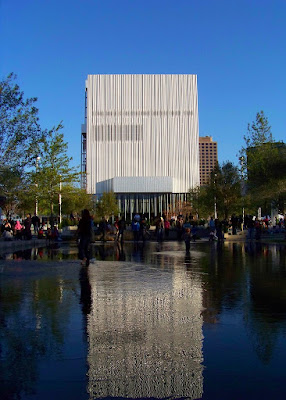 There has been an air of celebration among Dallas civic boosters, local media and even among many of its citizens these past few weeks. The opening of the $350 million AT&T performing arts center marks the culmination of an ambitious vision set forth by city leaders over 30 years ago in the


 As the current severe recession shuts down countless buildings and spaces everywhere, it is a good time to take stock on why some real-estate ventures succeed and others fail. The generous financing available the past five years not only led to lots of construction but also enabled the consideration and speculation for new models of development. Many large-scale buildings and instant communities were planned and built to a degree never seen before. Urban concepts that were confined to academia not long ago were suddenly put to the test as built projects. For example, entire abandoned airports were transformed into attractive neighborhoods with commercial town centers. Many cities seized industrial brownfield sites as a way to regenerate urban life by masterplanning dense mixed-use districts. After decades of rapid suburban development, the central city was due for a comeback, as demographic developments, pollution reductions and changing tastes conspired to make downtown living look enticing. It was just a matter of finding an ambitious project to kickstart it all.


