I keep the above concept in mind when looking at every issue, but in particular when it comes to environmental policy. As an architect these days it is well near impossible to avoid engaging in this issue. From my observation, architects, in desiring a status as independent craftsmen/artists, are relatively naive about the political dimensions of environmentalism and instead prefer to reflect on its attendant virtues of sustainability and harmony between man and nature. In the real world, we architects' inability to solidly grasp the theory of economic value and the mechanics of wielding political influence makes them incapable in making lots money or effecting real change. As we strive to improve the look and feel of our communities, we are often blissfully unaware of people's economic interests and the major political factions and powerbrokers that make things happen in the real world (...until it slaps us in the face in the form of architectural review committees, value engineering or canceled projects).
Friday, June 12, 2009
Beware of the Aristocrats: Architects and the Elite
I keep the above concept in mind when looking at every issue, but in particular when it comes to environmental policy. As an architect these days it is well near impossible to avoid engaging in this issue. From my observation, architects, in desiring a status as independent craftsmen/artists, are relatively naive about the political dimensions of environmentalism and instead prefer to reflect on its attendant virtues of sustainability and harmony between man and nature. In the real world, we architects' inability to solidly grasp the theory of economic value and the mechanics of wielding political influence makes them incapable in making lots money or effecting real change. As we strive to improve the look and feel of our communities, we are often blissfully unaware of people's economic interests and the major political factions and powerbrokers that make things happen in the real world (...until it slaps us in the face in the form of architectural review committees, value engineering or canceled projects).
Monday, May 25, 2009
Fight Club in the White House
Something else struck me about the group. I was reminded of the violence in their music, which was always oddly combined with a clean-cut look, an attractive (at least in the late 80s) bassist, and a calm demeanor between songs. This was a stark contrast to the overly rebellious music groups of decades past, whose violent music was always paired with a violent image. (Think Dee Snyder eating an oversized thigh bone, an iconic image at the time we would ridicule today.) Now, violence is an acceptable trait of the quiet man, the thinker, the amateur philosopher, the college student. What had once been public displays of pain turned into a controlled rage, a rage that was recognized, contemplated, and accepted. Who was it that bought tickets to see the Pixies on their reunion tour? 40-year-olds that listened to them in their heyday? No, from the looks of things it was 20-year-olds who still heard in the Pixies a freshness, and saw in them role models of their own controlled rage.
Tuesday, April 28, 2009
Podcast 7

Relieveddebtor and Corbusier take on green architecture and the changing institutional landscape in their most recent podcast. Enjoy!
Friday, April 17, 2009
As Institutions Crumble, What Will Take Their Place?

Life is always changing. But sometimes, change happens so quickly that we consciously stop and take notice. This is one of those times. With great expectations, we hoped the rust from the Bush years would fleck off. Instead, there seems to be a sense that more rust, a lasting rust, is forming. While Bush had his strengths (not least of which was his surety), he didn’t inspire confidence, especially when it was clear he had run out of ideas and support. For better or worse, Americans still need able leadership, even though we are remarkably independent in nature and history, and we were indeed ready for a change. And the results aren’t uplifting. At least, not yet.
This isn’t a screed against the current president. Rather, it’s a recognition that we were naïve at worse and overly optimistic at best to think that one person could fundamentally change the suspicions that had been growing within us for some time: suspicions that something wasn’t quite right, suspicions that the numbers weren’t adding up, and suspicions that a growing detachment from reality was here to stay. All of these suspicions were put on hold while we put our hopes in one man to make them go away. But he, because he is only a man, couldn’t possibly quell all such suspicions, and the basic detachments we’ve long sensed are now becoming realities. These are the detachments that we are no longer able to ignore, and they are motivating us to take real stock of where things are, and where they’re going. But what are the fundamental detachments from reality that have given us pause?
On a philosophical level, the first and most basic detachment is from the truth. The assumption that truth is relative is a devastating philosophical point-of-view, one that seems to promise freedom, but ends in enslavement. If truth is relative, then what exactly does one hang his hat on? And what protects your version of the truth, if another’s version is more popular, armed, or powerful than yours? Truth, detached from central, traditional, historic mores is not truth at all, just one man’s opinion. And if that one man has a following, an army, or a judicial system in his favor, what about your precious truth? Who will defend it, and on what philosophical grounds? I won’t be so naïve to say truth is an easy discernment. But are we even attempting anymore, or have we given up, using the excuse that it’s not real anyway, so why bother?
Postmodern relativism is simply an untenable philosophical framework, and it has led to a confusion in reality. It is certainly helpful for polite society, as it is a quick way to end an argument (“Well, you can think what you want and I will think what I want, and we can agree to disagree”). But if nothing is true, then nothing is real. If nothing is true, nothing can be trusted. If nothing is true, there is no legitimate need for respecting, much less loving, those around us. The only possible result is increased alienation, meaninglessness and rampant secularism, no recipe for social harmony to be sure.
Leadership that adopts a relativistic framework is bound to decrease confidence and increase anxiety, and this leads to our second unsettling detachment, detachment from our government. Does anyone have a hand on this thing anymore? President Bush acting against his own principles to save his principles is still a startling example of a lack of clear thinking that resulted in a panicked market. Our current president also has a tell-them-what-they-want-to-hear habit that leads to confusion, if not outright disgust.
Even worse than personal shortcomings in our government leaders is the sense that its size is starting to get away from us. In reality, it already has; we’ve officially become detached when our staggering debt load is more than we’re even worth as a nation. We’re officially detached when the interest on our debt is our fourth largest expenditure as a nation, following Social Security, Medicare and Medicaid. Those four expenditures don’t even take into account our annual federal budget! So while our government encourages us to save and be frugal, it is living on the domestic equivalent of credit cards with no prospect of income to justify the current purchases. When political promises are completely detached from what is fiscally possible (unless we charge more of
This leads of course to our growing detachment from economic matters. If only 53% of Americans prefer capitalism to socialism, we must have a serious lack of understanding. Worse, we must have a lack of trust in the market, and hence, each other. As massive companies engage in billion dollar boondoggles, only to get trillion dollar bailouts, we lose any sense of connection to the market, and let these failed experiment define the market for us. The market has become those rich guys stealing my taxes instead of the diverse, brave and industrious system that it is. The market, according to 47% of Americans, has become the source of our problems, be they environmental problems, healthcare problems, unemployment problems, or inequality problems. For too many of us, the market is not the solution, and we are simply feeling detached.
(Other institutions are suffering as well, especially the Church. This article is an insightful essay on the dissolution of the
From a spiritual point-of-view, the little things of religion stand a powerful opportunity to become absolutely vital again, the exact opposite of rote. Communion, liturgy, the Bible, small groups…all of these things could again become “mainstream” sources of hope and meaning. After all, haven’t these things always stood, through the decline of the
(Sometimes, it’s odd how articles with similar themes are born at the same time. I thought this said some of the same things I was thinking, in some ways better than I could.)
Wednesday, March 25, 2009
It's Not Easy Being Green- is it just about building performance or is there something else?
For those who have read my previous essays on green architecture, it is evident that I share some doubts about some of its major assumptions, even as I support it many of its goals. Thus my response to most articles and lectures advocating green design begins with the phrase "...yeah, but..." when impractical ideas turn up and concludes with multiple eye-rolls when the tone becomes alarmist. So it was with actual relief when I sat though a seminar on green design at an architects' conference where the main lesson was practical and modest about our understanding about the issue. No less surprising was that it was given by Peter Pfeiffer of the Autin architecture firm Barley+Pfeiffer, who are regarded as pioneers of a sort in popularizing green design in Texas decades ago (and who also happened to be the first visiting critic when I was a mere naive beginner student). What appealed to me in Pfeiffer's presentation was its emphasis on maximizing performance with sensible detailing of the building envelope and using of age-old devices for shading, ventilation, and moisture protection. The priority should be on minimizing a building's energy load before adding fancy devices that tend to add tremendous inital costs and may operate with compromised efficiency.
If designing green is nothing new, how come is it seen as the next big thing? First, beyond being a marketing gimick that endows a building with virtue, it's important to understand what buildings were expected to do before and after the machine age. Before the 19th century, the performance goals for buildings were limited by scarce resources that were readily available and the brute energy available from human and animal labor. Given this reality, it was important to concentrate the energy expended in a home to sensible and durable construction that required low maintenance and wielding natural forces for a minimal level of human comfort. The result was an extremely sustainable model of architecture by today's standards, yet driven by necessity rather than choice (the late Egyptian architect Hassan Fathy worked in this mode, with interesting results). The value of ornamentation in pre-machine era design was a testament to the triumph of the human spirit of frivolity and waste over a daily life that was mostly "...nasty, brutish and short." The act building was tremendous human endeavor, requiring enourmous amounts of manpower with the crudest means and most inefficient methods. But once a building was finished it used little to no energy, was passively cooled, and was made of non-toxic materials. Still, the buildings remained too dark more than half the time and still too cold (or too hot, depending one one's latitude).
Machines changed everything. They completely altered our expectation of what buildings could do in previously unimaginable ways. In addition to providing shelter from the elements, a building with the help of machines was capable of much more: providing a precise level of comfort, adequate lighting regardless of the time of day, clean our laundry, wash our dishes, rid waste, cook our food automatically and even irrigate the surrounding landscape. Thanks to advances in steam and electric power, fewer people were required in construction even as building size and interior expanded infinitely. The functions inside the home demanded less time and labor from members of the household and suddenly home had the additional task of providing spaces for private leisure. In contrast to a rough life of subsistence farming and huddling together with the family in a sparsely furnished hall, one could, thanks to machines and powered transport, pursue any occupation anywhere and eat food grown by others while lounging in compartmentalized rooms stuffed with affordable furniture.
ell known to leak which helped undermine the appeal of their work in the popular mind. Mr. Pfeiffer joked that there are only two kinds of flat roofs-ones that leak and ones that are about to. And although an unshaded curtain wall glazing facing south may look cool and sleek in Dallas, it doesn't excuse running a dozen A/C units hidden in the bushes (like this famous house). These shortcomings cost real money, and by properly addressing them with a tight leak-proof envelope (or a breathable one in some cases), sensible daylighting and shading, real long term savings are achieveable, especially in the long term.Friday, March 13, 2009
What Does it Mean to be Cool, Anyway?
What does it mean to be cool? I confess it’s a schoolyard question, but apparently, it’s one that matters politically. A lot. I remember thinking to myself “So what?” every time a political commentator mentioned how cool then-candidate Barack Obama was during the presidential debates. “It’s his ideas that matter,” I kept thinking, but no one seemed to agree. Not that McCain had great ideas (he never was able to mount himself as a viable option, as one appearing to have better ideas or a better economic philosophy), but Obama was scarce on details and a proponent of populist drivel when he did divulge. It wasn’t about ideas at all, I guess. Maybe it never has been. Maybe the schoolyard goal of “being cool” has smoothly transitioned into the most important issues and places of our time, to the point where actually debating an issue at length is no longer worthwhile. I find that alarming. Does anyone else?Of course, being cool under pressure is an absolute necessity for any leader, especially the President. The pressures must be unbelievable, at least for a serious thinker, which I’m not convinced Obama is. Everyone aims for the top, and you have to balance hundreds of relationships and the finicky public. Being cool can help to get an agenda passed, ease tensions with rival nations, and calm the nation if and when the government turns a crisis into a catastrophe. My fear is that we have mistaken aloofness for coolness and arrogance and laziness for confidence. From a moral point-of-view, this article speaks to this perfectly. From a political point-of-view, read this.
But in the midst of lackluster performance and falling approval numbers, is this the right time to start re-evaluating the value of being cool? Are there other values that equally matter, maybe even matter much more? To my recollection, the cool kids were never particularly impressive. (Admittedly, I wasn’t the cool kid. Far from a brainiac, I was reserved, lanky and more focused on theatre and music. I was an average athlete and socially insecure. So perhaps I write from a place of envy.) But in an effort to be intellectually honest, can we agree that while everyone liked the cool kids, it was rarely for their achievements? It was for their persona, even if they couldn’t manage to actually accomplish anything significant or unique. Only later do we appreciate the deeper thinkers, the quiet and the awkward, especially as they build businesses, employ others and consume our products. We end up reading their books, watching their movies and being inspired by the visions they often kept to themselves.
In the short run, what is cool is often what’s rebellious, what’s confident, and what’s independent. Cool art pokes fun at the establishment. It’s violent and edgy, often in form as well as substance. It is at times vociferously anti-religion and anti-American. In many circles, if art isn’t rebelling against the perceived “status quo,” it’s not worth creating. To follow up on corbusier’s previous post, perhaps this is why conservative artists have a difficulty conveying their values and making it interesting, and why too much Christian art has become boring.
But here’s the irony: the conservative persona often defends the most artistically viable ideas. Oh, they may not be controversial and hence, they may not be as cool, but isn’t liberty the ultimate artistic value? Aren’t honor and perseverance and the quest for the truth all perfect subjects for art? Does no one sense the irony that since the 1960s, popular art, from Warhol to the Sex Pistols and everyone in-between, railed against centralized power, yet cheer it on when it grows right in front of their face? Meanwhile, the very values they should applaud – intellectual diversity, freedom and being true to oneself – are scoffed at every time talk radio becomes the subject of debate. Art galleries, recording studios and movie sets are full of the very people who thrive in a free society and the virtues that make it work, yet crave this version of “coolness” even though it will ultimately imprison the minds and property of many.
On occasion, some conservative art gets through. I am always struck by the deep themes of honor, faithfulness and republicanism that drive Gladiator. Maximus isn’t cool because he knows it all; he’s cool because he’s strong, yet humble. Gran Torino also thrives on deeply conservative themes. Service to nation, economic and urban diversity, personal responsibility and sacrifice all play critical roles to the film. Both films are art that don’t require gratuitous sex or anti-establishment sentiment to be cool. Where are the artists, the politicians, and the thinkers that are every bit as cool as the current president? Or does he have the monopoly?
I accept the reality that in 8th grade we like the wrong people for the wrong reasons. Do we do the same as voters? I’m continually struck by the incongruence between the values of Obama’s voters, and his own values. How many would claim to support such reckless spending on credit, to the tune of trillions of dollars? How many would encourage him to increase the taxes of their employers and to discourage private charity? How many appreciate the copious examples of double-speak, with plenty of examples to be found here. Is he so cool to transcend all of that? I guess so…for now. But in the long run, isn't it better that the most liberating and proven ideas win the day, not the coolest candidate?
Corbusier comments: For a good dose of 'liberating and proven ideas' that win the day, I suggest taking the time to read a superb lecture given by Charles Murray of the American Enterprise Institute. Murray's pioneering sociological research on education, the welfare state and human accomplishment offers insights that are quite disturbing to many of those consumed by leftist assumptions even as it describes society far more realistically. While his speech is generally directed at America's elites needing to rediscover the roots of American exceptionalism, he points to our contemporary elite class being more preoccupied in seeming cool and posing as Europeans rather than reexaming fundamental ideas that we inherit from a long and rich historical tradition. The socialist political experiments of the twentieth century seem to inspire many of our elites, since they entertain notions of remaking humanity and recalibrating natural social inequalities. Yet it's a fundamentally adolescent conceit as Murray remarks:
The twentieth century was a very strange century, riddled from beginning to end with toxic political movements and nutty ideas. For some years a metaphor has been stuck in my mind: the twentieth century was the adolescence of Homo sapiens. Nineteenth-century science, from Darwin to Freud, offered a series of body blows to ways of thinking about human beings and human lives that had prevailed since the dawn of civilization. Humans, just like adolescents, were deprived of some of the comforting simplicities of childhood and exposed to more complex knowledge about the world. And twentieth-century intellectuals reacted precisely the way that adolescents react when they think they have discovered Mom and Dad are hopelessly out of date. They think that the grown-ups are wrong about everything. In the case of twentieth-century intellectuals, it was as if they thought that if Darwin was right about evolution, then Aquinas is no longer worth reading; that if Freud was right about the unconscious mind, the Nicomachean Ethics had nothing to teach us.
The nice thing about adolescence is that it is temporary, and, when it passes, people discover that their parents were smarter than they thought. I think that may be happening with the advent of the new century, as postmodernist answers to solemn questions about human existence start to wear thin--we're growing out of adolescence. The kinds of scientific advances in understanding human nature are going to accelerate that process. All of us who deal in social policy will be thinking less like adolescents, entranced with the most titillating new idea, and thinking more like grown-ups.
As Relieveddebtor has written above, part of being cool is to reject the status quo and being completely confident in rejecting the wisdom of the past. Speaking as an architect, it's safe to say that the appeal of modern architecture is that it looks 'cool' compared to the 'stodgy' traditional styles. The problem with being cool is staying cool, since it is such an ephemeral thing. It is supremely difficult to achieve timelessness in the modern idiom, but relatively simple when following traditional design rules. Despite this temporary luster that supposedly 'cool' modern architecture brings, it exacts tremendous permanent costs by ruining our cityscapes and impoverishing urban life. There is a huge price to pay for adolescent experiments and the refusal to govern as a grown-up.
Tuesday, February 24, 2009
Further Reading: On nostalgia, value and artistic virtue
- Nostalgia is a powerful factor in the development of new ideas and policies. As long as people have memories, nostalgia is a perfectly natural response to an environment that's gradually become uncomfortable, even hostile. It provides us an escape from reality just as much as it presents an attractive vision for redeeming the future by ushering a return to a more virtuous time and place. Since we tend to remember things in fragments, there is a deliberate selectivity in what we want recall, which makes nostalgia an exercise in incomplete image-making. Even if the details of what we remember have never been forgotten, it doesn't ensure that we understand very well what really happened at the time.
Lindsey argues that this nostalgic view of the post-war period is misguided, as it fails to take into account social and geo-political context unique to that time. While economic inequality was less dramatic, the unequal treatment between blacks and whites, men and women, union and non-union, corporate cartels and entrepreneurs helped make it so. Cultural and social changes since the late 1960's have made it impossible to return the supposed glory days of the 1940's and 1950's. In addition, a world war that destroyed the industrial competitiveness of Europe and the eventual rise industrial competitiveness around the globe ensured that the good ol' days of highly-paid manufacturing jobs and a growing middle class were to due to expire from the start. Lindsey explains that the economic policies pursued in the 1970s and 1980s were not part of a plan to destroy the post-war era of prosperity and social harmony, but as a response to its inevitable exhaustion due to a changing reality beyond any one actor's control.
Beyond providing a broader perspective about the overall issue of inequality, Lindsey's article is valuable as a quick primer on the economic history of the last half-century. It illustrates the connection between cultural values and economic phenomena, and that the success of a policy is only as good as its reflection of the culture that surrounds it. As values change over time, it is only prudent that goals will have to be reassessed as well. Likewise, what was once considered a problem in the past might be an advantage today, so it is reasonable to pose new questions for new times rather than applying the same old questions for a different set of circumstances. Inequality today means something quite different in the world fifty years ago, especially when seen in the context of absolute wealth and standards of living. Pursuing an abstract social goal like equality risks ignoring more tangible needs of the day-to-day life of average people.
Although Lindsey's article considers the short-sightedness of nostalgia in economics, there is a correlation with recent architectural discourse (but of course!). For anyone who has followed architectural trends in the last 40 years, it is obvious that nostalgia for an idyllic past has been a major influence on building design. Whether it is in the historicist strand within architectural postmodernism or in much of the work of the New Urbanist movement, there is an overt desire to restore the look and feel of a distant time and place. This is usually done in complete detachment to the reality of the current context, as portrayed by the juxtaposition of highway with speeding cars next to a lifestyle center designed in a style that originated from a time when streets were designed for pedestrian traffic and horse-driven wagons.
Just as nostalgia is memory based unrelated fragments, much of the historicist design is only skin-deep--elaborate facades made of thin veneers of foam insulated stucco or masonry veneer supported by a modern framework of steel and concrete. Instead of being connected to larger contemporary notions of space, time and transparency, the historicist project tries to recreate a fragmented reality all to itself, as an escape from an overarching reality that is beyond anyone's control. Just as we are bound to choose memories that recall pleasant feelings, erecting pseudo-European renaissance villages in modern-day suburbia is our way of choosing a happy reality that is completely of our own imagining. It's not as if there's any public will to bring back monarchies, guilds, philosophical humanism and a triumphant church hierarchy and other major influences on our beloved architecture.
Or maybe that's the point. After all, nostalgia is manifest in post-modern or post-structuralist reaction. When language, symbols, images or meanings aren't what the seem to be, when truth is relative depending on one's perspective and power, when context is what you make of it, maybe the superficial application of historic styles is the most 'honest' way expressing the reality of our times.
- Another article that I came across interested me less about its subject- Walmart - than the valuable nugget of insight into a major problem that affects American society today. Charles Platt, a former editor at Wired magazine, went undercover to see what it was like to work at the world's largest retailer. Beyond his observations about the efficiency of the way Walmart operates, and the highly autonomous decision-making on the salesfloor, which are both well-known, I was more taken by his restating of an obvious fact that is often ignored when debating the pros and cons of Walmart (a personal note: I don't like to go to Walmart- the dull decor and mediocre selection turn me off ). Writing on the relative low wages paid to workers (which are still better than many other retail outfits), Platt briefly summarizes the concept of value in the determination of wages:
I found myself reaching an inescapable conclusion. Low wages are not a Wal-Mart problem. They are an industry-wide problem, afflicting all unskilled entry-level jobs, and the reason should be obvious.- Finally, there was a short piece referring to one of my favorite films- Amadeus. Even though it first came out in 1984, this masterpiece by director Milos Foreman never tires from the dozens of times I've watched it, primarily because it offers one of the most compelling views into the mind of an artist. Especially near the end, when Mozart dictates his Requiem Mass to Salieri while on his deathbed, it is fascinating to watch the composer (brilliantly played by Tom Hulce) describe the piece's underlying musical structure while completely overwhelming his rival's comprehension. "Give me time..." yells Salieri, begging Mozart to slow down so that he can catch up in inscribing the notation, not realizing that this musical genius' life on earth was already running out of time. That's the nature of the creative mind, which has no respect for time and which tumultuously works through ideas and details on its own before ever putting them to paper.
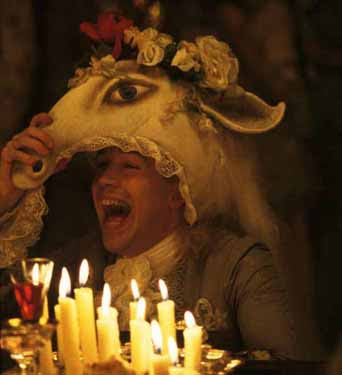
The creative mind doesn't care if you got the right beliefs or practice good virtues either. Doug Tennapel argues that the film Amadeus shows that the most creative people are not necessarily the most virtuous, and that believing the contrary hobbles artistic accomplishment. He writes:Thursday, February 19, 2009
Econ 101: It’s the Allocation, Stupid
For those that are gracious enough to visit this site, you may have noticed that we try to combine a variety of disciplines: economics, architecture, religion, politics. Though it is true that we, like most bloggers, are better schooled in some areas than others (and consequently go into more depth in those areas), we do not neglect common sense when offering commentary on how it is we thing society is best ordered. I would like to offer such common sense as it seems (at best) a healthy minority of friends and colleagues refuse to investigate the realities of our current economic mess.As I understand it, economics goes something like this: there’s a scarce amount of goods and services in the world, and we have to figure out how to allocate them. There are a number of ways of doing this, but two in particular have been tried most frequently, and one is in the process of being implemented in America as I write. The first way is to, as a society, do nothing. It’s often called the “free market” or “free enterprise.” It allows people, in a lawfully agreed-upon manner, to freely engage in trade. People are allowed to use their gifts, talents and skill to make products, offer services, transport goods, invent things, pretty much do anything that others place a value on. The market then acts not only as a place where goods are exchanged, but even more importantly, where information is exchanged. In trillions of daily voluntary exchanges, information on prices, demand, supply, production and everything related to the free exchange of goods is shared.
There are setbacks to this economic model. Good theology tells us people are sinful and imperfect, and in a free society, people’s innate sinfulness will spring up from time to time and cause harm. Most of the time, this sin, via the simple fact that sin will distort the free market and will thus corrupt the inherent value of goods and services, is localized and prosecuted, if it isn’t fixed within the market system itself. Greed is allowed to flourish in this system, as it does in all systems, and appropriate legislation and the rule of law are required to ensure the free market stays as free of corruption as possible. But greed, because it is spread so disparately across millions of producers and consumers, is rarely concentrated in a way that is finally detrimental.
The second model is one of centralized redistribution. The model is quite simple in theory and far older than the free market approach, but surprisingly complex in practice. The thinking says that we can morally take the property of individuals for the good of the collective, or use the excess of the wealthy to “balance” the poverty of the poor. In essence, through forced taxation (much like the medieval feudal system), citizens hand over their property to a central planner, who then “provides” for the needs of all. Various severities of this idea has been tried through the centuries. We seem, through the nationalization of several industries and by acquiring more debt than our GDP, to be slowly (or perhaps rapidly) adopting this point-of-view. Instead of feudal lords, the federal government is taking more and more of our property and centrally planning the economy.
There are setbacks to this model as well. History tells us that it is virtually impossible to administer this model because of its complexity, and because the voluntary information that flows so freely in a free economy is now choked off at several bottlenecks along the way. Information instead lies in the hands of a relative few people, people who cannot possibly have the adequate information to make informed decisions about the inherent value of goods and services. In other words, the proper allocation of resources becomes impossible, as an organic pricing system is replaced by an artificial pricing system. One small example might be the overabundance of size 12 shoes in the former Soviet Union, shoes that went unused. So where there wasn’t enough bread, there were far too many shoes that weren’t used. Information wasn’t able to be conveyed. There were simply too few ears for all the speakers.
There are serious moral ramifications of this collective model as well, too many to account for here. Suffice to say individual liberty and property are compromised. When allocation of resources is placed in the hands of a select group of people, rationing is the only possible result, as history tells us. So what inevitably happens is that the “class structure”, which are supposed to be eliminated through collectivization, is strictly enforced, as some get the scarce goods and some don’t, always for the good of the cause.
The difficulty with the free market is that it is that there is very little that is intuitive. It is not concrete. It really is the invisible hand. But we don’t like invisible hands. We like big concrete, centralized hands. We want someone else to produce X,Y, and Z, and we don’t want to leave that production to chance. What if someone doesn’t make it? What if they charge too much? What if I don’t like it when they do make it? Instead, we’d prefer to let a central planner tell us they’ll make it instead of leaving it to an unseen producer.
But with all its problems, one would have to be willing to live in ignorance not to be appreciative for all the free market does for us every day. It has solved, without anyone guiding it or directing it, the great problem of allocation. We have progressed as workers and are free to pursue those things we love to do precisely because we have allocated someone else to do the things we don’t want to do: grow food, ship food, build homes, build furniture, etc.. It wasn’t long ago that most folks spent vast amounts of their time in the drudgery of procuring food and shelter. Why don’t we anymore? We have let the free market decide how to allocate resources. At least we used to. Adopting the collective model will invariably lead to less efficient allocation of resources, bottlenecks, red tape and a terrible flow of information. At least, it always has.
Friday, February 06, 2009
Ideologues are Lazy
The Presidential Debate proved to be chock full of ominous warnings. I’ve written earlier about how I was bothered that a distinction of what is and isn’t a human/civil right with regards to healthcare wasn’t clearly articulated by either candidate. I was also bothered when Jim Lehrer asked: “Are you -- are you willing to acknowledge both of you that this financial crisis is going to affect the way you rule the country…” Hmmm, last time I checked, Presidents don’t rule…at least not under our constitution. At most, they govern, they lead, they act as a figurehead at times, and they are the Commander-in-Chief. But they simply don’t rule, especially on the domestic front. This idea of lords and kings ruling over us was what we revolted against in the first place. We instead chose a far messier process: democracy. (Or as purists prefer, a constitutional republic.)So this question would have been the perfect time for either candidate to inform Mr. Lehrer and the American audience that, in fact, Presidents don’t rule and it wasn’t their intention to rule. Mr. Obama might have won me over if he had said, “Well, I appreciate the thought, Mr. Lehrer, but it’s not my intention to dictate by fiat my ideology on 300 million people. It’s rather my agenda to sign legislation that the houses of Congress write that is in line with my vision for this great nation.” Of course, neither candidate said any such thing. Maybe its because they were quietly hoping they wouldn’t have to do all the hard work of governing, compromising and getting dirty with details of actually running a mammoth and complex government. With Mr. Obama, I’m getting the sneaky suspicion that he is more and more happy to rule, and less inclined to govern.
In his first 3 weeks we have seen him arrogantly throw the gauntlet on the so-called “stimulus” bill, threatening that if it isn’t passed there will be hell to pay. And one executive order after another has imposed a decree on corporate executives pay, among other things. Then there’s the “Rule as I say, not as I do” precedent where President Obama has ignored his own promises to refrain from hiring D.C. insiders and carrying about with business-as-usual pork spending. I’m not in the least surprised that Mr. Obama has carried on with a very typically liberal agenda, even as he promised change, even change from other liberals, like Hilary Clinton. (A great breakdown of this can be found here.)
And I’m not surprised for one reason: I always assumed that folks as ideologically driven as Mr. Obama were not tolerant of dissent, which to my mind, is a form of intellectual laziness. It’s not to say ideologies in and of themselves are bad. But Mr. Obama’s ideology is a simple one and a lazy one. His ideology is at best Keynes’ rejected idea of government spending, and at worst, a strong move towards socialism. According to the theory, government spending alone will stimulate an economy. Not only do I find this attitude foolhardy, I find it to be first-class daydreaming. Whereas markets take risk, this ideology hides behind false certainty, which is just another way of cutting off debate and refusing to engage in a diversity of ideas.
I have found few ideologues that can appreciate the inherent risk of the marketplace. Rather, they are intellectually lazy and push problems and solutions off on others. They often refuse to consider the unintended consequences of what might come, how government programs create terrible incentives, or that an honest solution might take more time and hard work than the phony solution of printing worthless paper. The solution to hand it over to someone else, especially a large seemingly beneficent government is far easier, even if fraught with peril in the long run.
And now that he’s not getting his way, he’s displaying signs of anger. That anger, that impatience that things aren’t getting done fast enough, that his nominations aren’t sailing through, that the pressures from foreign enemies are mounting hourly, are signs of his arrogance and his intellectual laziness. There is no evidence he has ever done the hard work of an intellectual. He has pontificated from time to time, but for the most part he has excelled at checkers. Presidential decisions are far more akin to chess. But ideologues don’t like chess. It’s too much work, too much scheming, too much preparation. It’s far easier to simply say “King me” and to rule. I have no doubt that’s exactly what he was expecting.
I remember a fascinating documentary about the rise of Nazism. One of the more striking details it revealed was the laziness of Hitler. You might think that a man as possessed as he was would have been a workaholic. But in fact, he often slept in until noon, watched movies, went for long walks with his dog, and routinely asked not to be bothered with work. Of course, there is no comparison to any American president with the evils of Hitler. My comparison is not one of morality, but one of temperament. An ideologue has no incentive to think critically, and that is precisely the problem with Mr. Obama. His mind is already made up, and that leads to pronounced intellectual weakness. For all of Bush’s faults (and he had many), a critic cannot honestly say Bush did not sacrifice his own ideology for the perceived good of the country. I humbly ask Mr. Obama to consider Mr. Bush's example.
Thursday, January 29, 2009
Podcast #6

In Podcast #6, relieveddebtor and corbusier discuss what impact the stimulus bill will have on architecture, an appreciate of contextualization in architecture, the beauty of Thorncrown Chapel, and how some Bible verses can be used to glorify ourselves instead of God.
Tuesday, January 20, 2009
O'Neil Ford: The Search for an Authentic Modern Response
When my older brother was going to college in San Antonio, he would mention to me a particular architect that had designed much of the campus. During my visits, I found each of the buildings to be of distinctive modern design and the spaces between them intimate in scale and responsive to the steep site. My brother praised the quality of the architecture by this apparently celebrated designer, O'Neil Ford, and continues to insist to this day that it was one of the most beautiful environments he had ever lived in. I had never heard of this architect, and I would soon forget about him until a couple of years later, he had me visit a house that belonged to a family whose son he was tutoring. There was a particular crispness to the exterior sillhouette, fine detailing and an original palette of materials and finishes. Inside, the rooms were layed out along a hallway gallery, which functioned as an strong axial spine permitting uninterrupted views of a beautiful large garden beyond. Sure enough, this handsome home was an O'Neil Ford design, which thus piqued my curiosity about the man and his buildings that would endear to my continuing interest in how local and and global influences could interact in a meaningful way.
ic corporate pioneers in its trademark industries of oil, retail and microchips. He would lecture and teach at the most celebrated architecture schools, and would even serve on arts commissions under president Lyndon Johnson. San Antonio's skyline would be indistiguishable without its 750 foot tall Tower of the Americas, which Ford designed as part of the 1968 World's Fair. Great swaths of historic building fabric that help make San Antonio the most picturesque city in the state were preserved by Ford's important advocacy. He introduced innovative structural systems to buildings, exploring the possibilities of thin-shell concrete and paraboloid roofs for industrial and civic buildings, including some of the most elegant laboratories for Texas Instruments.
cultural life (eg. Williamsburg), La Villita was to be integrated into San Antonio's cutlural life and produce artifacts that would help define the city's identity. There was little desire to recreate the look and feel of a place a specific point in time. Instead, the district would serve as an architectural panorama of the passing of time, emphasizing the evolving spirit of the diverse inhabitants and their affect on the built fabric. Ford's guiding reason for the district's redevelopment was "not archaeological-but rather attempt to preserve the spirit of architecture that is Texan".
In either the modernist or historicist mode, there seems to be an unfortunately tragic sense of cultural confidence. We are either anybody or we are somebody else, anywhere or and somewhere else, but never are we confident enough to reflect who we really are. An architecture that celebrates place and demonstrates a connection to its passage of time is therefore an affirmative act that will ensure the survival of a people's identity in the future. O'Neil Ford, along with his other global contemporaries trying to define a regional response to Moderism, serves as a model towards generating authentic solutions to modern problems that effectively preserves an authentic identity and spirit in the face of changing times. The practice of historic preservation and adaptive reuse is also signicant in achieving a cultural confidence through time, since one should never forget who they are and where they have been. Far from being a reactionary and defensive response to progressive calls for 'change' the appreciation of tradition as it has evolved in time encourages originality, spirituality and an overall depth that is sorely lacking in much our modern world.