Tuesday, January 30, 2007

Growing Into Anonymity

As the resident non-architect to blog on a site about architecture, I thought I owed it to myself to read The Fountainhead, Ayn Rand’s description of the ideal man, uncompromising architect Howard Roark. While I am not yet finished, I can say I’ve had a different reaction to this book than Atlas Shrugged, mainly in that I see more clearly the deficiencies of Ayn Rand’s philosophy and writing. The book has also caused me to reflect on what it is to grow older and grow into a profession, all the while contrasting what I have become with what I hoped to become in my younger years. As I age, I understand better that while the world was once my oyster, I am now becoming just one of many. Instead of growing into fame, power, or notoriety, I, and most of my generation, are growing into anonymity. I wonder, is that a good thing or a bad thing?

One of the facts that contrasts this growth into anonymity is the celebrity culture that seems to have no bounds. The notion of 15-minutes of fame seems to be a reality with blogs, YouTube, reality television, all of which tempt us to think we may be the next great contributor to our profession, pop culture, or society at large. In fact, what has happened with the proliferation of media is that anyone’s odds of standing out for longer than a few minutes in anyone else’s conscious have dropped considerably. While there are more opportunities to escape anonymity than ever, actually escaping it requires besting scores more competition. So it seems we’re stuck, anonymous and wondering when our time will come. And to some, this anonymity can be a crushing weight of perceived meaninglessness, and leave them wondering what their purpose was. The disillusionment of anonymity is one of the reasons for the wild success of The Purpose Driven Life.

As it turns out, the Christian take on all this is that anonymity is not necessarily such a bad thing. In fact, it’s practically a virtue. Over and over Jesus instructs his followers that becoming the least is our path to exaltation, and denying ourselves is preferred to worshiping ourselves. (Ayn Rand obviously has a different take, advocating man worship in no uncertain terms.) Other secularists would claim that this is the way religion controls people, by convincing them to become nothing so that someone else may control them. While this is undoubtedly true for many cults and dangerous sects of all religions, I don’t think this is at the heart of Christianity. From the Christian viewpoint, growing into anonymity simply puts us where we need to be: as creations of God worshiping our creator.

This is not an easy thing to accept in a culture that rewards those who stand out, even for Christians. Unlike the Soviet Union of Rand’s youth, America is home to constant temptation to shirk anonymity, to “make a name for yourself,” to become something special. Even in niche fields where the opportunities for fame are miniscule, I wouldn’t be surprised to learn that within everyone, there is a desire to stand out, even if only by having the widest read blog in your field. But these wonderful motivators in youth can be difficult to lose in adulthood. How does one deal with the fact that he/she will not be “the great man,” or that he will not achieve fame?

It is here I would have to come back to faith. While the meek certainly inherit the earth, Christianity absolutely does not (as socialism does) lump all humans together as cogs in a wheel. In fact, Jesus’ healing ministry to those in the most need (Mark 5 about the demoniac is one of my favorite stories) suggests that God cares very deeply about humanity on a personal and individual basis, assuming you believe that Jesus was divine. God’s words to Jeremiah are often used in the pro-life debate, but I use them here to suggest the way we may remember we are more than one of many; we are one full person in the eyes of God, and it is from this place we may find our full identity: “Before I formed you in the womb I knew you, and before you were born I consecrated you.”

My understanding of the mid-life crisis is that middle age allows man to reflect on his place in the world, wanting to know if he has made a mark. Ayn Rand can project her ideal man easily enough in a work of fiction; for the rest of us, we have to be content knowing that yes, our anonymity is a difficult thing to accept. But if we accept that our anonymity on earth is actually not a reflection of the way God knows us, perhaps it is a little easier to take. This is not a panacea; it is a reality of the spiritual life.

Saturday, January 27, 2007

The Truth About 15-Minute Meals: They Stink

I realize this may seem to be a bit of a departure from A&M’s usual fare, pardon the pun. We usually prefer to dabble in architecture (obviously), politics, religion and culture at large. Food, however, is something we all have in common, and the “Food Movement” in the culture, be it the “quick meal” phenom, or the rise in restaurants everywhere, that bears brief comment on. From the popularity of food television programming to the plethora of quick meal advice and recipes, there is no shortage of help for the good and bad in, or new to, the kitchen. But something has been lost in this movement to appeal to busy soccer moms and domestic dads: what makes good food good.

Cookbooks are, of course, nothing new. Even my grandparents, cookers of consistently excellent food for years, owned several and referenced them often. Any great cook steals from great cookbooks of years gone by. The trend now, however, is towards quick meals, be they 15- or 30-minute meals. (Someone recently gave me an old Julia Childs cookbook, and some of the recipes are 5 pages long. That book probably wouldn’t even get published today – too long, too complicated, and not user-friendly enough.) Besides the fact that these minute amounts are not entirely accurate when you consider everything that goes into cooking a meal besides cook time, can really good food be cooked in such a short amount of time by the lay chef? What most of the meals seem to do is take your basic meat, starch, vegetable combination, add a few spices, and call it a meal.

Certainly, most of the time, that’s a fine meal. But what makes good food good is time. Gone are the days where busy Americans have hours to watch a stew, or spend time with 10 or more ingredients. What used to be prized, slow-cooked food that allowed ingredients to marry, is gone in favor of what can be grilled, blanched or microwaved in 10-minutes or less and still be edible. And, there are is also the reality of duel-income families, so there is admittedly less household time to cook. When time in the house got short, an emphasis on good food was one of the first casualties. Hence, the rise in two industries: the restaurant business, and the “quick meal” section of the cookbook aisle.

Perhaps I’m nostalgic, but to me, we really lose something when we don’t bother spending time with meals. First, we lose the appreciation of different flavors converging, as they might in a stew, gumbo (I am from Louisiana, after all), or even comfort food like chili or enchiladas. Only when food is allowed to take time do the natural wonders seep out. Second, there is a lot of conversation lost. It seems that if meals have to be made quickly, then they have to be eaten quickly as well. Thus, the common family time, the meal, is limited. Food that takes time allows for conversation, most of it probably frivolous, but important nonetheless. Children hovering around a pot waiting for the soup to finish, or (heaven forbid) helping to wash fresh lettuce is a unique way families can relate to one another. And with food we are willing to take our time with, we get the benefit of using real ingredients. For example, if you look at the two main ingredients in a store-bought Italian salad dressing, you will see that they are not olive oil and vinegar, as you might have guessed. They are water and corn syrup. Is that what we really want to eat?

This is not, by the way, a critique of “fast food,” the McDonald’s of the world, or even quick meals. Because of the pace of life, we all need 15-minute meals from time to time. But I am an apologist for good food, no matter the cost or the time. We lose something when we refuse to spend time with food. Aesthetically, we lose a reminder of natural beauty when our senses aren’t involved with food. Culturally, we lose the communal aspect of both cooking and eating together. I guess you could say I’m not someone who eats to live. I live to eat. Yum.

Saturday, January 20, 2007

Traffic Jams: A Sign of a Prosperous and Free Society?

Thinking about corbrusier’s recent post, I have been considering again, and trying not to take it for granted, what it means to live in a free society. I certainly agree that America’s prestige and affluence have made it all that much harder for us to understand what it is to live under anything from our historically ideal conditions. Indeed, one could very well make the case that we are so unable to imagine what our lives could be like if we shared such a tyrannical government, that we have become completely spoiled. So spoiled, in fact, that as a nation, we may end up rotting from the inside out well before an outside force overtakes us. (Or perhaps the two will work together.) But whatever America’s moral flaws may be, I’ll save that for another post. I am more interested in trying to respect (literally, to see again) what a society that values life and the rule of law looks like, in opposition to a totalitarian society that we find hard to imagine.

So naturally, as I was listening to Chicago’s traffic reports yesterday morning, it struck me that traffic jams may be a wonderful barometer of a nation’s health. For example, this morning, the outbound Kennedy was jam-packed because a traffic accident, and its ensuing police investigation, blocked traffic to all but one lane. No doubt, all the rubber-necking slowed it down even more. I instantly had the same reaction commuters have to such news: because of one bad driver, thousands of others will needlessly be stuck in rush hour traffic for a very long time. Ah, the injustice of it all! But further reflection got me to thinking that maybe this was, in fact, a perfect representation of justice, of respect for human life, of putting rule of law that protects all people equally into action.

What does it say about a society that is willing to displace thousands of commuters for the health, either physical or legal, of one? From that point of view, traffic jams, though clearly inconvenient, say a lot. And most of it is good. Not only is it often crucial for medical personnel to get to a scene quickly for the physical well-being of the people involved, but for the legal rights of those involved in the accident, it is critical that an accurate police report be written. While it is true many frivolous lawsuits come from auto accidents, the legal claims any person can make following an accident are only secured if a verifiable entity (such as the police) accurately document the event, and then an impartial court presides over the case. In other words, it is more important that the potential health and legal rights of one person are preserved than the morning commute for hundreds of others.

While we not only take this for granted, but in fact complain a great deal about them, traffic jams are often (but not always) emblematic of what a free and moral society looks like. Can we say this for every nation? Surely not. It is hard to imagine that in every nation citizens have the confidence that their legal rights will be protected if they are of a low social standing, for example. And not every government protects the value of life to a point where it is willing to cause such congestion on the highways. Unlike so many nations where it is seemingly impossible for people of different ethnic, religious or racial backgrounds to protect one another, any person who needs health care, either on the highway or in the Emergence Room, gets it in America. The reason the story of the Good Samaritan is so popular is because Jesus knew how rare it was for a Samaritan to offer aid to an Israelite, and vice versa. The Samaritan, in effect, would have caused a traffic jam if he were first in line, not third. (The rabbi and the Levite’s morning commute would have been greatly hampered!)

Of course, there are many reasons for traffic jams, most of them good from a certain point of view: more people are driving, meaning more people can afford cars. Roads are being repaired or improved, in and of itself a pretty good thing, even if in Chicago large amounts of graft usually are involved in such construction. Or, there has been an accident, and the police are diligently investigating the scene to protect the health and legal rights of all involved. Come to think of it, there may not be a better representation of the greatness of America. Instead of bemoaning traffic jams, perhaps we should build statues celebrating them, or immortalize them in art showing an ambulance crew helping the victim of an accident while thousands of morning drives are delayed.

A free society is not always convenient. More importantly, it protects the rights of one person over the conveniences of hundreds of others. This is the sacrifice not-yet-free nations will have to learn to make, and somehow, live with.

Saturday, January 06, 2007

A Failure of Imagination: Underestimating the Influence of Saddam's Totalitarianism

The recent deaths of Saddam Hussein, Jeanne Kirkpatrick, Augusto Pinochet, the poisoned Russian spy along with the current debate on the extent of American intervention in Iraq have brought certain truths. The first being that political totalitarianism is awful on every account. This realization may seem obvious to anyone, but in monitoring current media chatter and listening to the reactions of everyday people to newsworthy events elsewhere in the world, it is apparent that there has been little effort to articulate in any detail the affect totalitarianism has on a people and how it leads to such widespread antisocial pathologies in countries that succumbed to totalitarian rule.

In our comfortably prosperous and civil environs that is middle-class life in America, such extremely depraved acts as assassination by radioactive intoxication, state-enforced execution with a taunting chorus recorded for posterity by camera phone and the tactics of militant forces that thrive in radically undermining any separation between armed forces and civilians appear incomprehensible to most of us. From our perspective of a society that takes for granted the prevailing rule of law and basks in limitless freedom to express oneself and make as much money as we endeavour, there is little difference between one dictator responsible for killing a few thousand of his countrymen for the sake of permanent political stability, rule of law and prosperity for his country and another totalitarian ruler who exterminated several hundred thousands of his own subjects for the sake of sowing permanent tribal division, economic degradation and political anarchy. Jeanne Kirkpatrick pointed to this difference, and urged that American foreign policy acknowledge it. But due to the extraordinary circumstance of growing up in a country where one hasn't experienced any degree of authoritarian rule for more than 230 years, many Americans are naive to the fact that most of the populations of the world are subject regimes that are far more invasive and deterministic in one's individual life than we can imagine.

If one looks at areas of the world where devastation by civil war, terrorism, or subjugation my Mafia clans or medieval tribalism, one can explain much of it through failed totalitarian experiments. In Russia, totalitarianism for seven decades begot a stunted and increasingly one party "democracy" that quashes opposition by whatever creative means, and in which the mafia is a major factor in daily life. In Cambodia, the Kmehr Rouge has achieved a sort national lobotomy that has prevented the country from being self-governing and deficient of and educated class to follow Vietnam's path to economic self-sufficiency. In numerous African countries, short-lived attempts at establishing socialist utopias have often lead to a radicalization of tribal animosities, to the extent that genocide and hacking off people's limbs are par for the course. In Afghanistan, the Islamic totalitarianism of the Taliban only succeeded in incarcerating women completely, as well to remind Afghans why it's more pragmatic for them to bow to those threaten with unrestrained violence over a democratic yet defenseless government of Karzai. In the aftermath of Castro's eventual passing, I don't expect Cubans to suddenly transform itself into a capitalistic democracy any time soon.

The largest totalitarian experiment in the Soviet Union has much to teach us about the system's adverse social effects. Although Russia under the Czar denied any modicum of personal liberty to its vast peasant class at the hands of the aristocrats, Stalin made sure freedom was only practiced by him alone. He made sure that everyone agreed to the Soviet state's omnipotence and ruthlessly ridding those who did not. What many people outside the USSR and other similar totalitarian systems is the extant to which it effects permanent changes that damage the psyche of subjected citizens that take several generations to eliminate. Paranoia becomes a tool of self preservation, as the social trust we take for granted in the U.S. is obliterated by a constant policy of purging suspected political enemies. People learn to be two-faced, carefully expressing one thing in public and voicing something contrary privately, which results individuals being skeptical about an other's true intentions. Such uncertainty erases all sense of trust, and essential ingredient in the building of any enterprise comprising of strangers that must cooperate. Nepotism becomes the rule in who gets to do what where, and competition between families rules out the neutral arbiters. Financing a business becomes a family affair, and for those families who do not have the means to pay for anything are beholden to underground mafias, who serve as surrogates to states who only serve the elites that control them. Where public trust is gone, one is evaluated no longer as individual with an independent conscience but rather one is identified as a member of a clan devoid of any real individuality. These observations are far from new, and have been better explained by Francis Fukuyama's book on the value trust from one society to the next.

What political totalitarianism does, then, is to eliminate individuality in all forms, particularly in one's thoughts. Once the totalitarian regime expires, it is not a given that such individual self-consciousness automatically returns. When an overarching identity defined by membership in a state is repealed, what replaces it are the layers of identity tied to simpler social structures: ethnicity, kin and family. To repeal those layers of identity to the individual is impossible in a social environment where one does not treat other individuals and humans with dignity, independent thought and sincerity. A free-society run by trustingly civil individuals is a huge leap in the history of social evolution. Totalitarianism does not derive from people deciding withdraw their individuality to become part of a larger political identity. Instead totalitarianism draws off pre-existing loyalties to ethnicity and kin to forge a far-ranging loyalty to the state. One one hears the common argument of how can a people maintain a free society when they have never know freedom, it's another way of stating that individuals in that that society haven't learned to trust each other. Contrary to the Marxist proposition that the final end of social evolution is the formation of a classless society based on economic equality (which to in my opinion is really about condensing several classes into one, which then becomes a 'state') I believe that totalitarian-enforced socialism is nothing more than a continuation of long tradition of abolishing individualism in favor of groups, from the family, to clan, to political party. Thus, when totalitarianism fades, the family, the clan and a the political party once again take precedence. In this context individualism never came to being in the first place.

From this perspective, much of what is happening in our world becomes comprehensible. In Iraq, Saddam for many decades was able to completely destroy any faint democratic notion remaining among his people, he used his ethnicity and his Tikriti-based kin to submit all other ethnic groups and clans to his and his party's rule. Individual identity was secondary to what ethnicity and clan one belonged to, and whether someone was a Baathist or not, or simply whether he did not like someone not as dignified individuals, but what threat they posed to him personally or how they could enhance his power. For this to happen, hundreds of thousands of people who did not belong to his group were slaughtered for none other than who they were. Kurds, Shia, Marsh Arabs, or even his kin who consorted with people outside his family were all people who betrayed Saddam's narrowly defined totalitarian identity. With Saddam gone, to where did the power devolve? To the next level of social structures: the clans, the religious leaders and religiously affiliated political parties. Demographic isolation is currently taking place in Iraq, with each of the three major ethnic groups claiming their own territory, with multi-ethnic cities changing into singular bastions of one ethnicity or becoming the home of a powerful clan. Such movements of people have made American objectives for a stable federal democracy in Iraq a tall order. Although such a goal is admirable and any country with an existing political culture amenable to democracy would jump at the chance America has given Iraq, the totalitarianism instituted by Saddam and his Baath party has diminished the ability for the Iraqi people to understand and embrace the golden opportunity before them. The post-Saddam era for many Iraqis seems to have presented an opportunity to rather exact revenge on the former ruling group.

When I read about the current difficulties facing American-led coalition forces in Iraq and the horrors afflicting Iraqi civilians from terrorism, I tend to see these events from a different perspective than what drives the contemporary debate on Iraq. In my mind it is easier to indict American military strategy, Iraqi political fractiousness, or the intelligence of George W. Bush than to confront the totalitarian reality that was Iraq under Saddam. This reality is not only beyond our comprehension, it is beyond our imagination. Totalitarianism brings out the worst in human nature and uses it as an instrument to wield control. More gruesome and more lethal forms of torture were developed under totalitarian regimes, systematic executions and show trials were means for the authority to communicate power and induce fear in the population. Islamic fascism takes the totalitarian ethic further by injecting fanatical religious conviction into the mix, thus inflicting cruelty and mercilessness not only to members within a political polity, but outside it as well. In addition to executing on the spot any villager who does not demonstrate loyalty to the controlling Islamic fascist, they will capture torture and summarily execute foreign soldiers and humanitarian workers with little regard to international law or any modicum of human dignity. Whenever one of those beheading videos are broadcasted, or reports of terrorist militants using schools and mosques to stockpile weapons and coordinate plots are written about, or blatant footage showing terrorists using civilians as human shields, I can’t help but think about the many years of totalitarian brutality in its many various forms that have led to such a sordid outcome.

But what I also cannot comprehend is the reaction of so many people to such blatant evil. Such resignation, such complaisance, such futility in trying to explain it away as a just reaction to what the Americans did beforehand. That is not how one should respond to this subhuman depravity. One should instead support efforts to eliminate it outright by force of arms. Any other alternative such as talking it out or making concessions will not stop totalitarian violence. Such misguided efforts through accommodation helps explain why many totalitarian regimes last for long periods of time long after the political subjects have tired of it.

One of the conclusions reached in investigating the 9/11 attacks was that there was a failure of imagination in preventing such an unconventional terrorist plot. Much of what made 9/11 such a traumatic event to the American psyche was its surreal quality, a sense that these attacks could not have taken place in reality, but rather somewhere in our imaginations, as if in a dream. I fear that much of the world has failed to imagine what the Iraqi people have been subjected to under Saddam which not only has affected American efforts to stabilize Iraq but also how most of us have no reasonable answer to a powerful evil staring right at us. If we cannot take a firm stand against totalitarianism and its evils in front of our faces, whether on the battlefield or on our television screens, how can we expect to protect our own freedom from it?

Thursday, January 04, 2007

Nanotechnology and Bread: How Technology May Change Religion

Listening to a podcast the other day spurred me to ask what the future holds for religion in a quickly-changing world. Futurist Raymond Kurzweil, who has a history of accurate predictions regarding artificial intelligence, sees robots becoming as intelligent as humans by the year 2029. Kurzweil, an incredibly prolific inventor and writer, holds that because technological change is exponential rather than linear, the world will see drastic technological breakthroughs in the coming decades that will increase lifespan, spawn robots capable of feeling, and have nanotechnology swimming in our bloodstream. All of this will eventually lead to a singularity, or the time at which humans cannot keep up with the advancements in technology. Imagine the replicants in Blade Runner, and you get a pretty good idea.

Which naturally made me wonder what the role of religion will be in such a new world. The vision in Blade Runner or Minority Report seems to be largely if not completely secular. People of faith, such as the "mystics" Ayn Rand portends in Atlas Shrugs, seem to be apocalyptic lunatics, caricatures who have only ever read the book of Revelation. But I don't think that will be the case in full. With every change comes reactions, and certainly the popularity of the dreadful Left Behind series is proof that changes in the world (even mere millennia) spark absurd reactions of fear. But ultimately, the apocalyptic fear monger is the exterior vision of the way technology may drive people to real faith. Technology, like a good photograph, is always full of promise and potential, but rarely cashes in. Technology, for many, brings with it a great amount of hope that our lives will be improved, diseases cured. Some dream of a techno-utopia.

But technology will be just as flawed as any other human effort. With every benefit comes a trade-off. You get to live longer? Great, but don't expect to be able to retire before you're 80 to pay for it. No more cancer? A plague is probably just around the corner; they always are, and they're always ahead of our medicine. More information at your fingertips? It's at everyone else's too, so the world just got infinitely more competitive. When technology fails, we will either continue to grasp for new hopes, or will revert to that which is real hope. That is not to say technology is a bad thing, or that I fear it. It's coming whether I like it or not. But its possibilities are limited, not infinite, and it definitely won't allow us to live forever.

What has the impact of technology already been on religion? I can't help but think that there is some link between the rise in fundamentalism over the last 20 years with the rise of technology. For example, the Internet has both allowed jihadists to propagate their message, but it may have also struck a great sense of fear among them. It was one thing when the West was relegated to nations thousands of miles away. But the Internet has erased borders and boundaries. The Internet has allowed the West to "infest" every corner of the world with its ideologies, commerce, and (gasp!) religion. It has gotten harder and harder to remain isolated, so it makes perfect sense that some who wish to remain so are fighting back.

We should remind ourselves that while America creates and devours knowledge at unprecedented rates, there is a real fear of information among many about what changes may come. We should have known that the information revolution would spark just that: a revolution. Surely we should have been able to guess that not everyone is in favor of knowledge. Some groups want to stay in the dark, and they desperately want others to stay there with them, at any cost.

So will it only get worse? Certainly the current wars will have to play themselves out. If democracy is possible in the Middle East, eventually the people there will adapt to technology, though it will take a very long time. I am optimistic that they will. But at a slower and steadier rate, I can't help but think that massive changes in the world around us will always draw people to faith. I'm not crazy about that evangelism strategy, mind you. But when I parallel the imagery of robots curing disease in our body, with say communion bread and wine, the older medicine seems like it may be a bit more appealing.

There is an aesthetic reason for this as well. It seems like the world of technological advancement is a sterile one, one where human interaction is limited. The blogosphere is even heralded by some as a replacement community to local communities. I don't see it. Technology enhances are life, it doesn't change the needs of people. We will always crave real relationships, real truth, and religion offers this in ways technology can't. I'll certainly be interested to see the way technology, not just the Internet and vaccines, but serious new technologies change the role of religion in society.

Friday, December 29, 2006

Christmas and Birthdays: Welfare for the Rest of Us


I remember it very well. On Christmas morning when I was about 11, I opened the front door to my mother's house, looked at the assembled gifts underneath a modest tree, and asked, "That's all?" Little did I know that an abundance of toys had been replaced with a refinement of them. My older brothers made it clear that wasn't the right response, and I look back on it now with embarrassment. With that statement came the realization in hindsight that the dependent culture is no longer relegated to professional moochers. With every Christmas, birthday, anniversary, Valentine's Day, etc., it seems the impetus to be charitable has gone from being a "nice thought" to being a mandate. Is there any one of us who does not expect gifts to mark these occasions? Or more to the point, do not all of us feel compelled to buy more elaborate gifts every year? How have occasions for celebrations turned into such times of material expectation, and is there any way to curtail such expectation?

The real problem with expecting a bounty at every Christmas or birthday is that the joy of receiving such gifts inevitably dulls with time. I especially notice it in children who grow tired of new toys within a span of days, as their appetites for consumption grow more and more insatiable. The build-up for the next round of gifts decreases, as the getting of gifts is assumed. There isn't much wonder in what gifts will be given. With gift cards, there is even less creativity required of the giver. So holidays and birthdays become more and more akin to waiting in the welfare line: even though we haven't done much to earn these gifts, we expect them with all the self-righteous vigilance of a hard laborer awaiting his day's pay.

Memories of my early childhood (before I had become so spoiled) certainly include toys. But with mismatched G.I. Joe's, Transformers, and even homemade Dukes of Hazard cars, I could create situations and entire war zones that would entertain me for hours. I was still bored at times, so playing a sport outside would be another good alternative. Boredom, as it turns out, is a crucial impetus for creation. We never had cable or a gaming system (I had to wait until my twenties for a gaming system, and I still don't have cable), so I was forced to use my imagination. Like most boys, I appreciated war scenes the most. And when I was bored with that, I learned an instrument, went to a friend's house, or read.

Creators and inventors are people who are too bored with the way things are, and I would guess that they were compelled early on not to ice their creative spirit. With a delusion of material possessions, however, it has been relatively easy to create a generation of distracted children who require more and more distraction. It is true that a delusion of toys can still encourage creativity; for example, new Lego robots require builders to amass specialized parts and write code to operate them. But to really make something from scratch, or to really imagine something beyond what is in front of you requires patience and probably boredom. On the plus side, perhaps it will make the next generation of inventors that much more clever and ahead of the curve.

But isn't losing the need to create is the great tragedy of the welfare mentality? It discourages innovation and creativity because it simply doesn't require it. Why bother creating when you're paid to do nothing? I wish conservative politicians would keep speaking of the "soft bigotry of low expectations", because it very accurately describes the welfare state. But the same is true in the family. If children are constantly expected to create no real entertainment for themselves, that's another way of saying you don't believe they can. Worse, though, is the establishment of an attitude geared toward expectation, rather than appreciation. While many Christians complain that Christmas has become too secular, they are often equally guilty of basting their children in toys of distraction. With the marginalization of Christmas, I hope Christians will take the time to explain why we give gifts to begin with, as a response to the gift which was first given us.

Children aren't the only ones with this attitude of expectation; it's often no better with us as adults, unless we consciously train ourselves to resist such temptations. And our toys aren't cheap. A natural maturation will hopefully teach us to eschew material gain, as our concerns grow more selfless. But that spoiled child within us never leaves, and it is harder to quench an appetite than to never develop one. So why do we so restlessly convince our children that every minor celebration, or even major one requires gifts? From a theological point of view, gifts should be Gospel, not Law. They are something unearned, and hopefully appreciated. With every holiday season, though, I feel more and more as though they're law, a requirement devoid of much joy.

Friday, December 22, 2006

Whither the Cardboard Model?

For those fortunate to have attended college on a campus with an architecture school, visitors to the architecture buildings are instantly captivated by the small architectural models built by students. These little cardboard or bass wood miniatures that manifest spatial ideas in physical reality is often the most accessible way for non-architecture laymen to understand a design concept. At the same time, the ubiquitous display of models throughout an architecture school give an impression to laymen that architecture lacks a level of seriousness, since spending time doing arts and crafts is commonly understood as a part of child's play. It gives the impression that architecture students must be having fun while in reality there is nothing more tiring and frustrating than gluing small pieces together with such concentration and precision.

Along with the challenges posed by building the model, there is much expense involved as well. It is easy t0 squander hundreds of dollars for a reasonably detailed model for a school project. For some students, modelmaking is a serious craft, the goal being not to solve three dimensional problems toward improving a project's design, but rather to execute a model with great precision, detail and realism. Lacking fine motor skills, patience, and being naturally stingy, I made models as seldomly as possible, and made them intentionally rough as a tool for spatial exploration and problem-solving. I intended them to be abstract, so that concepts could be more powerfully presented, while also thinking that too much detail winded up giving a model a dollhouse-like character.

The major reason I tried to avoid building too many physical models was the amount of time it consumed. There's no way of rushing a model. One can only cut a straight line with an exacto only so fast and glue can only harden so quickly. And still , there was no way of testing various alternatives without building three separate models. The finished results might be intriguing for onlookers and will better help those who want to discuss the project with the student. But they were a chore to complete, and I knew that model-building skills were among the least important in the expansive practice of architecture.

Therefore, as soon as I enrolled in studio classes that did not require physical models for presentations, I switched to using computers to create virtual three-dimensional models. In addition to ensuring high-quality line drawings of unparalleled accuracy, computer aided design (CAD) could build models very quickly and with infinite precision and verisimilitude. The best part was that it spared me from making trips to the nearby crafts store, thus saving me substantial money. It also helped that computer skills have become essential to getting any entry level job in architecture. As an additional benefit, becoming proficient in computer-aided design served as a gateway to understanding computer animation, graphic design and artistic rendering.

With all these advantages, there was yet a significant drawback to computer models: a stranger could not take digital model and view it from any angle in the physical realm. The closest means of doing this on the computer is for that stranger to muddle through unfamiliar software and navigate in virtual space. Since the model could not come to them, the next best thing was to print on paper as many points of view as possible. A digital presentation often consisted of dozens of different views to help convey the spatial idea. This often made such presentations disorienting to those unfamiliar with the project. The physical cardboard model, by contrast, was a lot more straightforward in that it could be viewed from every angle simultaneously by moving one's eye.

Since finishing architecture school, I've rarely had to dedicate any effort into building physical models. Clients will almost never pay for study models, setting aside money only for presentation models useful in selling the project to potential tenants and investors. Since the latter type requires tremendous amounts of time and high levels of workmanship, they are usually outsourced to an independent model making workshop (which are increasingly found in places like China and India). Architect's fees are inherently tight thus rewarding an efficient use of time and manpower that are antithetical to model making. Computer models suffer from an inaccessible interface for people unfamiliar with the software, making older architects unable to fully appreciate the merits of a design. Until this problem is resolved, whether by rapid prototyping or by creating a virtual reality environment that anyone can physically participate in, non-reimbursed cardboard study models will be used from time to time.

As I've taken on more responsibilities on the design end in my professional projects, I've maintained my aversion towards physical models. Luckily, computer modeling software in the last few years have made significant leaps towards intuitiveness and user-friendliness. They are easier to learn, have more efficient rendering engines, and yield quick results. I particular enjoy using Sketchup to investigate massing, shadows, perspectives, and quick fly-through animations. Although it tries to bridge the art of sketching with modeling, Sketchup is deceptively simple, providing few tools to modify objects and yet it accomplishes better results than more expensive and complicated software. Together with trace paper, the schematic design process goes quickly, and the program's compatibility with standards drafting software allows for little time to be wasted in producing two-dimensional plans and elevations.

With all these new innovations, what will become of the cardboard model? My guess is that it will still be of use so long as computer model remains virtually existent int the hard-drive of a computer. Clients can understand a model over something that is almost unintuitive in the forms of architectural plans. Still, a computer-generated rendering is more seductive, can be more easily edited and obviously ship better than a physical model. I predict that physical models will eventually cease becoming the product of exacto knives and glue. In their place will arise models built by machines following computer generated architectural plans. Such technology is in its infancy now, but will soon permit designers to more productively test alternatives. The architect becomes more empowered when he or she does not have to worry about being a craftsman of miniatures.

Monday, December 11, 2006

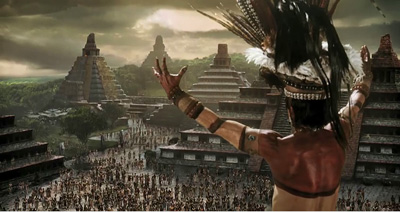
Apocalypto: Gibson's Theology Still on Display


In Mel Gibson's Apocalypto, viewers of his previous two films will experience the familiar: brutal violence, fierce action, and a powerful story line. The movie is confidently made, and Gibson is to be commended for re-thinking the genre and putting a grand-scale story over superficial and glossy puff pieces. It is unashamedly bold, and a marvelous experience. (That is, if you can stomach the violence, which my wife could not.) The anonymous actors are surprisingly engaging, even endearing, capable of saying an awful lot in a few words, a trait Hollywood usually pays actors millions to attempt. If you couldn't already tell, I am a Gibson apologist, who appreciates an artist willing to tell big stories in an age where political correctness at best, and rampant liberalism at worst has often limited the scope to agendas and feel-good defenses of relativism.

But knowing that Gibson is an openly devout Catholic, I was interested in seeing how theology would influence his works post-Passion. Now that Gibson was "out of the closet," how would his faith intersect with his art? Perhaps I was looking for it, but his theology is certainly there. While the movie is ultimately a sociological morality tale, Gibson's faith and cynical understanding of man is prominent, guiding the story to a place of real depth, not the pretended anguish so common in Hollywood.

The most frequent line in all of scripture is the command, "Do not be afraid." This is the advice Jaguar Paw's father gives to him as his village is ravaged by another tribe. The advice serves as the basic moral struggle within the main character's journey, and it mirrors many Biblical characters. John recalls these words in Revelation that Jesus said to him. God said it to Abraham, Moses said it to the Israelites, and Gabriel said it to both Mary and Joseph. The idea of being fearless in the face of adversity is in many ways the definition of faith, and Gibson's own life struggles seem to have convinced him of how important that message is. The journey of Jaguar Paw is very similar to the journey of Christ in The Passion, who both are forced to take journeys towards death, and who both display the faith of martyrs.

That's not to say Gibson's view of humanity is very optimistic. In response to the overly positive theologies that were born in the 1960s, many Catholics have responded by reclaiming the sinful nature of man. (Sad that such a nature would ever need to be "reclaimed.") Modernist hopes of world peace rested on faulty and convenient dreams that man could overcome himself. Perhaps no one has done more to dispute this overly positivistic theology than Benedict XVI, who disowned many of the Vatican II changes and theologies that exalted man too highly. Gibson's own far-right branch of Catholicism, which I believe would make him a sedevacontist, even rejects the modern Catholic church, and certainly many of the popular theologies (Liberation Theology, for example) that put faith in man's ability to build the Kingdom of God on earth. Apocalypto goes against such a belief, and reminds the viewer that kingdom-building is a very perilous business.

Gibson, who rather famously does not support the Iraq War, offers a prophetic voice with regards to the War on Terror. As those in England refuse to even use the phrase "War on Terror", and the Iraq Study Group propose leaving before the job is done, it's not hard to see the way Western civilization is in the process of collapsing in on itself, ready for a pouncing from outside forces. But this need not be a death sentence. The West, whose prosperity has made it fat, happy, and far too confident that its culture does not need defending, may very well reclaim its ideological tenets in time to defend itself.

Until then, Apocalypto tells the story of what happens internally to a culture that turns on itself. When a culture is unable to preserve the very fragile ideas and cultural axioms that have gone before it, it is doomed to fall. Anybody that has spent any amount of time in academia knows the kind of thinking that goes on when a culture hates itself. The wisdom of the ages is lost as we bludgeon ourselves with guilt, and refuse to listen to the bearers of our own tradition. In the midst of all of this tumult, it seems Gibson says we are to heed God's frequent command: "Do not be afraid." I agree.

Monday, December 04, 2006

It's Not Christmas Yet! The Danger of Losing Advent

It's that time of year again. That confusing time of year. The time of year where we look ahead to Christmas before we're done with Thanksgiving leftovers. The time we get out Christmas trees before it's even December. The time of year we argue about the baby Jesus in public places supported with public dollars, when it's still 60 degrees outside. And the time of year we spend ridiculous amounts of money on gifts as though they were Law, not Gospel. Of all the negative consequences that have come with the rampant commercialization of Christmas, however, perhaps losing Advent is the worst.

Yes, it seems to me that the Church is in real danger of losing Advent. Oh, it will still be on the liturgical calendar. The blue vestments will still come out four weeks before Christmas. Advent hymns will still be available for nostalgic singing. But the spirit of Advent is dashing before our eyes faster than any flying reindeer. Advent, celebrated in Church only about 5-6 hours during a four week span for most churchgoers, has a tremendous amount of competition from all the forces telling us it is "The Christmas Season," now that Thanksgiving is finally out of the way. I can just see corporate CEOs (who I am usually the first to defend), mimicking The Simpsons' Mr. Burns as they celebrate the end of Thanksgiving so Christmas spending can begin. I say, "Bah Humbug..."

Who has allowed this "Christmas Season" myth to perpetuate? The Church is partially to blame for not reminding parishioners that post-Thanksgiving does not mean this is the Christmas season. Please correct me if I'm wrong, but doesn't Christmas begin, not end, on December 25? Hence, "The Twelve Days of Christmas," a tune that needs a decoder given that it was written for persecuted Catholics in England. Isn't the Christmas season 12 days beginning on December 25 and going until Epiphany on January 6? So if Christmas doesn't begin until the 25th of December, why in the world are we already talking about it? And what is the Church's role in saying "NO" to the world that wants to get to Christmas without waiting for it?

I think losing Advent carries with it at least two serious consequences. The first is that a lot of people who are in the Advent stage of their lives lose the liturgical frame of reference for that time. Anyone who spends most of their days waiting surely knows the meaning and tragedy of losing Advent. I think of widows and widowers who are waiting to be reunited with those they love, and certainly with God. I think of the unemployed who are waiting for work. I think of the sick waiting for cures, or maybe even a diagnosis. The rush to Christmas ignores the way these people are waiting, and instead says, "We're not worried about your problems. We're too focused on Christmas!"

The second problem is that rushing to Christmas without Advent is like Easter without Lent. It is like being a child and finding the presents our parents tried so hard to hide before Christmas. It is another form of cheap grace, by refusing to ignore the way we are unprepared to receive Christ. Without the recognition that we need to prepare ourselves for the birth of Jesus (as we prepare ourselves for his resurrection during Lent), we are ignoring that we are wholly undeserving of the birth, the incarnation itself. Of course, our Lutheran theology tells us we will never be fully prepared, and the birth then is pure grace because it comes whether we are ready or not.

Yet, it seems to me the Church should continue to remind the culture that before Christmas comes Advent. Churches should refrain from calling anything post-Thanksgiving the "Christmas season." It's not. That doesn't start until December 25. I wonder what Christmas symbols should be in the sanctuary before Christmas? Should a Christmas tree even be up before Pentecost is over? Maybe we're not only in danger of losing Advent, it seems in our hurry to usher in Christmas, we're in danger of losing Pentecost, too.

Monday, November 27, 2006

Unchained Anchor:Why We Don't Visit Our Historic Town Center

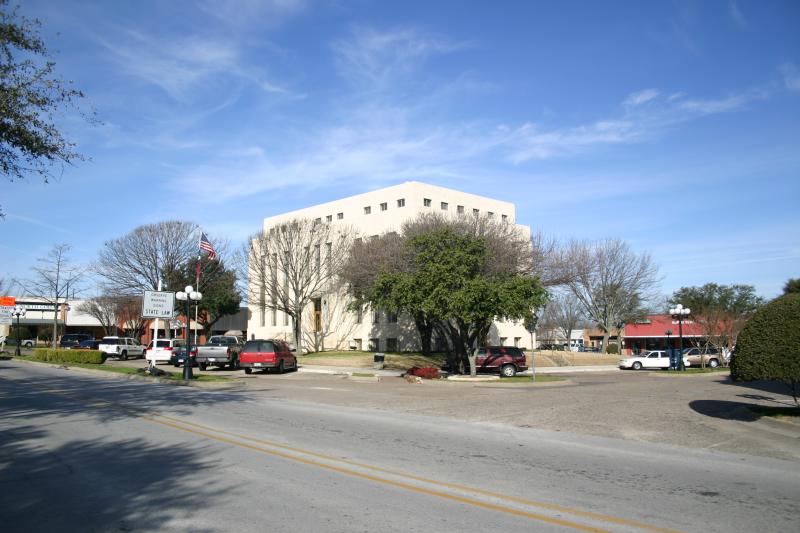
I'm fortunate to live in a town that can claim to have a historic 'downtown' in the form of a courthouse square. Our county courthouse is dressed in a refined art-deco style, framed by streets lined with facades most of which are more than 90 years old or so. There are a couple of retailers, antiques and cafes. Since pedestrian traffic is almost non-existent in this part of town, most of the space within the buildings framing the square has been leased as professional offices such as law firms and dentists as well as housing municipal and county services. Compared to other suburban communities in the Dallas Metroplex that resemble each other and is almost impossible to locate its core, my town possesses an authentic sense of place with the courthouse and a handful of surrounding streets containing old Victorian cottages.

For several years I worked for an architecture firm that specializes in historic preservation. What mostly kept us busy was an endless pipeline of historic courthouses that could afford to be renovated thanks to a program pushed by that governor who was known to be such a friend to architects, George W. Bush (???!!!). Texas has over two hundred counties, and many of them contain beautiful courthouses that span in from Richardsonian Romanesque to Second Empire to Neo-Classical, to Art-Deco. Although I've always had a soft-spot for historic architecture, I realized in that job that I wanted to create rather than restore someone else's work. But even with all that knowledge and insight I gained from this job, there is one thing I never got around to doing: I have never actually visited the historic square in my town.

I've driven through it from time to time, mostly on my way to places near the square. But I never walked past the storefronts, nor even spent an afternoon at the few arts and crafts fair held on the lawn around the courthouse. I've always told myself that I will get around to making a quick trip to the square but so far, I've had no good reason to do so.

In college I did not own a car, and thus I was relegated to walking to the courthouse square of the town to accomplish the most basic errands. My experience made me aware of how stagnant these places were, how difficult it was to get the most basic things (for example there was a drug store which only would sell Tom's brand toothpaste, when all I really wanted was Crest). The quality of the services were not better in inverse proportion to all the convenience of chain stores. The square during my college years was in relatively healthy shape, with several restaurants, a soda fountain, an independently-owned coffee house, a small department store, a bank and even a hardware store. And yet there was nothing that compelled me to want to return to the square other than that I couldn't drive to the town's outskirts near the main highway to frequent the big-box retailers.

What will make me come to these architecturally handsome urban places on a regular basis? In one word: anchors. This term is more commonly used in the realm of real-estate development, which describes a any kind of major attraction, whether a major store or a non-profit leisure destination (such as zoos, museums, municipal water-parks, performance halls, school campus) that can generate a high volume of pedestrian traffic from which smaller nearby enterprises can benefit. The problem with a lot of town squares is that they have no real anchors to draw people. A government office building or any other non-retail business will not generate enough foot traffic to supply a rich variety of services and stores. That's why across the street from the courthouse there might be one or two delis and none more, since that is all the demand from the workers in the vicinity can muster. The equation changes considerably when the anchor functions as an irresistible magnet for people. This is usually achieved when an establishment offers a diversion unavailable at a relatively close distance elsewhere.

People will always want to enjoy themselves by going somewhere. Catching a movie, watching theatrical performance, or even observing captive wild animals is something people do repeatedly for fun. But in this day and age of extraordinary material wealth, most people spend their time outside work or home at stores and restaurants. We especially like to visit with greater frequency stores with lots of selection, ever-changing inventory and efficient service. One doesn't find these amenities in historic town squares. The beauty of the architecture doesn't breath life to a space; it requires the engine of commerce powered by the motor of an anchor.


Chain stores serve the anchoring purpose well and are extremely prized by municipalities who crave the sales tax revenue. They tend to occupy new structures that generally charge higher rents, and because of the strength of their brand can generate lots of revenue quickly compared to mom-and-pop stores. As chains, they are by nature not original to the place in which they are located, but rather makes them serve as reminders of the world outside the community, with all of its universality, its sameness and standardization and alien-ness to local color. It is precisely these attributes that appeal to most town residents. Chains offer an expansive selection of goods that keep local residents from having to leave town to find them, meaning there is a greater likelihood for chance encounters with fellow towns folk. Chains command brand loyalty, guaranteeing that people will return much more frequently than the half-dozen or less times townspeople convene at the historic square or street block. It is therefore not very surprising to find the most bustling area of town to be right at the intersection of a major state road and the interstate highway. Every major big-box retailer and chain restaurant under the sun seems to be represented, and the parking lot is streaming with pedestrians.

Although the town in which I live can't compare to the cache and urban richness of the country's greatest cities, it is nonetheless quite fascinating to monitor its growth at the local level. Each time I drive by familiar streets I notice a new structure emerging out of nowhere or a grand opening to a new business being advertised. There is lots of local excitement around the arrival of a major chain store, as if it gives the town some much-needed stature. One of my favorite chain restaurants just opened last weekend, "La Madeleine", which now gives our town instant credibility among other rival towns in the area. I realize that such enthusiasm for this or that chain may sound shallow and devalue the historic heritage of our small towns. Yet the reason the arrival of chains to the town generates so much interest is that their existence is a testament to our town becoming more livable.

Dallas' very own Virginia Postrel writes about this particular feature of retail chains that have come to dominate the American landscape. She argues that while chain stores have sapped the uniqueness of towns, they have made them more livable and its citizens better off overall. Although tourists remark than traveling from one city to the next has lost its allure due to the homogeneous commercial landscape brought on by chain stores, these towns in essence function to serve the needs of their inhabitants, and in particular their needs as consumers. Although having elegant landmarks add distinctiveness to the town's image and attracts outside visitors, they do not help retain a town's population nor attract newcomers. Postrel summarizes well why cities should exist for livability than for historic charm:

Contrary to the rhetoric of bored cosmopolites, most cities don’t exist primarily to please tourists. The children toddling through the Chandler mall hugging their soft Build-A-Bear animals are no less delighted because kids can also build a bear in Memphis or St. Louis. For them, this isn’t tourism; it’s life—the experiences that create the memories from which the meaning of a place arises over time.

I'm not arguing that chain stores are the answer reviving the historic town centers across the country. Rather, I think city leaders and planners have to consider ways to draw in repeat customers; that is, townspeople who satisfy their wants and needs within city limits. Whether that is done by more institutional anchors or more commercial ones, a constant and diverse flow of traffic is crucial. Successfully achieving this first goal enables more fruitful re-developments to follow. Once this generator of pedestrian traffic is retained, it is fundamental that city leaders preserve the conditions helpful to the success of that anchor. To implement policies cracking down on anchors just because they are not authentic to the town will kill town centers much quicker than the time it took to lure them in. It is just as critical that towns should diversify businesses and multiply the number of anchors to cope with the fluctuating nature of business activity.

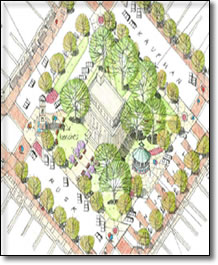
Looking at my town's masterplan for its historic core, I see little to no evidence that a strategy to lure a major anchor of a sort has been articulated. Indeed, the proposed building typologies are quite attractive, and will likely add charm to our town's image that even its residents will find appealing. But just to write that certain blocks or parts of buildings will accommodate desirable restaurants and cafes does not mean that they will come by virtue of the attractive street-scapes described in the masterplan. Certain ideas, like that of inserting a clock tower and a band-shell on the grounds surrounding the courthouse, while potentially achieving a sense of place by providing an attractive backdrop to festivals, will do little to contribute to regular pedestrian traffic. My impression from having worked on a few of these masterplans is that they intend not to re-energize the historic core of the town as a central economic engine, but to turn them into glorified living museums that are mildly commercially sustainable. They admirably find new uses for the old urban fabric, but they don't restore these places to nearly the level of prominence they once played in the lives of townspeople. They become forever consigned as just another leisurely distraction that you may take out-of town guests over to see, but nothing remotely as important as the local strip shopping center.

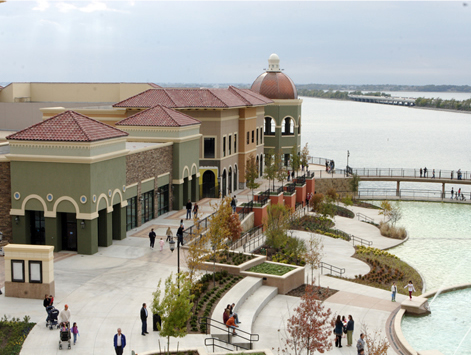
Ironically enough, my town is investing lots of its own resources to build a brand new town-center along its waterfront, far from its historic town square. Why do our city leaders think this a good idea? For one thing, the new town center, while looking and feeling like a traditional urban street, is more optimally planned for accommodating major commercial anchors. There is a cinema complex at one end of the development and a brand new hotel/conference center at the opposite end, with "blocks" of retail, chain restaurants with views of the lake, and elegant fountains and walkways. There's even a landscaped amphitheater for open-air concerts, and the new town center has recently proved to be effective in gathering large numbers of people to watch fireworks.
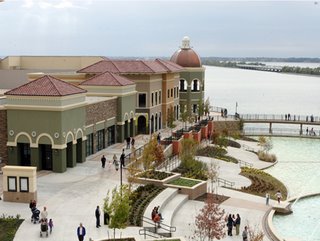
Such "lifestyle centers" are growing in popularity in suburbs across the country. They are basically unenclosed shopping malls, and their thematic architecture makes little attempt to relate the authentic vernacular of historical areas of the towns near which they are located. Our new instant town center by the lake resembles an Italian fishing village with cardboard cutout detailing, instead of the much more native Texas lakehouse style found in nearby rural areas. Still, they manage to restore a sense of place, regardless of how instantaneously they are conceived. Our older, and often more tastefully built town centers of yore could apply lessons from the success of lifestyle centers.

Maybe then I'll actually patronize the businesses of the local town square.

Wednesday, November 22, 2006

Ken Roberts Memorial Delineation Competition: And the Winners Are...

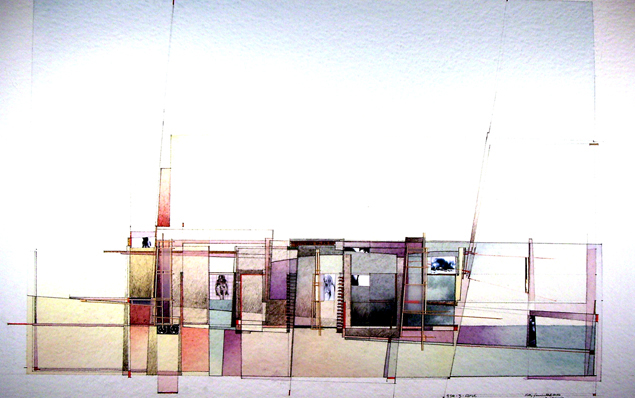
The 2006 Ken Roberts Memorial Delineation Competion been a great success. On November 8th, the winners of the competition were announced during a special ceremony at the Dallas Museum of Art. Architect Randy Brown, whose work has been published nationally and even internationally, was the main juror of the competition and explained to the public in attendance the merits of the winning entries. There were overall 4 winners, 4 juror's awards, and 25 or so finalists in which all the entries were presented at the reception on plasma screens as well as inside the auditorium. You can view the winning work at the Ken Roberts Competition website, krob06.com.

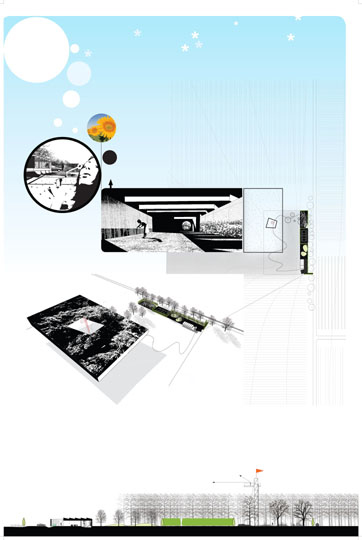
There was a seven-fold increase in the number of entries submitted compared to the year before, and the quality of the work in general was on average much higher as well. More than just mere projections of a building's plans and elevations, the drawings crossed into the realm of art and in some incorporated techniques often found in graphic design. Compostion, color, and overall expression were more important the merit of the building's design. The KROB finalists demonstrate that architects are more than mere technical designers of structures; they are attentive to aesthetic expression, in pleasing the eye and making something that moves the soul, even in the form of a sketch. Maybe putting all this attention to detail on such artistic pursuits explains why architects are underpaid compared to other professions, but it's also why our profession attracts so many bright young people to it.

Although a solidly consistent set of plans help assure the completion of a building as smoothly as possible, it is often architectural renderings that will give a project the financial go-ahead. They are crucial in marketing the proposed design, generating interest among potential tenants, and inspire owners to persist in seeing the job through. Floor plans invite a client to point to flaws in a building's functions, but renderings of a project are often immune to functional criticism. They instead set the tone of the project, the desired moods of a future place. When a rendering becomes more an "objet d'art" than just a pretty picture, it infuses an evocative quality to the building.

In my opinion, a large part of what architectural design comprises of is a a careful meditation of three dimensional forms in light. There's only so much importance that can be given to technology, as such matters don't contribute much to a building's meaningfulness within its cultural context. As a creative endeavor, architecture should strive to surpass fulfilling programmatic requirements and actually produce something beautiful, something that moves us. Le Corbusier encapsulates this ideal so clearly when he wrote:

"The Architect, by his arrangement of forms, realizes an order which is a pure creation of the spirit; by forms and shapes he affects our senses to an acute degree and provokes plastic emotions; by the relationships which he creates he wakes profound echoes in us; by the relationships which he creates he wakes profound echoes in us, he gives us the measure of an order which we feel in accordance with that of our world, he determines the various movements of our heart and of our understanding; it is then that we experience a sense of beauty."

Take the time to visit the Ken Roberts website and keep in mind Le Corbusier's notions when viewing the winning entries.

Monday, November 13, 2006

The Limitations of the Word "Christian"

Over the years, I have grown more and more uncomfortable defining myself as a "Christian". Not because I no longer confess the faith; rather, because the faith I confess seems a little limited by this exact word, in this context. Maybe because all the recent political debate, maybe because of a growing awareness that Christianity's plurality makes the term too vague. For whatever reason, the word has become a banal description of what I seek to be, and what I think "Christians" should seek to be. (Often failing, but still seeking.)

It strikes me that the Christian response to Postmodernism should be one of careful delineation from the culture. In this sense, the term "Christian" doesn't help much as it is just another of many cultural labels. At least to those of us from European backgrounds. Obviously, for Christians in Asia or the Middle East, the label would suffice to let everyone know the religion of that person, and I should note here that a majority of the world's Christians are not from Western traditions.

It's not our fault that the word has lost its bite. The history of Christianity is one that involves a virtually incestuous church/state association. Bishops were princes, Medici's were popes, church attendance was often mandatory, and the church was geographically and figuratively the center of city/town life. So to be a "Christian" was an assumption. Not that millions weren't genuinely faithful; it was just a way of life. My understanding of the origin of the term was that it was derogatory. Those who were followers of Jesus were called "Christians" in the Roman context, and there was nothing complimentary about it in such a context. It was a slight, a sign of inferiority or weakness, sort of a, "Oh, there go those Christians again." Characteristically, early Christians took on this term of derogation and delighted in it. After all, the humble shall be exalted and the exalted shall be humbled.

When Constantine became a Christian in 312, however, everything changed. For the next 1,700 years, the faith would become virtually synonymous with the West's political and cultural identity. The advantage, obviously, was that many people over the centuries were Christian. This is, in some ways, a good thing from my perspective. Christianity as part of the culture led to advances in education (universities), healthcare (hospitals), and it provided a backbone of morality for millions.

The flip side was (is) that the faith was diluted at best, and corrupted at worst. The faith life of the believer was a state matter for many Europeans. Indeed, it still is. In many nations, to be able to receive the sacraments of the church, one must admit to being a believer to the state and then proceed to pay a hefty tax. It's a lot cheaper to simply say you're not a believer, if you think you can live without the sacraments. Yet, most of Europe would still say that they are "Christian".

I wonder if Americans were asked in a census if we were Christian what our response would be? Would it be the same if we were asked if we were "Followers of Jesus"? How about "Disciples"? "Apostles"? These are the options of which the New Testament is full. Jesus never asks those around him to become Christians. (The Greek equivalent is never mentioned that I know of.) Jesus frequently asks those who are healed by him or those who come to him for advice to follow him, to be his disciple, or to be an apostle sent out on behalf of the faith.

Yet, we are able to say, and very safely at that, that we are Christian without doing any of the things Jesus actually demands simply because the label "Christian" has become such an accepted part of the culture. This is not necessarily a bad thing. None of us deserve the other three titles either. I merely want to propose a change in language so "Christians" can be clearer about who they are. I worry that this sounds like a litmus test or judgement, but it seems right to me that this is a helpful way to reclaim the original meaning of "Christian."

Saturday, November 04, 2006

Will There Ever Be Another Bach?

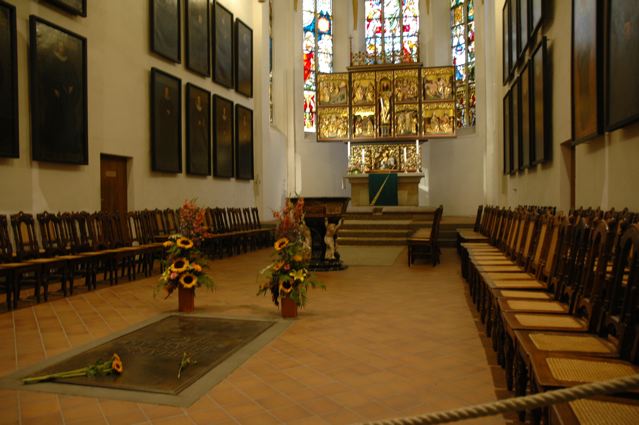
Every time I attend a Bach Concert at Saint Luke Lutheran in Chicago, I find most every one of my senses stimulated. My hearing, of course, by the brilliance and beauty of Bach. My eyes by the space itself. My smell by the incense (which they use for evening prayer). If they served communion, my taste and touch would be equally employed. I also find myself wondering, "Will there ever be another Bach?" It seems a fair question to ask. Wasn't Bach just a genius, the kind of aberration that is entirely likely to appear again? And isn't the world of classical music due another such iconic figure? It has been a few hundred years, after all.

By no means could the discussion be limited to Bach. Others might site Beethoven, Mozart, Brahms, or any other set list of composers. For me, none compare to Bach in brilliance of counterpoint, soul and sheer volume. But will there be another? I say no, for at least 3 reasons.

It's become kind of a cliche in the classical music world, but if eccentric geniuses like Beethoven or Mozart lived today, they'd be stuffed so full of anti-depressents or downers that their creative output would be greatly diminished. There is some truth to that; I think we simply have less tolerance for eccentricity and seek to medicate and stifle difference as soon as possible. (This is especially true in the West.) The reality is that eccentrics take a lot of patience. If the reports about Beethoven and Mozart are true, they can be unpleasant to be around. (They were also capable of incredible warmth and depth, which is often overlooked.) While Bach seems to have been a little cranky, he doesn't come across historically as eccentric, which is one more reason he is so rare.

Second, another Bach seems unlikely because of today's pervasiveness of media. Whereas Bach was largely able to work in obscurity (except for his fame as an organist, not composer, which wouldn't come until 1829), a genius today would probably be paraded on television, written about in books, and have his own blog that would occupy precious creative time. In spite of his 17 children and directing the pesky children's choir, Bach was able, forced even, to produce almost inhumane amounts of music because of his duties of Kapellmeister at Saint Thomas Church in Leipzig. No genius would have such a luxury today. There are simply too many distractions in today's world, too many temptations. Besides his enormous family, Bach had relatively few, to his advantage.

Third, and most importantly to me, Bach was a highly spiritual person. His enormous output, and the works themselves, were done with a higher purpose in mind. To say the least. And Bach was no theological slouch who just accepted the theology of the day. It turns out he had a pretty impressive theological library, and he was quite capable of theological insight. All of his works, even his secular works, famously bore the initials SDG for "soli deo gloria," or "To the glory of God alone." I realize my religious bias, but it is impossible for me to consider that anyone could create so much of anything so brilliant for so long without a firm understanding of humility, grace, and thanksgiving. God was the fuel for Bach's creativity, and in God revealed through scripture Bach found a never-ending supply of strength, sustenance, and ideas.

Allow me to contextualize all of this. I recently heard Cameron Carpenter play, who is simply unbelieveable as an organist, probably this generation's Virgil Fox and then some. But what I found lacking was a sense that his was a gift from God to be used for the glory of God. He is a product of a culture that says individuality and personal expression are more celebrated than humility, so it seems his career will be more about performing accomplishments than prolific output. The media temptation for him is also there, and not without good reason. He feels there is a huge market for his skills, and he wants to capitalize. Generally speaking, I can't blame him for that. He is refreshingly eccentric, I have to give him credit there. The irony is that he played a lot of Bach as well as I've ever heard it on the organ, with wonderful interpretative skill.

But will there be another Bach? I just don't see it. Unlike other great composers after him, or even great thinkers, writers or artists, the guy simply didn't produce any (and "any" is no exaggeration) bad music. He is the father of western music for so many reasons, and thankfully he is more popular now than ever. We should cherish him especially because no one will ever be able to compete.

Tuesday, October 31, 2006

Further Reading

Below are a few interesting posts I've come across that present a few issues from untraditional viewpoints, but with which I agree with for the most part:
  • When I was in high school and college and was following the events leading toward the construction of the European Union, I was hopeful that old continent would regain its stature as a premier economic powerhouse on par with the U.S. I was naturally rooting for the Euro as a means of reviving my country of birth, France, as a dynamic place to do business. Since those days, beginning with the ratification of the Maastricht treaty of 1993 followed by my own experiences as a student in Germany and France, I've grown a lot more cynical about Europe's prospects. In the back of my mind I was always hoping that a unified European economy would embrace greater deregulation and fiscal flexibility, along with the elimination of punitive taxation. Alas, those reforms never materialized while a common currency was pushed into use anyway, earning considerable resentment among everyday Europeans. And strangely, the imposition of the Euro gave economic liberalization in a bad reputation even as its implementation and the present reality of European economies are nothing of the sort. For someone such as I who tried to hold his faith in the virtues of a European economic union, this article posits that the Euro may have been one of the worse things to have happened to Europe in a long time. The article's description of the reality in Eastern Europe are fascinating, as I lived in one part of it not long after German reunification. Hattip: Instapundit
  • Most architects will tell you that they do not do their jobs for its monetary rewards, since they are traditionally quite meager. It was therefore tough for me following through on my decision to pursue architecture as a career precisely at a time when it seemed everybody else was making lots of money on what seemed to me the shakiest foundations. I was in the middle of my graduate studies in architecture when the Dow Jones Industrial Average was hitting new highs, the term "dotcom" was thrown around ubiquitously, and the concept of the "New Economy" was taking hold in a lot of amateur economic reportage I was reading at the time. There were many times I would ask myself: Why should I forfit the considerable earning potential available in these new internet-based industries for a career notorious for its long hours, low pay and high burnout rate? I was envious of those making out like bandits during those heady times, but in the end I wanted to master a 'trade' of sorts, which was how to conceive and prepared graphic instructions for any kind of building. How old-fashioned, but somehow I couldn't quite make the complete jump into the virtual world of web-design, mass-marketing, and computer generated graphics. I don't regret my decision at all nowadays, but I do wonder whether the mild recession during 2001 put the idea of a New Economy to rest. What's becoming increasingly clear to me is that the mechanisms underlying our national economy are changing rapidly, and a new set of winners and losers are emerging from this new reality. This discussion about the nature of our current econonic reality is explored in detail here, here and here.
  • Having gone to American public schools all my life before going to college as well as belonging to family that briefly received food stamps, I had the chance to get to know people who would be classified as poor. The older I get, the more convinced I am of the view that poverty is character problem that besets people who can't hold on to money. Most of one's monetary donations serves as temporary salve that promises little long-term reform of the impoverished person. The character traits that have typified the poor have always persisted throughout human history. Yet I tend to believe that for much of it, the poor could rely on a stronger social net of family relationships as well as religiously based associations. These social instutions served as a bedrock for character formation, and allowed for the massive rise in wealth for all groups of people who were provided the freedom to thrive. With the breakdown of the traditional family structures, a character vaccum results, often condemning subsequent generations to unbrocken cycles of poverty. This post in Clive Davis's blog describes the phenomena of the contemporary poor so succinctly and yet so true. One of the major privileges in being born in the middle class or above is the comfort in knowing that one can make many bad choices in life and yet still recognize the qualities necessary to achieve one's goals and lead a prosperous life. Such valuable knowledge is tragically lacking among most born into poverty. Sadly, I don't expect things to improve since institutions that function to relieve the poor fail to demand from their recipients any commitment to living with honor and strong character.
  • For a good anecdotal account depicting the moral and spiritual poverty of young kids who are likely to be among the lowest class of Americans in the future, I recommend this post from a young teacher-in-training who I happen to know very well.

Wednesday, October 18, 2006

Is the Conservative Movement Turning In On Itself: Modern Powerbrokers Vs. Postmodern Young Republicans

It seems Rush Limbaugh has created a monster. Say whatever you want about him, his influence on the conservative movement is second only to William F. Buckley or even economists like Milton Friedman. While I have no doubt that many 20-something bloggers regard Limbaugh as a relic, it is hard to deny that he was the tipping point for an awful lot of college-aged kids who were confused as to what politics was all about, and who desperately needed someone, anyone, to explain what they felt already: that conservatism was the way to go. Over the years, it seems this generation of Postmoderns has outgrown Rush, and have even begun to question the master himself, most pointedly in the current debate over Rush’s criticism of Glenn Reynold’s “pre-mortem” post on Instapundit.

The debate seems to paint Rush in a very Modern corner, that is, a corner that forces him to react like a cat trapped against a pack of dogs. He insists that a Democrat victory in November would mean catastrophe on issues like the War on Terror, tax cuts and the Supreme Court. He is more right than many know-it-all bloggers (like myself) want to give him credit for. But he is the victim, I think, of being perceived as a Modernist thinker in a Postmodern world. What we bloggers cannot forget, even at the peril of becoming the history-forgetting liberals we often deplore, is that Rush continues to have an extremely important seat at the conservative table. His style is often repetitive, and he doesn’t often go to the level of sophistication Gen Yers would like. And his portrayal of Democrats=bad/Republicans=good is limiting, though he is more critical of Republicans than his detractors give him credit for. But for what he does, it is hard to ask for a better expositor of conservatism and capitalism in mass media than Limbaugh.

My level of interest is the bigger sway here, which is that the conservative movement may be turning in on itself. Like a dragon who finally recognizes his own strength, the conservative movement has become exactly what you would expect of conservatives: disloyal, skeptical, and self-critical. Each one of these characteristics is in what defines conservatism:

They are disloyal to central authority, not trusting it and the power they believe will eventually become corrupted. The core conservative understanding of the free market is that it is voluntary, and that information is best disseminated through this process, not through one source from the top. The same is true in the world of ideas.

They are skeptical of one train of thought that is seen as the final arbiter of truth, and even moreso of one person espousing that train of thought. It is this skepticism that fosters a belief in limited government, the free market, etc.

Conservatives, especially Postmodern conservatives, are self-critical. They don’t necessarily even trust each other when it comes to ideas. The reason there is fear of conservatives sitting out the election is because they can debate the major issues of the day, and some even consider a wrong conservative a worse enemy than a liberal.

As far as what to do this term, I tend to agree with Rush on principle that you can’t win by losing. Although everything within me wants Republicans to pay for such a poor showing over the past four years. The person we should be genuinely upset with, however, is Bush. Aside from the War on Terror, he has been Bush the Disappointment, not Bush the Conservative we voted for. His severe lack of leadership has left conservatives in both houses of Congress without direction. Let’s face it: he wasn’t what we thought he was. We were all duped to a large degree. Losing the houses won’t fix it. Neither will nominating McCain. Long term, it seems likely that a conservative third party may be on the horizon, and these growing pain in the conservative movement may be its impetus. Looking back, we may be on the verge of something very big. That’s at least a little exciting.

Saturday, October 14, 2006

Can We Create Justice? Or Joy?

A few weeks ago, I sang a hymn called "A Place at the Table." It had powerful themes of justice and inclusion, reiterating the Lutheran dogma that all are indeed welcome at the table, regardless of age, power or wealth (not to mention race, ethnicity or sexuality). However, I couldn't help but notice the lyrics of the refrain, and it gave me pause as I sang them: "And God will delight when we are creators of justice and joy."

On the face of it, I suppose the lyric implies that Christians have an obligation to help create a just society, to work on behalf of those who cannot help themselves, and in this way be the light of Christ in the world. Equally, we are to take seriously what Jesus said when he told us that he came so that his joy may remain in us and our joy may be full. When we are a joyful people, no doubt that will help make us creators of joy.

I worry, though, about some of the deeper assumptions, and some of the places this exact language may take us. First, if we are creators of justice, where does this leave God in the mix? Final justice belongs to God alone, does it not? Especially because our own sense of justice is flawed. We are saint and sinner after all. The assumption that God will be ever so happy with the justice that we create seems both arrogant and immature, forgetting the vast amount of human suffering that we have created, sometimes, maybe even often, in the name of justice.

We should remind ourselves of all the dictators that makes such grandiose promises of justice, only to commit human rights violations and mass murder in the process of achieving that view of justice. The idea that we can create justice is awfully tempting, but it can also become an idol. When we believe fully in our ability to decide what is just, we are in prime position to go down a very slippery slope where the winners win and the losers lose because of how we define justice.

Second, do we, as humans, have a good justice track record? Does our legal system always create perfect justice? Is there even a monolithic understanding of justice among all judges, lawyers and lawmakers? Not even close. Just as ten Lutherans share eleven opinions on justification, ten lawyers also, I'm sure, share eleven opinions on what defines justice. Part of what defines the American legal system is a dogmatic focus on defending the Constitution first, not our own biased understandings of justice. That is why in one courtroom, two lawyers with two equally impressive law degrees, working on the same case, will make two completely different arguments about what justice is as http://www.blogger.com/img/gl.link.gifthey understand it in the Constitution. Yet, we are supposed to make God delight in our creation of justice? Perhaps God delights in our attempts. God delighting in the creation is harder for me to imagine.

Finally, this focus on justice seems to neglect a sentiment even more powerful than justice, and even more in our "control": mercy. Mercy picks up where justice leaves off, because justice is so arbitrarily defined. I’ve written more about this here.

Mercy, on the other hand, strikes me as a much more likely goal for us to achieve. Human justice, and therefore social justice, is a highly imperfect art, full of loopholes, prejudices and differences of opinion. Mercy, however, can pick up the slack. I wonder, if we are going to go about the business of pleasing God, what would do it more: to be merciful, or to be just? Or more to the point, which are we more likely and able to achieve?

Addendum: For an amazing commentary on this subject, check out Pope Benedict XVI's first encyclical, Deus Caritas Est.