Thursday, September 28, 2006

Even if Iraq is Breeding More Terrorists, Does that Make Terrorism Right?

With the recent National Intelligence Estimate (NIE) report pontificating that the “Iraq conflict has become the ‘cause celebre’ for jihadists”, I keep asking myself, “Was it so much better before that we should long for the good ol’ days before the Iraq war?” The way the information is presented and the way the MSM has loved reporting it hints that if the war were never waged, the terrorists would be perfectly happy being single-celled organisms working independently from time to time killing off the West. The way it’s been reported, one who didn’t think for themselves might believe that the cause is the Iraq War and effect is terrorism. Wrong. They might also think that because of the war, Muslims who never would have considered violence as a viable alternative to the influence of the U.S. have all of a sudden decided to hate our decadence and take action. Sorry, but that doesn’t hold water.

We apparently need to be reminded that this war was never about the short term. This is obvious both in its goals and its lack of short-term success; the planning for this arena was obviously weak. This was always a visionary conflict, one that would require massive amount of change, both functional and “adaptive,” in the language of change agents. The plan wasn’t simply to rid of terrorists; does anyone actually believe that Bush ever considered the war to be about that, and that alone? It is about the belief that democracy in the Middle East will encourage the people in their own country to demand reform from the extremists who have gained too much power while citizens were looking the other way. This is a long fight, and perhaps it is ridiculous to think these nations can ever change. The question is: was it worth the gamble? For our own security and for the security of those in the Middle East, I think it was.

Is it possible that the increase in jihadists has in fact proved W more right than ever? With every outrage these sensitive religious ideologues experience over the slightest criticism, or even the most serious criticism, their radical nature exposes itself more and more to be deeply at odds with what we call civilization. That Iraq is such a threat to their way of life, and that more jihadists are protesting it, doesn’t it prove that there will be no meeting of the minds with these extremists and the globalized world? And unfortunately, we no longer live in a world where can politely ignore each other, which seemed to be the case only 10 years ago. Advances in transportation and even the Internet have brought the jihadist threat further out of the woodwork so that it must be dealt with, either by them adapting to the standard of living the majority of the world wants, or by being defeated.

I was reminded the other day again of the horrors of the Thirty Year’s War, the result of Reformed Christians and Roman Catholics failing to peacefully resolve their differences. Perhaps this is the stage that Islam is in. After all, Islam is about 600 years “younger” than Christianity, and maybe this is the natural flow of such belief systems: civil war is necessary at certain points to define true doctrine, or to learn how to peaceably live together. I believe Bush’s goal in Iraq is to give the work of curtailing terrorism back to the people of the Middle East. Can they do it? Time will tell. That there are more jihadists since the Iraq War does not mean the answer is no.

For now, that Iraq is breeding more jihadists should come as no surprise, and it changes absolutely nothing, except prove the war’s necessity. It does not make terrorism a more valid or moral act and it in no way legitimates their violent ideology. If anything, the quote from the NIE report that directly follows the above quote carries a great deal of hope with it: “Should jihadists leaving Iraq perceive themselves, and be perceived, to have failed, we judge fewer fighters will be inspired to carry on the fight.” This should be the headline, not that more jihadists are being bred. In fact, the more that are bred, the better. There will be that much more to taste defeat, lose heart, and eventually be pushed aside altogether.

Sunday, September 17, 2006

Keeping Out the Riff-Raff: the Morality of Sprawl

While browsing on the assorted web postings featured one day on Pajamas Media, I came across this brief essay by ‘sammler’ over at A Chequer Board of Nights and Day on the topic of zoning. The writer argues that neighborhood zoning is a way for settled citizens to control subversive behavior that threatens the stable moral foundations of most middle to upper class communities. With no recourse to policies of overt segregation, zoning that proscribes specific housing densities and economic activities was the one legal way for conformist communities to prevent deviant ways of life from emerging. The essay implies that while many of us value our freedom, few are willing to embrace it totally when making decisions on where we choose to live.

Freedom for many seems to involve rights, a belief that one is entitled to do and go wherever he or she wishes. For others, though, freedom often entails the choice to remove oneself from other people or objectionable conditions. When it comes to making decisions on where to dwell, it is often less a matter of what one wants than what one doesn’t want. Discrimination is fundamental to the way we make choices, although few would openly share some of the reasons they opted to leave in one area over others. We are free enough to exert a certain amount of control over the social environment we live in, but we are at the same time captive to others' efforts in denying us the right to live the way we’d like at a particular location.

Americans have tolerated life along the edge between freedom and the restriction of their own freedom for its entire history. Our country’s vast and relatively unexploited spaces have allowed us to wander and resettle ourselves far from troublesome places in our past. If your lifestyle was impeded by the surrounding community, the solution of moving away to a better future was always an option. The very lack of density in much of our territory has likely helped diffuse potentially violent social tensions that have commonly erupted in densely populated countries in old Europe. Everyone here is happy so long as one doesn’t have to put up with other people’s mess.

The dominant urban pattern since the rise of the industrial economy has been the out-migration of people from the city center out to the surrounding suburbs. Whether the reason for this is due to a desire for improved environmental conditions or a longing to own an affordable home, or to live near a good school district, it is important to consider factors that drove households away from their old city home. As most recent émigrés from the older major cities to the newer suburbs will tell you, there are many things cities can do to make living within ever more difficult and not worth the hassle. From blindly ensuring that their schools decline in quality to levying property taxes to fund inefficient and often corrupt municipal services, the flight of a city’s most productive citizens to the suburbs is, contrary to many critics of sprawl, a rational phenomenon.

Still, a problem won’t be necessarily solved if there is no assurance that it won’t emerge in the new location. Zoning restrictions have become the most effective guarantee against unforeseen problems migrating from undesirable locations. Seen as major hindrance by many contemporary urban designers, zoning laws were originally legislated to preserve property values by restricting the arbitrary construction of buildings that would cause surrounding properties to rapidly depreciate (e.g. dirty factories, dump sites) Zoning laws also helped control the amount of noise, the desired amount of open green space and the extent to which neighbors are willing to share their space with others. Because the aim of zoning is to ensure predictable stability of a place, there is little tolerance for urban experimentation, iconoclastic expression or any effort in adopting new visual identities. As communities grow, zoning makes sure they do not change in the way the community once saw itself at the time they implemented rules dictating that communicates supposed ‘character.’ This determination of what a community ‘is’ depends largely on what that community believes it isn’t.

One thing most community founders who create restrictions on future development don’t seem to want is for their community to change. It is obvious just from looking around from one new suburban development to the next that there is a set image that they would like to preserve, with every lot precisely defined to maintain a particular stylistic theme. Any individual deviation is forbidden, as harmony has supposedly been achieved in the new residential subdivision. As an enthusiast for dynamic and eclectic cities, I am no fan of zoning. One of my most beloved big cities is best known for its lack of zoning, and as a result offers a wealth of visual interest, contradictions, and unique spatial relationships that I find lacking in many newer suburban developments. Even as I myself live in an outer ring suburb of Dallas, I explicitly chose to live in an older neighborhood of a heterogeneous character. Each house is distinct from the other in spite of having been built within the last three decades, many of them transformed by major additions and other sorts of remodeling experiments. And still I’m reminded of the reason my neighborhood originally came into being, as an isolated retreat separated from the dirty sprawl of Dallas’s older established suburbs by a brand new reservoir lake. Soon my neighborhood would be joined by thousands of new homes elsewhere in the town, most of them governed by notoriously intolerant homeowners’ associations.

The fact is that most people aren’t like me. In spite of all the values we pretend to live by, such as being open-minded to all peoples and lifestyles, most of us would rather not be bothered at all. Keeping out the “riff-raff” through zoning is a way most of us would prefer to preserve the order we work hard to achieve. I believe it’s a natural impulse, one that in my opinion too few idealistic urban planners fail to appreciate. It is one thing to smugly suggest to people that living in greater density is a better way to live and it is dellusional to deny this truth. It is more important to understand the deeper social issues at work that define the reasons sprawl has be come the preferred pattern of human settlement in the U.S. It has become quite difficult for those who have internalized the density of the bustling city life to understand what satisfaction suburban life can bring. Enjoying a safe environment that is quiet, where neighbors share common values, where there is abundant parking, open day-care spots, efficient municipal services, large parks and small associations looks quite good to what city dwellers typically face: noise pollution, transient neighbors from who-knows-where, no parking, standing in a smelly train rubbing other bodies, over-loaded parks, failing schools, and a city bureaucracy that does its best to waste your tax contribution.

Sprawl is a physical manifestation of the priorities most people have when it comes to envisioning how they would like to live. Traditional urban typologies that include dense multi-story apartment blocks, row-houses, and zero-lot detached houses, though useful for many centuries have lost their appeal to spacious ranch-style homes, inconspicuously introverted low-rise apartment complexes, and the two-car driveway. The former typologies might be more attractive, more charming, or even more distinguished, but they no longer fill the needs of a majority of homeowners of today. It is less helpful if the older urban typologies become infested with gangs, the drugs and other criminal activities. The supposedly ‘superior’ architectural typologies embraced by designers are no match to the bland landscapes of the exurbs if social stability and comfort are not provided.

If cities are to win back those who have long left it for greener pastures, the best urban plans and the most attractively designed neighborhoods will be of little use. City leaders and their bureaucracies must assess what their city’s social values are, what is important to those they wish to move to their city. The mere value of tolerance for all of its citizens is often counterproductive. In a place where tolerance is the rule without any sort of moral standard or enforced distinction between better and worse, the more decadent elements in a diverse social environment always wins out. If those who wish to instill public virtue are undermined by relativist points of view regarding such virtues, a cherished diverse social fabric frays and disintegrates. The vitality of a city is not found in its diversity and tolerance alone. It requires the additional element of socially enforced moral standards that allow a modicum of order and predictability.

My parents have spent many long years as proud residents of some of theworld's most cosmopolitan cities. They love where they live and revel in all of the big-city amenities it offers and the convenience they enjoy in diving short distances to the most frequented spots in their region. But now they feel that they can’t bear living in their beloved city any longer. Their leaders and their city’s insipient political culture have made it clear that their opinions and wishes are of little concern to them. The values of civic virtue, and of patronizing the arts, of clamping down on crime or of teaching children well are not those of their home city. Their city does not care to serve them meaningfully. Rather the city functions to serve its most needy, its most helpless, its least contributing sector of its residence—those who exhibit the least civic virtue to strengthen their communities and improve the lives of younger generations. My parents feel used and don’t want to put up with such dysfunction. Now they hope to resettle in a better-run established suburb next door. For you aspiring urban planners, there’s little that buildings can positively change until public virtue reinserts itself into the broken fabric of so many older cities.

Tuesday, September 12, 2006

The Commerce of Che

Isn’t it odd that in Europe, a land of towering intellectual icons, the image of Che Guevara, an ineffective South American rabble-rouser, would be as prevalent an image as the cross, the European Union flag, or even relics of European royal history? In the same countries that da Vinci, Luther, Bach, Goethe, and Michelangelo created masterpieces that would forever dictate the course of western civilization, an alien to Europe would have guessed that a bearded discontent lionized in a simple black and red portrait had more of an impact on the continent. Merchants everywhere sold his mug on t-shirts, and graffiti paid homage to the man lauded as socialism’s greatest guerilla warrior. It made me wonder again and again: what did this Che guy do that has allowed his influence to grow, four decades after his death, even in countries that had been failed communist experiments only a few years before?

Perhaps the most disappointing depiction of Che was on the Berlin Wall itself. Given the Berlin Wall’s infamy as a wall that forcibly kept people imprisoned inside a communist prison state, it is highly ignorant, or perhaps simply evil to depict a communist like Che in any sort of positive light here of all places. Of course, the fact that the Berlin Wall was an enforced border to keep people in has been lost on many in my generation. Peacenik sensibilities have led them to believe that all walls are bad, so they decry the building of any wall, be it one that would keep illegal immigrants out of the US, or one that keeps terrorists out of Israel. The Berlin wall was not one such wall; its building served one purpose only: to disallow those from the East to migrate to the West. But the irony is that this wall seems to be one that gets a pass. These communists have claimed it, in a sense, as one that was good because it preserved communism. It is, in a sense, the communist wailing wall, the last vestige of that deplorable religion where communists can gather together to mourn.

But my run-ins with Che were no limited to graffiti.While walking around Berlin we stumbled across some disenchanted communists who were protesting that communism as a political party was outlawed in Germany several decades before. And whose face did they parade as they silently protested for their right to be legal communists? Who else? Che! I would have respected these demonstrators more if they bothered to champion communists from German history, and they didn’t pick such a cliché like Che (I just noticed the pun). Alas, Che has made his way to Germany to champion guerilla warfare in a country that hates war, and is only now seriously studying WWII. The irony never ceases.

And who was Che, anyway? This article, a review of “The Motorcycle Diaries” gives a wonderful account of Che’s true legacy: failed coup attempts, labor camps (that were not exactly friendly to leftist causes like homosexuality and AIDS), and totalitarianism, all in a context of anti-catholic imagery he himself adopted. He was a champion of violence, yet somehow, his legacy is one of justice. Generations X and Y apparently find Che’s legacy appealing, but I would doubt many of them actually know anything about him. Do they ever consider that he was a terrorist, in the truest sense of the word? Would they parade around a t-shirt with a picture of Bin Laden on it? Or do they just hate America so much, and find the concept of communism sexy enough to adopt Che long enough for a superficial fashion statement?

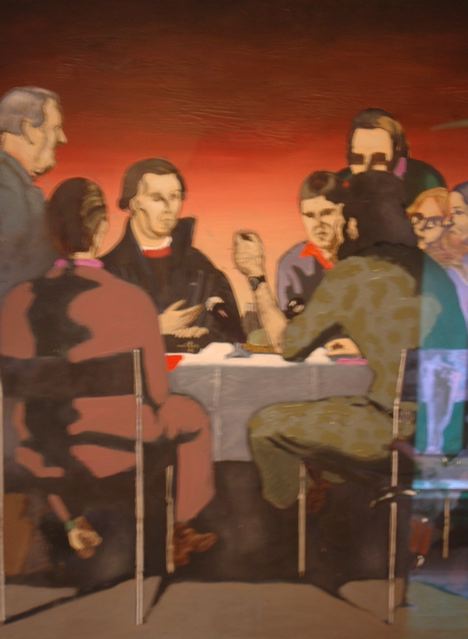
It was not only Germany that Che was so popular but Italy as well. And not only in tourist traps and graffiti, but also in art. In Martin Luther’s very home is a painting of him sitting at a table with Che, as though Luther’s Reformation and Che’s revolutions were equitable. I started to wonder if I could go anywhere without seeing this guy!

What I find deliciously ironic is the popularity with Che among the bourgeois. As his shirts sell for $15-20, and a whole range of products from hats to backpacks to cigarette lighters make some entrepreneur very rich, I can’t help but feel that capitalism had the last laugh for poor little Che. Everyone from t-shirt vendors to book publishers and movie producers are making a mint off this guy, and I can’t imagine they have to pay many royalties to do it.

Saturday, September 09, 2006

Ughh! Why the Reconstructed Ground Zero has Become a Big Letdown

So five years on after that tragic day, Ground Zero in New York remains a big hole. After much back-and-forth, a final design has been approved for the Freedom Tower. Originally conceived to become the tallest building in the world, its height of 1776 feet will be all the less impressive compared to other skyscrapers coming on line, in particular when the Burj Dubai will be surpassing 2,300 feet. What once would have been a poetic crystal form has now become boring glass obelisk with a top spire that relates very little to the rest of building shaft below it. The spire’s only there to conform to the buildings final height, which in my book would never be considered part of that measurement. At least the Freedom Tower will not be the one of the simple boxes that characterized the old twin towers, but will likely function better and be more attractive than Minoru Yamasaki’s austere and lifeless environment of before.

A few days ago, designs for three neighboring towers at ground zero were unveiled. From the provided rendering, I’m sorry to say that I am quite under-whelmed at all the proposed towers. None of them indicate anything all too extraordinary, no formal innovation that has become characteristic of contemporary skyscrapers elsewhere. No attempts are evident in trying to incorporate technological features that allow tall buildings to produce their own energy, to realize amazingly complex geometries and conform to aerodynamic realities of the site. The potentially most disappointing fact is that these three towers were designed by the world’s best known ‘starchitects’, and rarely have I seen such uninspired design from Norman Foster, Richard Rogers and Fumihiko Maki. I’m certain that special restrictions were placed on the designs for projects at ground-zero, from security to the laws of commercial real estate, but if these proposed schemes are the best such celebrated designers can come up with, it therefore proves that talent is as ephemeral and fickle in the realm of design as any other art. So far the assembly of towers seems to be no more captivating than the downtown skylines of countless American sun-belt cities.

Such subdued designs may be a testament to the ability for even the best architects to turn out real duds, but I suspect the mediocre architectural result at ground zero is more a problem of planning. The reconstruction at ground zero has been marred by an incoherent planning process, consisting of various state and city-sponsored committees, private civic groups, and the developer. The new Freedom Tower and its neighbors are good examples of the inadequacy of “design by committee”. When an architect has to work with a hydra-headed client, pleasing various conflicting factions, the resulting compromise logically produces an aesthetically compromised building. Rarely has design by committee ever produced worthwhile monuments and structures, since it reveals an unsettling fact about design that harmony-seeking people are loathe accept: Design is more an individual pursuit than a collective one. Design teams are less a collaboration among equals than a hierarchy in which one person conceives and the others enables his concepts.

The design of buildings is inherently undemocratic. The client is the only one that votes, so one hopes that he votes with quality and tastefulness in mind. Every built masterpiece we acknowledge today, from the great Roman monuments to Hausmann’s Paris, was the result of patrons, uninhibited by other municipal groups, sponsoring visionary designers they believed in. An individual patron can convey a simple purpose, which often begets a design driven by a more powerfully unified and coherent concept. In contrast, multiple patrons communicate competing and often contradictory purposes, resulting in a muddled scheme that tries to do too much. When certain groups can take responsibility making design recommendations without backing them up with their own pocketbook, it becomes too easy to be indecisive.

Taking financial responsibility for ideas to be implemented by the architect provides a welcome clarity and efficiency to the design process. This is why most architects prefer to be paid by one owner with one voice rather than answering to a committee that is not accountable to taxpayer-provided funds. Architects work better when the relationship with the client is simply structured. The only reason an architect is willing to deal with a committee is for prestige offered by prominent public buildings. Otherwise, architects would rather look for wealthy owners sympathetic to their design philosophy and willing to unload generous amounts of money to realize their ideas.

I suspect the architects for the towers (David Childs, Foster, Rogers and Maki) jumped at the chance in being able to contribute designs in the most well-known urban site in the world, with all of its recent historic and cultural significance, in exchange for submitting to the contradictory wills of ground zero’s various committees and clients. From my perspective, this understandable tradeoff has nonetheless lowered the esteem I once had for these once-great architects.

Note: Archidose shares his own mixed review of the new towers, finding particular merit in Foster’s diamond-topped tower.

Call for Entries: Do your peers at school or at work acknowledge the quality of your architectural renderings? Then maybe you have a shot at winning the 32nd Annual Ken
Roberts Memorial Delineation Competition. Entries are due by October 31st , and submitting an entry requires little hassle, so please visit the competition’s website, http://krob06.com. The competition is limited entries from the U.S. For a brief overview of the competition you can read my recent post here.

Thursday, September 07, 2006

From Wittenberg to Rome: Retracing Luther’s Steps

It was decided early on that Italy was a non-negotiable for our honeymoon. After all, what is more romantic than a sunset gondola ride in Venice or a trek across the sun-kissed grape vineyards of Tuscany? Nothing, except, of course, Luther and J.S. Bach sites in the ever-efficient Germany or a visit to Vatican City in Rome. Of course. I’m still not sure how I convinced my wife to allow me to go to all the geeky spots I wanted to on our honeymoon, but, alas, she agreed. So off we went to Europe in search of sealing our married life together as well as some very interesting historical sites.

We started in Berlin, which was fascinating in the sense that it is clearly history in the making. With the Wall down only 15 years, and the disparity between East and West noticeable only in the bad socialist architecture leftover by the Soviets, seeing Berlin was seeing a work in progress, and it was light years away from the quaint historical towns we would stop in along the way. From here we went to Wittenberg to see the church door on which Luther (according to legend) nailed those infamous theses in 1517, the Wartburg castle he hid in for almost a year, and Erfurt, where Luther lived as an Augustinian monk, surpassing all of his peers in his obsessive eagerness.

Being in the lovely Wittenberg is close to being back in those innocent heady days where you can still imagine the naïve Luther spoiling for a good debate, but little more. Because the town is not close to Rome, was never sizable to begin with, and had housed Luther’s university for a mere 15 years, it is easy to imagine that Luther honestly never expected anything to come from the posting of those theses. It was little more than an intellectual game of chicken. (He won.) Wittenberg was, and is, an unpretentious place, a site one would never presume to be the setting for one of the most monumental singular events in western history (without overstating it a bit), and it reminded me that only one small act by Luther against the Roman church would lead him to denounce the entire papacy in a matter of years. And when princes started to latch on to his ideas, the politics got real messy real fast, and the Reformation achieved a life of its own.

But before the theses were ever posted, Luther made a trek through Germany and Italy to get to Rome on monastic business in 1510. It is debatable as to whether or not this trip began the Reformation in some sense: was Luther’s faith beginning to crumble as he witnessed debauchery and apathy among priests? Was he beginning to see Rome not as a Holy See but as a den of thieves? It is hard to say, because Luther himself didn’t speak about it for years, and by then he was thoroughly embittered by his experiences with the Roman church. Personally, I find it hard to believe this trip did not at least plant seeds of distrust that would ripen into powerful fruits in the years to come. But I can only comment on my own experiences, as a Roman-defending Protestant en route to the mother of all Catholic destinations. (And because reading someone else’s travel journal is beyond boring, I’ll keep it short and to the point.)

Here were my major points of contention as I moved closer to the Vatican. It became harder to tell who was being worshiped: Jesus, Peter (and his successors) or Mary. I get it, I understand, I love Peter and Mary too, and I know Romans love Jesus more than either. I did find the indulgence altars that still stand in churches a little discomforting (even though I understand it would be a historical sin to destroy them), the numerous offering boxes right by places to kneel and pray were disquieting, and the altars adorned with as much imagery of Mary and popes as Jesus were just awkward for me. “Solus Christus, Sola Fide, Sola Gratia, Sola Scriptura” were the refrains that kept going through my head as I saw what I thought were distractions from these theological tenets. For example, I kept looking for the icon of Jesus as teacher (the one souvenir I sought), but I found Madonna and child way more often. And I also found it hard to accept the sheer opulence of the Vatican. I was torn between the realization that it was all supplemental (at best) to faith and my belief that aesthetic sensibility plays a huge role in the “proper” adoration of Christ. (This in an of itself will get a full post one day.)

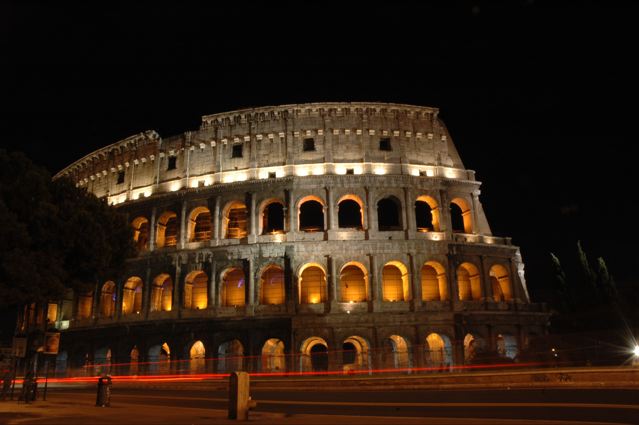
Here’s what I love(d) about Rome: the city itself holds a fascinating tension between the secular dominance of the Empire that lingers with its ruins and the Catholic dominance that has been present since the Empire disintegrated. Seeing popes attempt to reclaim the Coliseum, or use its very marble for St. Peter’s is a surprising combination of historical powers. But it seems that, in the words of a friend of mine, popes today are finally reclaiming their role as pastor more than politician, which was all too rare in years gone by. (Our visit to Florence reminded me that too many Medici’s were popes. The politics of those appointments is rather disheartening.) And I, as a Christian, feel greatly indebted to Rome in a spiritual sense for its unwavering stances on doctrine, its reliance upon the Church Fathers, and its sheer volume of believers. The strength of John Paul II against communism and Benedict XVI against “the dictatorship of relativism” literally almost bring a tear to my eye. I owe them a great deal for their strength of character. If only such men were popes in Luther’s day!

To make a long post short, it was worthwhile to see in a span of two weeks the vast difference between the humble town of Wittenberg, Germany and the opulence of Rome. It reinforced again that no one in their right mind would believe what a self-loathing monk in a no-name town could accomplish with the help of good timing, political friends, and years of pent-up frustration among German and Scandinavian nobility with Rome. Just hearing the difference in the languages of German and Italian reminded me of the vastly different world Luther lived in from Rome. (It is true that they would have held Latin in common, though with noticeably difference accents, which can make a difference.)

This is not a total defense of Luther or a total condemnation of Rome by any means; it would have been preferable if Luther could have learned to keep his mouth shut, and if the Roman church had listened when valid criticisms were made. Alas, at least it’s a little clearer after following in Luther’s steps. Well, as much as I can on a 168 km/hour train.

Monday, September 04, 2006

Carnival of the Architects and Urbanists, 3rd Edition

It's been a while since I rounded up a whole host of postings from the architectural blogosphere. Below are some more interesting items from my other blogs you should visit:

* While the major media outlets have devoted many resources covering the after math of Hurricane Katrina one year after, there is still a big hole in the ground in Manhattan five years after 9/11. Lawhawk looks at the ongoing conflict between the World Trade Center's main tenant, Larry Silverstein, and the government hierarchy represented by Gov. Pataki and Mayor Bloomberg. I find that many aspiring architects forget the fact although they are part of a creative profession, they do not initiate the will to create the built environment. That is the privilege of the client, whose vision and energy is facilitated by the achitect.

* Care for some Singaporean wisdom on rejuvenating your home? Visit the Home Rejuvenation Blog. As a note of disclosure, I lived in the "City of the Lion" as a child for six years. It's probably one of the best places in which a kid could grow up: clean, crime-free, the most exotic food around, the most courteous people, and great family diversions (zoos, bird sanctuary).

*Architecture should often be comfortable. And yet so many designers forget the value of ergonomics.

*Mark Waldo shares his experience with OMA's new Seattle Public Library. For those readers unaquainted with the current trends in architecture, the Office of Metropolitan Architecture founded by Rem Koolhaas is responsible for some of the most stimulating if bizarre architecture in recent times.

*An example of a building ahead of its time, or was it? Asplund's Stockholm Public Library exhibits a pared-down neoclassicism that looks almost downright Post-Modern a la Michael Graves.

*All architecture students strive to assemble the perfect model for their projects. But what if one's models could be transformed in the same way as old cars are revamped as in the show "Pimp my Ride"? Welcome to "Pimp My Model"... Hattip: Mirage Studio

*East Coast Architecture Review highlights the latest innovations in skyscraper design as demonstrated by SOM's projects in China. I've visited the Chicago office of Skidmore Owings and Merrill recently and can attest to the breathtaking designs that have been commissioned by Chinese developers.

*There's a gorgeously elegant new Miesian glass pavilion in Toledo, of all places. Life Without Buildings cites the building's glowing reviews. Progressive Reactionary shares more photos and thoughts on Japanese firm SANAA's new gem.

*Mad Architect of Architechnophilia provides the straight dope on Jamaican Modernist architecture.

*New Orleans architect Kinch declares: "As I have posted before, the rebuilding of New Orleans should be driven by the residents and the planning process, slow as it may be, is going about it the right way. This city is almost 300 years old and it wont be rebuit in one." Read on his insights regarding the planning process in Post-Katrina New Orleans.

*When Wright can be Wrong- Archizoo links to an articles on the flaws typical in many Frank Lloyd Wright houses as well as to another blog (BELT) argues that Wright was one of the twentieth century's greatest artists as opposed to one of its greatest architects. Ecology of Absence reconsiders Wright's achievements and compares them to his mentor, Louis Sullivan.

*Why can't Architecture be evaluated like the Fine Arts? "Do You Want Coffee?" offers an explanation.

*Norman Blogster invites you to vote in an informal poll as to which nominated project should win the Stirling Prize. He's interested to see how mere fancy pictures can influence one's opinion on an unfamiliar building. Hattip: Archidose

*BLDGBLOG examines the potential of airports becoming the center of new and highly effician urban agglomerations. The geometry of the layout of most airport terminals seem to have an unintended neo-lithic quality--fascinating...

*The architecture of mosques embodies pure prismatic volumes, an austere interplay of light and shade, and meticulous detail. Mercedes Afshar shows you what to look for when appreciating this building type.

*Although I have never been sympathetic to Russia's October revolution, the ferment in architectural ideas during that transitional period has proved to be influential in understanding current formal trends. Alas, the eccentric home of one of Russian Constructivism's most prominent visionaries is under threat to be demolished. I'm sure some good private funds could renovate this unique building.

Saturday, August 26, 2006

2006 Ken Roberts Memorial Delineation Competion: A Call for Entries

The practice of architecture involves a wide variety of intersecting disciplines. Art, Physics, Math, Philosophy, Sociology, Religion, Biology are all emodied in the way we shape our built environment. Such matters often come into focus long before the final construction drawings are completed during the intial design phases. In contrast to the dull, highly specific information found in a construction drawing set, the first few sketches and colored renderings reveal a building's driving concept with dramatic clarity. Visual communications are essential on conveying ideas that are impossible to articulate verbally. Designers who have mastered skills in drawing and rendering frequently provoke greater receptiveness to their ideas. An elegant rendering of a building will sell a building far more than a well executed set of technical drawings.

Architecture competions have been common for a long time as a means of stimulating novel design solutions to a chosen site. The juries that select winners of these competitions judge submissions based on the merits of the project's concept, its appropriateness to the given problem and the effectiveness of its presentation. The renderings of these submissions are often dazzling and in isolation are true works of art.

And yet there are few if any major architectural competitions that award the artistry and sophisticated techniques involved in architectural rendering. It is for this reason that the Dallas chapter of the American Institute of Architects has sponsored for 32 years the most senior architectural drawing competion in the world, the Ken Roberts Memorial Delineation Competition. Continuing a yearly tradition the began in the late 1920's by the Architectural League of New York, the Ken Roberts awards both architectural professionals and students who exhibit outstanding ability in hand illustration as well as computer-based rendering. Entries to come from throughout the country, and it is hoped that an even broader number of submissions from around the globe are received for this year's competition.

I've chosen to volunteer in the promotion of the Ken Roberts competition partly out of the inspiration I get from looking at the numerous striking renderings found in professional studios as well as in the darker corners of architecture schools. It is a valuable opportunity for anyone engaged in the pursuit of building design to exhibit their talents as illustrators. If you are one of the many from the field of architecture are quite pround of at least one of the drawings you prepared for a school project or for a real-life building, I encourage you to submit it to the Ken Roberts Competition before the end of this coming October. The competition is open to everyone, whether from the U.S. or abroad, whether as a student or as a professional. Student work will be judge in a category separate from professionals, and work that has been hand-drawn will be evaluated separately from computer-derived examples.

For the first time this year, entries can be submitted electronically (by either PDF or JPEG of a certain size), though you can deliver your entry by mail if you wish. Multiple entries are encouraged, and illustrations in any kind of media are welcome. There is a $400 cash prize for best hand-delineated entry, as well as another prize for best entry in digital media. The Best of Show entry, which may be either done by hand or digitally, will receive $500. Recipients of the jurors citation awards will receive a $100.00 gift certificate from Asel Art Supply. The awards will be presented on November 8th, and the winning entries will be exhibited at the AIA Dallas for two months thereafter.

Such awards are pretty generous considering that you might have already have a competitive entry lying around from recent school work or or ongoing commissioned project. No lost hours incurred from devising entire building schemes from scratch as demanded by most architectural competitions. Architects invest much time and effort in crafting projects, but rarely are true gems that result from the design of buildings ever recognized.

Pllease visit the official web site at http://krob06.com/, which will show examples of previous winners, as well as the kind of jurors that will pick the winners. Contact us at infoRequest@krob06.com for any questions you might have. Please tell anyone you know who might be interested about the competition, and the Ken Roberts committee will be more than happy to answer any of your questions.

Click on these two images which provide detailed information regarding the Ken Roberts Memorial Delineation Competition.

Saturday, August 19, 2006

Keepin' It Weird by Keepin' It the Same

Upon returning from my recent trip through the American Midwest, I’ve been reminded about how controversial architecture can be. Although few non-architects could tell you much about who the most famous architects are or what style a given building portrays, everybody has an opinion about which buildings are good or bad for their community. One often thinks that the construction of brand new buildings, whether they are new offices, residences, or civic landmarks is a sign of optimism and hope in the future. To outsiders, major construction projects are signs that a city is economically or at least fiscally healthy. From the point of view of poor inhabitants who have long struggled in communities offering few opportunities, the sight of construction cranes and scaffolding must buoy their spirits to witness something that is nothing but good.

But a city’s growth is also about its change into something permanently different. Although man is an adaptable creature that can overcome any change in his environment, he is also one that relishes a sense of predictability which allows him to be comfortable in his surroundings. It seems that the more a community prospers, the more concerns about quality of life arise, and the more antagonism against urban growth and change gain strength. NIMBY-ism (Not In My Back Yard) is often a response common to wealthier areas of a city against a new development that threatens its quality of life, usually because the people in those areas have achieved an ideal state that demands predictable comfort. Although cases of NIMBY-ism usually involve issues such as ecological impact and aesthetic disruption, the underlying conflict is informed by a fear of permanent change brought on by transforming the built environment.

In talking to a small group of residents in Madison, Wisconsin, I heard many opinions against the city’s growth. Whether it was the rapid rise of condominium towers dotting downtown, the recently built Frank Lloyd Wright-designed convention center, to the brand-new performing arts center, each development was suspect as to the actual benefit the state’s capital city. The typical questions were usually: Who can afford all these condominiums? What was wrong with the old civic auditorium? Isn’t the push to build convention centers really just a last-ditch effort by the city for desperately awaited revenue? Such criticisms that center on the actual need for a new facility, the dubious speculation for the elite or its flawed economics are actually quite valid. Since these criticisms are based on established facts and existing reality on the ground, they are often more persuasive than arguments for new buildings that rely on unverifiable estimates and abstract visions.

Madison is a university town and therefore is host to an eccentric cultural scene consisting of bohemians and traditional social outcasts. Many in the city relish its role as a liberal bastion surrounded the relative conservative rural areas that characterize the rest of Wisconsin. The emergence of new structures that symbolize wealth, bourgeois aspirations (the performing arts center, condos) and competitive boosterism (convention center, luxury hotels) goes against the communal and left-wing instincts of many of its long-time residents. There is a natural fear that the very fabric of the community is threatened by a new influx of middle and upper-income migrants which bring their own set of values that contrast sharply with native Madisonians.

This is similar to what is going on in Austin, a city which mirrors Madison in many ways except that it is a bit bigger and its transition to a bustling commercial center far more advanced. The slogan over there is “keep Austin weird”, which denotes that there was a time when the character of the city was indeed far more eccentric and that it should remain so. There are large portions of the city that still contain residents of a hippy and decidedly left-wing (or morally libertarian) leanings, but it is becoming more and more in difficult to stay due to rapidly rising real estate values. Yuppies are moving in, the tech sector dominates the local economy, and suburban growth encroaches ever further west towards the Hill Country plateau west of the city while massive new highways and bridges are being built to accommodate suburbs to the north (e.g. Roundrock). The consensus among long-time residents of Austin is that it wasn’t quite the place it once was (its golden age occurring during the 1970s). Aside from its distinct topography, there less that distinguishes Austin from other cities in Texas.

To those who oppose the city’s growth and development, it’s not only the loss of what once was but also what a particular faction could call as their own. There is little tolerance among the liberal-bohemians for newcomers that follow more traditional bourgeois lifestyles, who desire single-detached houses with two-car garage on quarter-acre lots. They accuse young professional singles who are buying condominiums downtown of homogenizing the city’s once supposedly distinctive night-life, while engendering the gradual bulldozing of old community businesses with new fitness gyms, grocery stores and other modern amenities.

In essence, such constant griping sounded by these factions, whether in Austin or Madison, is in essence a distinctly conservative impulse. Their opinions on these matters is based on their wish that the city’s growth remains static; or better, for the city to undo its recent growth and to become hospitable again to more liberal bohemians like themselves. This faction organizes itself to promote zero-growth policies against further development, rallying around protecting the local environment or preserving the city’s ‘authentic’ identity. The irony is that such policies only accelerate the rise in property values and with them unaffordable property taxes. Aside from the few former hippies who became business tycoons, most of these liberal bohemians earn relatively little income running low-profit businesses like trinket-selling shops and casual restaurants, or working in low-wage jobs in larger stores. This reality further undermines this faction to maintain the old status-quo, as cities often change to the dictates of its local business elites with considerable political leverage, not citizen-based coalitions who contribute relatively little tax revenue to the city’s coffers. The most these coalitions can accomplish is to stall development, which is often opposed by cash-starved city councils accommodating developers with tax credits on the promise that a new development will generate much needed tax revenue. Such political dynamics typical in most large municipalities overwhelms any grassroots effort with its own ideas on what their city should become.

The establishment of Madison’s new performing arts complex, the Overture Center, is a case in point. City politicians, always searching for ways to levy ever more revenue under the pressure of ever-rising budgets, are usually receptive to proposals that will stimulate new economic activity and consequent new tax revenue. Along comes a wealth businessman, Jerome Frautschi, who donates 205 million dollars of his own money to build a brand new state of the art performance hall with art galleries in the center of the city. The fact that the site of the new complex is located along State Street, Madison’s most cherished street for eccentrics, instigated heavy opposition from the liberal-bohemian faction. As part of a half-mile long pedestrian promenade fronted by an eclectic assortment of storefront facades from all periods, the Overture Center’s clean Modernist lines and its large scale (it occupies an entire urban block) are obvious visual intrusions to one’s impression of State Street. But the biggest underlying threat to partisans of the traditional State Street is the Overture Center’s effect on surrounding property values and taxes. Rents for the ground level retail spaces along the street have begun to rise, ensuring that many of the low yield-locally owned businesses that offer specialized fair will be unable to remain. National chain stores have gradually taken their place, as they are usually the only kind of tenants who can absorb the higher rents. In all the city’s coffers will probably make out well in the long run, collecting higher taxes from more valuable properties, at the cost of losing the former character of its best-known street.

Another major point of disgruntlement among the liberal-bohemian faction is that the city has to now maintain the Overture Center with tax dollars. Although operating expenses for the new center are expected to be a lot larger than the old civic auditorium it replaced, they are probably a small portion of the city’s annual overall budget. And despite the fact that the building’s construction was completely paid for with private dollars there has been widespread objection that taxpayers should ever contribute to the upkeep of a major cultural landmark for the city. It’s often the case that those who complain the loudest about how their tax dollars are spent are the ones who contribute relatively the least. Those who pay the most taxes and assume the greatest tax liability of any income group are often those who do desire a world-class facility and a desire to for their city to gain broader prestige. Such abstract aspirations are inherently bourgeois and antithetical to the values of community, simplicity and contemplation of the liberal bohemian faction.

After touring by myself the Overture Center without my friends’ knowledge (who shun it with passion) I was impressed by how well it turned out. Cesar Pelli’s scheme works well in transitioning the change in built scale from the administrative office district one side to the three story-high storefronts on the other side. A crisp modern idioms is in full display, sharply contrasting anything around it, but inserting an intriguing dialogue between its elegant formality and the hodge-podge casualness of the rest of the street. The site is distinct along State Street, as it occurs right to where the street itself terminates to the Wisconsin state capitol. The capitol is surrounded by much larger scale buildings containing offices, museum, and condos used by white-collar workers who likely would demand structures that lend prestige. One can get wonderful views of the city from the top steps of the Overture Center’s lobbies. What I think is helpful about the Center’s location is that it adds more programmatic complexity to a street that is mostly one long walk full of eateries, trinket stores, and small apparel shops. Now there is actual art to look at, a concert performed by a highly trained ensemble (as opposed to those oh-so-talented street performers), and a play to watch.

Unlike those factions who oppose almost any plan for future urban development, I embrace the view that the city is an unceasingly dynamic entity. Structures come and go, communities mutate through the ages in response to changes in the built environment. Certain patterns remain through time, such as the city’s street grid, its natural features as well as its sacred places that embody timeless importance to each generation of inhabitants. One thing that a city isn’t is an unchanging one, with its rises and declines often occurring many times over through long spans of time. For factions who have specific image of what their city should be, it should help to ask and consider what other groups’ ideas for they want their cities to become.

Cities are diverse places, a confluence a competing ideas and visions. For one minority group to hold the rest of the city captive to its narrow goals counters the messy give-and-take and ephemeral phenomena that make cities such exciting places. Maybe it’s just me but I look forward to seeing new buildings every time I return to the same city, since it satisfies my desire in witnessing progress in time and space.

Update: Here's a thoughtful post on urban dynamism from Dallas' very own Virginial Postrel.

Friday, August 18, 2006

I Hold the Ramsey’s Partly Responsible

I recently went to a county fair where I saw some kids I work with show off their cattle, hoping to place high enough to compete in the state fair. They were so proud of their heifers, steers and bulls, to the point where they spent hours grooming them, from making their tails bushy with cow hairspray to ridding them of all the excrement they routinely walk in. I couldn’t help but note the irony that Miss Champaign County was walking around, complete with sash letting everyone know who she was. I wonder if anyone else noted the eerie similarity between the way we parade cattle around and the way we parade ourselves around?

I completely understand the need to show and place cows; this is a way of ensuring we are good stewards of the animals, that we take care of them and get the most we can out of them. It also helps us scientifically understand more about the way cows are used for food and genetics, and helps us place a fair market value on them. (I am told there is simply no comparison in the quality of today’s cattle from 50 years ago. Thanks to these types of competition, cattle quality is superior to that from previous generations.) Now, why we do it with ourselves is beyond me. Just when I think we’re civilized, we do something as primitive as beauty pageants.

What’s even worse than Miss USA, however, is that 5 year-olds compete in these as well. Isn’t that a little too young to teach children that beauty is only skin deep? Pardon the cliché, but I don’t know what other values these sorts of pageants can possibly teach these children. Besides, of course, good posture. For that reason, I hold the Ramsey’s partly responsible for the death of their daughter. Even though it appears that someone is finally confessing to the murder of JonBenet Ramsey, I am not quite so ready to exonerate them for their part in making their daughter a target. I realize in the eyes of the law, they are innocent and even model citizens. But in a world where pedophilia is on the rise, why would you subject your daughter to such emotional brutality?

It is irritating that we look the other way when parents allow their children (who are barely old enough to even remember these formative years of their life) to participate in such sick competitions. Does it really matter that a child can wear make up, or dance or sing at the age of 5? Why is it okay that we glamorize this lifestyle, when the children have no opportunity to say no?

It is this sort of activity that reminds me that so many of our problems in America are self-inflicted. Systemic poverty and no father among the poor? This wasn’t nearly as big a problem before LBJ’s Great Society. Lung disease, diabetes and obesity? Smoking and high-sugar diets seem to help bring these on. I don’t want to turn this into a complaining session. I just want to point out that while the Ramsey’s didn’t inflict the fatal blow, they were complicit in what I see as a very sick culture. Perhaps the right people haven’t made the compelling arguments for putting children in this sort of limelight. But to me, it is asking for trouble when we see the totality of the human person in such a narrow light. After all, what else are we expected to value about JonBenet if her own parents don’t see beyond her glamorous possibilities?

Friday, August 11, 2006

Prophets and Martyrs: Can You Choose to Be Either?

In both the radical right wing of Islam and the radical left wing of Mainline Protestants, I see a resurgence of classical religious paradigms: the prophet and the martyr. As I hear of “martyrs” on suicide missions trying to wipe out as much of the West as possible or left-leaning American “prophets” critical of the West’s economic or foreign policies, I can’t help but think that not only are these two groups strange bedfellows, they also have come to rely on faulty understandings of both vocations. More problematic than that, however, is the arrogance it must take to give yourself the title of prophet or martyr, an arrogance which negates either title from being applicable.

Part of the problem with these words being so carelessly thrown around is that they will negate the power of the prophet or martyr’s role. Because history generally respects true prophets and martyrs, modern day self-idolizers have taken to use the term as they think it applies to them, hoping to borrow the power of the title to claim a monopoly on all things just, right, and ordained of God. I had similar thoughts when I wrote this. When someone starts talking about “social justice,” all of a sudden, we assume they are the all-caring, all-knowing, all-feeling god/goddess of compassion, when actually, they are at times selfishly claiming a monopoly on truth. But just because someone claims it doesn’t make it so. The same is true here. I am hoping the time is coming were self-assigned prophets and martyrs are ignored, so the real prophets among us may be listened to, and the real martyrs remembered.

I am by no means an Old Testament scholar, but the knowledge I do have tells me that prophets were two things that modern day prophets often are not: chosen by God, and generally unpopular. To be a prophet means to say things that invariably go against the tide, but often speaking to your own group. Amos spoke to his own group about their hypocrisies. Didn’t Elijah, Elisha, and Jonah also do the same? The prophets of old spoke to the Israelites, to remind them of their covenants with God, to keep them on the right path, am I wrong? And for this, they were often hated, appreciated like most great artists well after their deaths. To be a prophet should not involve media celebrity, but more likely a lonely life, one that involves isolation, betrayal, and possibility of death. (The martyrs I mention below could use some good prophets.) John the Baptist is the greatest New Testament example of the costs of prophecy (besides Jesus Christ himself who holds the job title “prophet” in a singular manner given his divine status). John spoke against the sexual antics of his own Jewish (or part Jewish) king, Herod. Ultimately, it cost him his head on a platter.

So when I hear left-leaning Christians confuse policy matters in DC with prophecy, when I hear them say that they are the new prophets who are called to fight for change, I must confess that my usually iron stomach is weakened. Besides bad economics, I find most self-acclaimed “prophets” in liberal mainline churches to be people that are angry at the world for their “exclusionary practices”, and instead of choosing humility before God and Church, they designate themselves “prophets” and demand to be included, no matter the reason they aren’t. But being prophetic does not merely mean railing at those who don’t like you; it means calling God’s people back to God. If you are doing prophetic work, it will speak for itself. The title will come in good time.

As far as martyrs go, doesn’t it seem rather arrogant to name yourself a martyr? Like that of the prophet, shouldn’t that designation be assigned by someone else? If being a martyr is a privilege, or an honor, how humble is it to choose how one will do it? Also, what is the distinction between being a defender of the faith until the point of death, and knowingly killing innocent people and yourself, supposedly for the faith?

I realize this strikes most sane people as obvious, but Nazi’s killing you because you’re a priest standing for your faith before the state is not the same as suicide that takes out women and children in the process. Martyrs die for what they believe, because the hostile world has left them only these two options: give up your faith or die. Until the world or even their home nation quits allowing Muslims to practice their faith, they commit a grave error in calling themselves martyrs. They are not faced with the limited options of life or faith. In most parts of the world, they have the option to have both. Unfortunately, the same is not true for Christians, who are regularly persecuted in Muslim nations, not to mention communist nations.

Does they miss the hypocrisy completely? That which they feel they are victims of they themselves commit! What audacity to proclaim themselves martyrs, when their faith is tolerated in so many of the countries that they hate. It is not up to me or any non-Muslim to straighten out their doctrine; Islamic leaders, if the faith is capable of all that the optimists say it is, must proclaim that this is not martyrdom but an evil manipulation of any religion outside of Satanism. It is so hard for me to imagine Christians ignoring Tim McVeigh if he said his execution was martyrdom, yet this goes on the Islamic world all too often.

Tuesday, August 08, 2006

Sarcasm: The New Generations' Weapon of Choice


Hanging out with 12 to 16-year olds for two weeks on two different church camps recently made me realize again how popular sarcasm is a method of communicating for that age group. One quip after another proved that honest open communication and even affection between teenagers is somewhat rare, happening in private, behind closed doors if at all. It seemed much easier for these kids to relate with other in exaggerated manners of speaking, self-deprecation and mutual teasing more than simply being honest and concerned for each other. Don’t get me wrong; these were great kids with good hearts. They’ve just learned that sarcasm is a “better” way for them to relate to one another. And sarcasm as the preferred way to speak is not limited only to teenagers. Generation X has long prized sarcasm as a valuable skill.

I remember in my single days (as of 08/06/06, I am officially no longer single, thank God) reading profiles on myspace.com or similar websites, and remarking how often people looked for others with a penchant for sarcasm. Not only that, but when Gen Xers described themselves, it was clear that they saw their sarcastic tendancies as one of their greatest gifts to offer others in a relationship. This question kept coming up in my mind: why would anyone value such an annoying characteristic in someone else? Didn’t we avoid such people in the past because it was hard to see them as trustworthy, or certainly as very straight shooters? Since when did sarcasm become such a worthwhile possession? It is true that good sarcasm at the right time and place can be wonderful wit. If used sparingly in familiar company, a lot of laughs can be derived from sarcasm.

But we’ve reached a time when sarcasm is not used sparingly, but persistently, and annoyingly. My theory is that sarcasm is en vogue because Generations X and Y have a hard time relating in mature ways with one others in their age range. (I’m not sure which I’m a part of; I think I barely made that troubled Gen X.) Even at a time when sex in some form or another is practiced by many middle school age and most high school age kids, sarcasm is popular not because it always brings people closer, but because it avoids the stages of discomfort that come in forming lasting bonds. Sarcasm by nature involves speech loaded with double meanings, which makes clear communication difficult. Because sarcasm usually involves words that should be easy enough to understand and a tone that contradicts the meaning of the words, sarcasm ultimately keeps others at bay, and leaves them wondering what you really meant. The Kids in the Hall skit (which I do find hilarious) explains it all.

But aren’t the pitfalls of this readily apparent? Isn’t it obvious that the great relationships (think marriages, best friends, etc.) are great because they involve clear communication, affection and mutual building up? Sarcasm is a weapon because it prevents all of these things from happening. Therefore, persistent sarcasm as a manner of speech will stunt the growth of teenagers, and it will make real intimacy between two people that much more difficult. I would go so far as to say that because this real intimacy has been lost, substitute intimacy in the way of sex has attempted (and failed) to fill the void. Is it any wonder that the generations that prize their sarcastic habits also seem to devalue sex and real affection?

Perhaps it has always been this way. Maybe teens have always related in such a way because it is safer. If you are on the offensive with sarcasm as your weapon, it is harder for others to hurt you. It just seems as though we prize a very strange thing when we tout the values of sarcasm. Sarcasm keeps others at a distance, leaves them wondering what you really meant and makes the truly worthwhile relationships that much more difficult to manage. I can only say that I will try to use sarcasm more sparingly, so I don’t end up like the Lonely Sarcastic Guy from The Kids in the Hall.

Monday, July 31, 2006

Le Corbusier Lives!

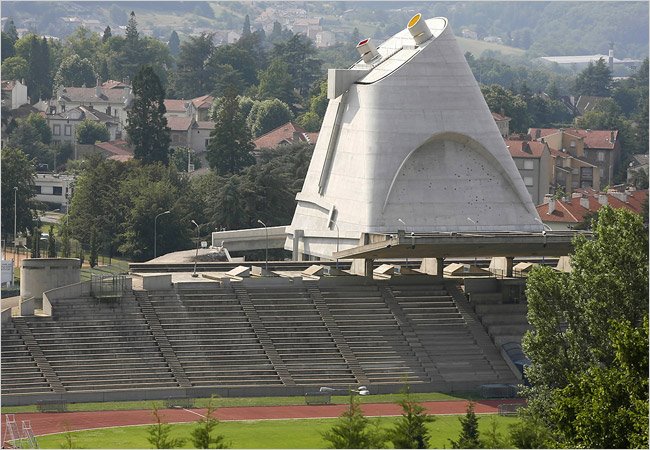
A rather significant event occurred in the world of architecture in the last year—at least from the point of view of this writer. In the city Firminy-Vert, a historical mining community in France, a church initially designed by Le Corbusier was completed. It is the fourth Le Corbusier structure to have been realized in this town, the result of the architect’s fruitful relationship with its post-war mayor. The Church of Saint Pierre was realized by one of Le Corbusier’s numerous acolytes, Jose Oubrerie, who collaborated with the master architect in the last years of his life during the early 1960’s. More than 40 years after his death, the church is finally complete, and in spite of Oubrerie’s own influences, the design of the church of Saint Pierre is remarkably consistent of Le Corbusier’s later works. Many details in the design were the result of stricter building codes, as well as Oubrerie’s own aesthetic predilections, but the rest of the structure combines formal elements that have become the trademarks of Le Corbusier’s most celebrated projects, such as his monastery at La Tourette, his Assembly building in Chandigar, India, as well as from his Chapel at Ronchamp du Haut.

It is not unusual for an architect to die before the completions of designs for a few years afterward. It is rare to build based on plans from several decades before, often because it requires another architect to interpret the design intentions of the original designer, divining on what he was thinking. The best way at ascertaining this kind of intangible information was to rely on an architect’s protégé. Frank Lloyd Wright, who surrounded himself by many sycophantic apprentices who lived and worked in his large private compounds in Wisconsin and in Arizona, produced dozens upon dozens of architects who mastered and internalized his style so as to be indistinguishable from Wright’s own work. Such disciples probably helped in the completion of the one project that I’ve seen which was built many decades after Wright’s death: the Monona Terrace in Madison. Although most of the details and interior spaces are contemporary, the overall lines of the structure are unmistakably Wright’s.

Le Corbusier ran his Paris studio like a monastery workshop, with young ambitious architecture students from around the world coming to work on his projects for little or no pay. They eventually left and returned to their home countries and disseminate the ideas and practices of their master. Le Corbusier’s former apprentices would thus synthesize his ideas and idiosyncratic forms with cultural influences of their native countries, creating a more localized Modernist vocabulary. Examples of this are found in Oscar Niemeyer’s work in Brazil and Balakrishna Doshi in India. Because of this desire for synthesis, it is not easy to confuse an actual Le Corbusier design with one of his acolytes’. Contrary to most people’s general view of Le Corbusier as the standard bearer of a monotonous machine aesthetic and standardization, his architecture was progressed quickly toward radically different phases. As he matured as a designer, his light and purist structures gave way to heavier, rougher, more organic buildings. His works for sacred functions expanded his expressionistic style and use of symbols that derived from his painting. The more sculptural his designs became, the more mysterious imagery, recurring formal themes and various textures would emerge. Unlike the relative consistency of his earlier villas, which followed his ‘five points’ faithfully and would not elaborate them any further than necessary, Le Corbusier’s latter works juxtapose symbols, creating tense dialogues between them. They also incorporate curves , shapes , and numerological codes that reveal deeper meanings less related to the building’s function than to the wandering mind and soul of the atheist architect.

The Church of Saint Pierre reminds those who relegate Le Corbusier as simply the inventor of the cubist architecture on stilts that there was much more going on in his mind as his career evolved. It serves as a summary of where the master was near the end of his life, and is a testament to his unceasing inventiveness. When put in the context of the architecture produced today, the church stands out in though its lyrical and sculptural complexity. Its deliberate artistic qualities distinguish it from countless other contemporary buildings, which derive their meaning from their function and from the obscurity of their fancy exterior skins. The effect of the latter is for one to say that the building’s effect registers a ‘je ne sais quoi’ response. Le Corbusiers’s late works leave so many vague formal cues and symbols that one naturally responds with “where do I begin to try to understand this?” In my experience the layers of embedded meaning are many yet accessible to all who make the effort.

Le Corbusier sought to enrich formal language of Modernism, and Jose Oubrerie should be thanked for providing us another example of the Swiss architect's achievement towards that end.

Hattip: Archinect

Monday, July 24, 2006

Coddling Jesus: He Was a Carpenter, You Know

After returning from a church mission trip to urban Milwaukee, I have a few new thoughts concerning assumptions about helping the poor. This was the first mission trip I had ever been on, and overall, I thought the experience was a good one. Working in soup kitchens, spending time with the mentally/physically disabled, and playing with children who get very little attention from home were rewarding experiences for all involved. It was good that the youth at my church got to see a different way of life, and to experience the reality that poverty, violence, and homelessness do exist. What I walk away with as much as anything else, however, is the realization of how generous Americans are. We have so many charities here, no one should ever die of starvation. In fact, I am convinced that we could probably make do without one more food pantry, soup kitchen, or government program. Seeing so many charities in action leads me to think that, if anything, we need to be personally involved with those whose life experiences have broken them as much as handing them a hot meal from time to time.

One of the popular sayings of those who favor liberation theologies (theologies that focus primarily on reversing the plight of the poor, often adopting Marxist ideas and politics) is that when you spend time with the poor, you begin to see Jesus in the their face. They make the point that Jesus had a “preferential option” for the poor, and therefore the whole mission of the church should be to care for the poor. I do not dispute that Jesus did have such a preferential option, but it was not limited to the financially poor only, but also the spiritually, mentally, or physically poor. And yes, as hard as it is, it is crucial to see Jesus in all people, as a way of protecting the sanctity of human life and seeing the value in those who are in very different situations. The problem for me is what we do with these people after we see Jesus in them, and even after we recognize that Jesus has a preference for them?

When I think about the life of Jesus, I do not see his ministry only, which was only the last three years of his life. I see a man who labored for probably close to 18 years in back-breaking work. The Greek word for Jesus occupation, “teknia” suggests that he worked with heavy materials, certainly wood, but also possibly stone or even metal. Jesus, unlike so many “holy men” of ages past, never looked for a handout, or found a way to get out of working. And from those precious 18 years that he labored we get the sanctification of work, of labor. We get holiness in the workplace not from cube-to-cube evangelism, but from the fact that Jesus himself, God made flesh, toiled with humanity.

Now, from here I will not go on to say that the poor are poor because they are lazy, although some of them certainly prefer begging to working. My point is that if we are going to say that we see the face of Jesus in everyone, and especially the poor, then why do we often coddle the poor? Why do we assume that the only way they can succeed is by taking money from rich people and giving it to them? Is that how we would treat Jesus, with pity, and not mercy, with a handout, but not love? I’ve said it before, and it’s worth saying again, when Bill Clinton suggested that every church should help to take one person off of welfare and help them transition into the workplace, this was a very appropriate understanding of how the church can and should help the poor. Unfortunately, the church (technically the National Council of Churches) said, “No thanks.” What a shame. So the poor have enough Jesus in them to be pitied, but we dare not have expectations for them? Can we not ask that addictions be quelled? Can we not ask that efforts be made by those able to work? Can we not ask that mistakes that helped lead to poverty not be repeated in the future, not out of high-handed elitism, but out of love?

The more involved I am in church work, the more I realize the real economic issues at work in America are either ignored or flatly misunderstood by the Church. I don’t expect such mission trips to be able to cover everything that is at play in what helps create, recreate, or sustain poverty. But let’s at least act like we mean it when we look for the face of Jesus in the poor. Let’s have a little respect for what they are capable of, instead of writing them off as welfare-dependent victims. Then we will really be looking for the face of Jesus in the poor. And not just the Jesus who died for our sins and fed the 5,000, but the Jesus who toiled with us so that our own labor might be redeemed.

Saturday, July 15, 2006

Pride Mixed with Pain: The Recipe for Liberalism?

For conservatives, the last 20 years have been both an immense frustration as liberalism has become ingrained in media, academic and pop-culture circles, and a blessing as the new media has given voice to the conservative leanings of many Americans. The last 20 years have also defined conservative vs. liberal as much as the founding defined federalism vs. states-rights. And it seems we’ve now reached the point where the rhetoric has taken on a whole new level, where conservatives and liberals can hardly be in the same room and where liberalism is understood more as a “mental disorder” than a political ideology.

Michael Savage and Ann Coulter have both championed the idea that liberalism is a psychological condition instead of an set of opinions, apparently with much success in conservative circles given their book sales. And when one looks at some on the far left, I can at least understand the sentiment: such anti-natalistic tendencies as abortion-on-demand, fiscal policies that create poverty and unreasonable vitriol for President Bush all lead me at times to think that hard-core liberalism is based on a very different foundation than my conservatism. The emotion-driven responses to these sorts of issues often make the liberal making them appear to be irrational to the point of insanity. How can one, after all, support such silly fiscal policy after seeing how dreadfully it has failed for the last 40 years? How can it be that any group of people would fight so hard for the right to abortion? Does this not strike others as bizarre at best, and macabre at worst?

But I find the “mental disorder” schematic too easy, appealing to the masses in the worst sort of way, and simply ignorant of what is behind a lot of liberalism. In my experience with those who proudly champion liberal causes, I often find a combination of pride and pain. Now, if conservatives wanted to say that those who are prideful or in pain are, in fact, suffering from very real mental disorders, I suppose they could. But that wouldn’t be particularly reasonable, either. Most of the liberals I know speak from places of pain, not psychosis. This does not excuse their positions that fly in the face of logic (liberal fiscal policy), history (liberal foreign policy) or virtue (the liberal understanding of conception/human life). But it does more accurately diagnose the condition of liberalism as one in need of healing more than scorn. Telling those who hold near and dear positions to their heart that they have mental problems won’t help anybody.

I realize the arrogance of saying that a whole group of people live lives of pain, and make deluded judgments from there. But I find the combination of anger-driven political idealism, agnosticism (or atheism), and unfounded optimism for “progressive” attitudes to be most common among liberals. And I find that what drives it is the sorts of pains that many of us experience, and consequently want an easy answer to solve them. We see injustice, we see ideals not realized, we see meanness, and we all want a solution. But those with a sense of history and cautious optimism have the best chance of providing real solutions, not those who react to injustice with self-righteousness and blind faith in plans that have failed for years.

And that brings me to pride. A cursory examination of history should humble the examiner if nothing else. The past century was full of failed socialist experiments in every form and fashion, yet miraculously, socialism still has a lot of power in the world instead of fading. It is sheer pride in humanity that would allow anyone to hang on to Marxism for one more minute, because it completely ignores the brokenness of our human condition. It is also pride that allows anyone to think that tomorrow will bring something different, even though history often predicts what will happen next. Raising the minimum wage, for example, won’t work. To believe otherwise is an exercise in pride as much as ignorance. To not protect the sanctity of human life has serious consequences about how we care for all the vulnerable in our society. To believe otherwise is also an exercise in pride.

Would this be the wrong time to say I have a lot of liberal friends? This is not a diatribe against them. If anything, I aim to defend them against the Coulters and Savages of the world, who would write them off as loons as soon as consider the origins of their ideas. And this is nothing new. Conservatives are generally polled to be happier, more hopeful and more joyful than those who call themselves liberal. Maybe instead of trying to get liberals to be conservative, we would have more success if we could just get them to be happier.

Thursday, July 13, 2006

Zidane: The Face-Saving Ethic Strikes Back

Zidane Head Butt


The last few weeks were surprisingly momentous for me and millions of my French compatriots. The success of ‘Les Bleus’, the national soccer team of France, was not expected at the beginning of the World Cup over a month ago. Consisting of a slew of relatively old players and a coach who consults his astrologer regularly, this year’s team achieved results that few would have believed possible after its lackluster performance in the preliminary group matches. I am by no means much of a soccer buff, as I only pay attention to the sport every four years for the World Cup, usually out of some inexplicable duty to one of my two native countries (the other being the US, of course). And still I was overjoyed by the championship victory of ‘Les Bleus’ in 1998 over the Brazilian favorites. Watching this year’s repeat of that match in the quarterfinals, I was convinced that France had finally rediscovered within them the spark that had spurred them to winning eight years ago.

Naturally I and many Frenchmen were disappointed by France’s loss in the final to Italy. So close, and yet so unjustly determined by penalty kicks. Since I was eating lunch with my family while watching the game from the corner of my eye, I had not noticed what the French captain Zinedine Zidane had done to merit his red flag. I only saw him talking to the referee after the red card had been issued and then strutting off the field looking quite dejected. Only after the match was I able to see the video footage online further clarifying his head-butting of an Italian player. Zidane’s display of aggression made all of us wonder what the reasons were for this kind of behavior, but it had already become the consensus among most in the French press that the act was reprehensible regardless of what provoked it, and that it had probably turned the tide against the French in the crucial final minutes of the championship match.

As the story on what was said between the two players unfolded, it was clear that offensive language and taunts were common in soccer. Zidane’s outburst was still surprising (not having paid attention to instances of his violent behavior throughout his carreer—remember I’m not much of a soccer fan) and to anyone who thought that the shear gravity of being part of the World Cup finals match would be enough to prevent any player to willfully eject himself from the game, few could imagine any kind of plausible explanation. It was clear that for all of Zidane’s impressive accomplishments in soccer, certain other issues were more important that could only be resolved violently.

As the past week progressed, the Zidane and his Italian adversary Materazzi offered sparse explanations of why events turned out the way they did. In an interview of French television, Zidane revealed that Materazzi had said some nasty things about his mother and sister and to not fight back against such insults would only condone these harsh insults. Zidane’s logic seems puzzling to me and others at first, since it assumed that a civilized response to such verbal provocations would be to ignore it and focusing on the more important task of finishing by winning the match. Materazzi’s behavior was likely an intended effort to rid the star player from his leadership role on the French team by exploiting Zidane’s tendency to overreact. Such tactics are quite underhanded on the part of some Italian players, but a truly great player would easily evade any opponent’s provocations.

And still, Zidane’s head-butt reminded me how the ethics of saving face can easily undermine larger goals of a community. Defending the honor of his family is more important than what over sixty million Frenchmen would otherwise like, such as keeping cool and focused, winning high-stakes matches. Such thinking is indicative of a pre-modern ethic and common throughout most Eastern cultures (Zidane is of Algerian birth) from honor killings of women to pressures in Asian families for their offspring to excel in selected professions. Face-saving has been largely supplanted in the West, probably the result of the emerging influence of individualism and humanism beginning in the Renaissance. Ideals would no longer worth being defended if there was no rational basis that could enhance individuals. Behavior would now be directed for productive ends, with individuals weighing on how to get the most out one’s own efforts as wells as from the efforts of others. Participating collectively in a task would no longer be a means toward maintaining long-standing social ties nor as fulfilling an obligation based on family honor and reputation; rather, the new Western model advocated collective action as the most practical means of accomplishing tangible goals.

Conflicts under this more modern and mechanistic mentality must be borne out of practical desires. Instances where two individuals are practically better off resolving a conflict than in working together are rare, because there is usually little rational basis for them. Yet a person acting in the name of preserving his family’s honor does not evaluate success in pragmatic or even utilitarian terms. Success relies on whether face-saving virtues have been upheld and familial shame averted.

Zidane accomplished the latter objectives, but his violent act left few French soccer fans to wonder how he was so willing to disregard the hopes and aspirations of millions just to settle a non-productive resolution.

Friday, July 07, 2006

Rafts and Rabbit Cages: What the Brightest Architectural Minds Have in Store for New Orleans

Like all members of the AIA (the American Institute of Architects), I receive my monthly complementary issue of Architectural Record, the official professional magazine of the organization. Along with the numerous glossy pictures of recently completed projects typical of architectural journals, the magazine focuses on the current events affecting the public image of the profession. Thus, constant concerns about climate change among many in the profession leads to copious articles about environmentally sensitive technologies and buildings, not to mention editorials excoriating architects for their failure to be ecologically minded enough. Naturally 9/11 and the rebuilding of the World Trade Center received lots of column-inches, with large numbers of elite architects handing down their own verdict on the submitted designs and related changes. Soon after hurricane Katrina flew over New Orleans and the Gulf Coast wreaking havoc along its path, contributors to the magazine were quick to lend their expert insights on what is to be done next.

As a profession innately desirous of the building for the future, the mood among the editors of the magazine was optimistic, since the storm had left a large scale opportunity to reinvent a major American city. Mindful of New Orleans’ chronic social and economic troubles during the last several decades, the columnists promoted progressive solutions that gave cleverly concealed nods to the local context and traditions while proposing abstract building volumes with high-tech and environmentally sensitive systems. Somehow the idea that much of the existing urban fabric of New Orleans could serve to inspire new proposals didn’t seem to get much attention in the magazine, except for a few scathing editorials against more historicist schemes of the New Urbanists, who sought to extend the local vernaculars to proposed areas for rebuilding. Reed Kroloff, the Tulane University architecture dean and the city’s eminent champion for the Modernist movement, helped organize an architecture exhibit in the Netherlands that featured schemes from avant-garde designers around the world. Each of these schemes is an attempt to remake the New Orleans, or at least to add and enliven the city’s sense of identity. None of the schemes actually show any reverence to the older architectural gems that characterize New Orleans. None of them seem to have ever consulted with New Orleanians. The exhibit wasn’t about actually building something as it was to stimulate the public’s imagination on what New Orleans could be.

And even then, some of the schemes are unintentionally patronizing. Several of the schemes made its most monumental function that of being a shelter in case of massive flooding. The Dutch firm MVRDV suggested the idea of a big hill in the middle of the city which would be tall enough so that people could seek refuge on it in emergencies. I could only imagine how inhabitant of New Orleans would enjoy seeing a big mound reminding them of the utter futility of even living in it, since the real essence of the city itself is about seeking shelter from the storm. So much for letting the good times roll if all you're really supposed to worry about is how to survive the next big one. Another much-discussed scheme by the dutch firm U.N. Studio features a green glass zigurrat that contains a media library and administrative offices for the city. Other than the form adding a bit of bold visual interest, the program itself is in my opinion quite irrelevant to the needs of New Orleans. Think about it: a massive hurricane wipes out a major American city and the best thing one can build to revive the morale of the city is to build a massive media library?

The architects wished to give New Orleans a new 'urban icon', as if of all things that the city needs a new symbol for progress is of the highest order. I seem to remember the largest indoor stadium in the world, the Superdome, filling that role quite nicely. Somehow, giving New Orleans a cool new ziggurat was going to have the same positive effect as Frank Gehry's masterpiece in Bilbao, Spain. The problem with that kind of thinking is that one shouldn't compare the uninviting Basque port that few wanted to visit to one of the U.S.'s top tourist destinations. Besides visitors come to the Big Easy not only for its quirky architecture as for its cultural ambiance, its food, its festivals, and as a welcome setting for debauchery and fun. A self-absorbed media library or hill with a school and buch of emergency shelters don't mesh with New Orleans' existing urban identity.

In the latest issue of Architectural Record, the magazine sponsored a design competition (co-hosted by Mr. Kroloff, again) for new housing prototypes for New Orleans. The best submissions were published, each accompanied by comments from the select members of the jury, each nationally respected architects. Browsing at the proposals made me shake my head at the arrogant naiveté conveyed by these schemes. Although the drawings, renderings, and forms were attractive, the absolute disregard for the on-the-ground reality of New Orleans was obvious. Maybe it was beyond the scope of the competition, but little was mentioned on what daily life is actually like, what people in the afflicted communities actually aspire to, what actually matters as important to New Orleanians. And although each of the schemes tried to resolve a problem by clever design, I really hope that the designers have the humility in knowing that the destructive social pathologies that afflict New Orleans are far more complex in nature than the simple elegance of their logical-looking drawings.

The submissions reminded me of a contant tendency that has helped generate public disgust against much of modern architecture. Most of the high-density housing schemes presented show little contextual response to the uniqueness that is New Orleans. They could be built in any other city around the globe, often exhibiting a look more in keeping with Dutch housing prototypes, which to me can look a stack of elegant rabbit cages. There is also a clear revisiting of LeCorbusier's Unite d'Habitation in Marseilles, from the design of the apartment units to the way they are related to the high-rise structure. And similar to Le Corbusier's tendency to design high-density dwellings that were so generous so as to be more fitting for wealthy bachelors than the 'masses', the schemes in the magazine propose units more generous and better built than the priciest uptown condominiums. Certainly the cost for housing a significant portion of the population that lost their dwellings in the ninth ward would be exhorbitant if built to the luxurious standards of the proposed schemes.

Among the entries for a single-family housing prototype, there was at least a bit of respect for the traditional housing typology of the shotgun home. And yet some of the designs harken back to the tendency to design with a patronizing air of pity. One scheme demonstrates how modular housing units no different from shipping containers on stilts could prove to be a quick solution to rapid and economic reconstruction. The most absurd scheme in my eyes was an entry by Harvard students, no less. It describes how many of the city's inhabitants would live inside a two-story cube to dwell in, and designed to float on water in case of massive flooding. The area where these units would be would in times of high water act as a large village of glorified life rafts. When the waters recede, the units would sit back on the ground, changed in location from before the storm, thus reconfiguring the order of the neighborhood. You know, I've always thought of humans being naturally terrestrial creatures, and I can't think of one place where people happily live on the sea in private life rafts. There are very good reasons why human settlement has gravitated toward drier land instead of embracing naturally flood-prone areas.

It is obvious that none of the projects submitted ever had the intent of being built. Competitions and exhibitions of theoretical work serve not only to stimulate new debate on the future of a place but also to enhance the prestige of those who submit the schemes (since preparing an entry takes lots of unpaid man-hours and deferred earnings doing 'real' projects). And although I'm all for promoting a lively philosophical discussion and fruitful brainstorming, it is not clear why the participants of these exhibitions and competitions believed it was necessary to complete re-envision the city of New Orleans. The Crescent City is blessed to have inherited the most picturesque urban landscapes anywhere, its architectural identity solid and beloved by everyone who lives there. In terms of pedestrian scale, the distribution of density, and its organic relationship with the landscape, New Orleans has much to recommend itself as an example of good urban design. Looking back, Katrina was more of a technical problem for the city, having little to do with the quality of its planning and urban monuments. Faultily constructed levees, poor evacuation planning and mobilization, and ill-conceived strategies for drainage of the Mississippi delta all contributed to tragedy following the hurricane. Fancy media libraries, man-made hills, or floating cubes in the water don't offer much in the way of helpful solutions to the technical dilemmas that face New Orleans. Such typically inadequate responses from these elite designers lead me sometimes to doubt the utility of even enlisting their ideas in the first place.