Monday, January 30, 2006

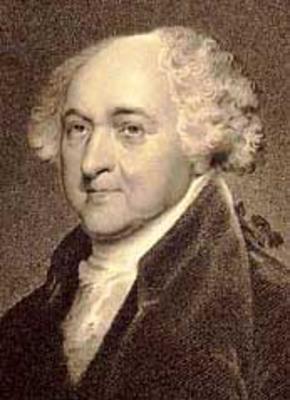
John Adams: The Liberal Founding Father?


As conservatives point to the past for the ideological underpinnings that have given rise to the conservative movement, the founding fathers and their beloved documents quickly take center stage. Brilliant minds like Jefferson, Adams, Washington, Madison and Franklin give credence to the modern conservative view of limited government, states rights and the protection of private property. But it appears as though one of these distinguished men has garnered more attention of late, perhaps in an attempt to show the “diversity” present at the founding of America.

John Adams, subject of a recent “American Experience” documentary on PBS and a Pulitzer Prize winning biography, has enjoyed considerable notice in the last several years. David McCullough’s “John Adams” enjoyed months of being a bestseller and is considered by many the preeminent biography of Adams. Now we have from PBS “John and Abigail Adams,” a documentary about the private life of Adams as well as his political philosophy.

But what is it about Adams that merits such attention? Perhaps all of the founding fathers go through cycles where we are interested in them, one at a time. When DNA tests attempted to prove that Jefferson fathered a child through Sally Hemings, he was the center of attention. But unlike “John and Abigail Adams,” Ken Burns’ PBS documentary on Jefferson captured the sense of contradiction Jefferson’s life and ideas lived out, and was willing to praise him and condemn him when necessary. In this documentary, Jefferson is seen more one-dimensionally as a wealthy, back-stabber who was wrong about the French Revolution, and who only got to write the Declaration of Independence because Adams let him. (Adams would later regret letting Jefferson do it, thinking the Declaration and its language would be forgotten.)

But Adams seems to embody something that Jefferson didn’t, making him the darling of the left and left-leaning media: big government. Adams had no trouble seeing America through a monarchical lens, even though he fought for democracy, and he argued for a strong federal government. Jefferson, meanwhile, espoused a vision of limited federal government and a subsequent pastoral dream world of gentlemen farming and a couple hundred acres of land per family. (Sounds nice, doesn’t it?)

But most of all, Adams fought for that most hallowed value among those on the modern left: peace. When French man-of-war attacked American merchant ships, all of America (apparently) called for war with France. But Adams refrained. Instead he sent not one, but two diplomatic peace missions to France to find a peaceful resolution to the conflict, much to the dismay of Congress and the American public. This unpopular move, which does now seem to be the prudent one, single-handedly cost Adams his re-election according to the documentary. And to make Adams’ plight even worse, his peace treaty was signed, but because of delays in communication, it was not known until after the election.

The implication seems to be that even if a nation supports war, the proper action for a president is to refrain, and diplomatically try to find a peaceful resolution. Sound familiar? And while the documentary paints Adams as a martyr who essentially acted as a fall guy for the peace movement of the 1790s, there were other reasons Adams lost the election, which are hardly mentioned. For example, his extremely unpopular and undemocratic Alien and Sedition Acts brought contempt from both major parties. (The documentary does cover these, but does not seem to offer them as reasons for his defeat.) Doesn’t it seem likely that these contributed more to his loss than not going to war, especially given what the country went through to rid itself of suc centralized power?

And it’s not as though Adams was a gregarious, lovable personality. He was infamously brash and arrogant. But I do not want to discount the contributions Adams made. I don’t doubt his brilliance or regret the role his brash personality in convincing Congress to declare independence. I do discount the modern left’s attempt to “take away” the founding father monopoly from conservatives, and I do not doubt this is what is really at play. If the liberal media can convince some that not all the founding fathers were on the side of modern conservatives, the conservative movement will lose some credibility and there may be hope for big government liberalism. This was the subtext of this documentary, and hence all the attention lately on this Adams fellow.

Oh, and did I mention Adams was from Massachusetts? There aren’t any popular senators and/or presidential hopefuls from Massachusetts, are there? I wonder if Adams would be ashamed of the politicians Massachusetts elects these days?

Thursday, January 26, 2006

The Futile Search for the Enlightened Despot

Upon hearing the news that Hamas had won a majority of the votes in Palestine, I just shrugged. Anybody who makes the effort in getting to know the priorities of Palestinians and their worship of Islamic martyrs with their deep hatred of Israel would predict that the terrorist party of Hamas best reflects the values of most Palestinians at the moment. It is obvious that the outcome of the vote was not the kind wished for by Israel or the Western world, in particular when the U.S. which is seen as the main broker for the peace in the Middle East. Such a vote for the fundamentalist party at first appears to be a repudiation of the policy for more democratization in the Middle East. John McIntyre at Real Clear Politics (one of the best web-based political analysis on the web) points out that the policy of democratization of a country that has been oppressed for a long period of time carries an inherent risk: that of voting for the ‘bad guys’. He explains:

Today’s Hamas victory is one of the problems in President Bush’s policy to push democracy as the answer to the problems in the Mideast. What happens when the really bad guys win? It’s just a tad bit hypocritical to push democracy and elections, and then when you get results you don’t like say we don’t recognize your government.
Don’t get me wrong, I am not necessarily arguing that we should recognize Hamas, only pointing out one of the serious flaws in preaching democracy as a cure all.

This critique of the policy of democratization is commonly held by the realists, who emphasize the value of power and stability over the promotion of philosophical ideals held by the Democratic Idealists. As I’ve discussed in a previous post, I am far too mindful of the common humanity of all people to desire a stable resolution to an unsolved conflict which denies individuals to live in freedom. The will to express oneself openly and make one’s own decisions is to my own naïve mind a universal longing, and any measure taken to bring people towards such freedoms is therefore good.

And still, I realize that in many situations, democratization is far less preferable than enlightened despotism. I agree with many political scientists that often democracy should be an end rather than a means: that is, a society must develop solid institutions based on the rule of law, economic prosperity, and a subsequent middle class before democratic rights and practices can be achieved. An enlightened despot seems to be the answer for leading a traditional authoritarian society towards the proper path by emphasizing judicial independence and dynamic economic growth. Such has been the path of successful democracies like Chile, Taiwan, South Korea and Singapore. Lee Kwan Yew, Singapore’s first and longest serving Prime Minister, was probably by far the most enlightened despot the world will ever know, virtually prohibiting political opposition yet ensuring the rapid rise in economic influence of what was once a British colonial backwater. The same route is hoped for with the People’s Republic of China, as its leaders look to Singapore for clues on how to maintain authoritarian political control while benefiting its citizens through the free market.

The problem with the strategy of setting up the groundwork for democracy to thrive on later is that necessary enlightened despots are sorely lacking in the world. For every Lee Kwan Yew there are thousands of Idi Amins and Saddams. From my cynical point of view, human nature is so fallible as to favor the emergence of depraved tyrants over enlightened despots. Power and influence seduce many seemingly rational people into structuring society to serve for the despot’s private gain. That was the major defect in the dominant cold war policy of supporting anti-communist dictators: it was often likely that America’s ally in a third-world country had no interest in honestly setting forth a social evolution towards a democratic civil culture. Failing to instill this kind of change will predictably lead to political and social chaos after the passing of the despot, with civil wars and the most committed (often the most extremist) factions taking control to embark on the next regime of oppressive rule.

I find that the Palestinians are in a situation that is all too familiar. After decades rule by a despot in the figure of Yasser Arafat, a man who failed to establish a deeply entrenched civic society, most Palestinian voters have little inclination towards government run by moderate values and a desire to actually live in peace with their neighbors. Arafat purposely allowed hatred to fester among his people, for order and social services to be left to groups outside the state’s capacity. Hamas’ platform at first glance seems to resemble that of Arafat’s Fatah, only that the later doesn’t openly admit its real intentions internationally and has succumbed to corruption after decades of uninterrupted rule. Yet Hamas cleverly took on the responsibilities of providing valuable social services and a code of social order through its strict practice of Shariah, and thus managed to succeed in the ballot box, much like their cohorts in Egypt, the Muslim Brotherhood. Democratic elections taking place in a messy political void often yield undesirable results.

However undesirable such results may be, I take the view that democracy accelerates a much-needed self-appraisal of a failing society. Hamas is now put a in a position of government and will have to adjust to the responsibilities of a sovereign state. The voters who put them in power now are responsible for their own political choices. Before they absolved themselves of any responsibility as they could easily blame the supposedly unjust actions of the Israelis or the unceasing corruption of the Fatah party. Now every failure to improve the current lot of Palestinians will rest on the ruling party, and I predict that Hamas will lose its legitimacy once it becomes evident that a policy driven by the destruction of Israel is no viable substitute in restoring order and economic prosperity in Palestine. Then will the reevaluation of what actually afflicts Palestinians follow.

It is well worth noting that this recent election fulfills one of the major milestones towards a stable democracy, in the peaceful transfer of power between the incumbent party and the opposition. No coup, no evidence of obvious rigging and no bloodshed is a testament to the salient power of democracy in helping to resolve issues that could not be brought to a head by dictatorships.

This post explains the potential silver lining to the Hamas victory.

Monday, January 23, 2006

Catholic or Charismatic: Is Music (a)Moral?


For those of you who visit this blog because you are an aesthete and enjoy discussions of architecture and its subtexts, you may wonder why, on occasion, there are discussions on preaching or music in Christian worship. I hope to tie the two together, to express that aesthetic choices in worship and/or architecture assume a subtext that says, “form matters,” or to take it a step further, “form has moral ramifications.”

Many of my thoughts are supported if not guided by a new book from Evangelical Press, “Why I left the Contemporary Christian Music Movement” by Dan Lucarini. A former Contemporary Christian Music (CCM) leader in several churches, he refutes many of the arguments Contemporaries make in defending their rock ‘n roll style of music in worship. In doing so, he speaks to the core of the divergence in Mainline Protestantism I see defining MP churches for the next generation: will MPs become more catholic or charismatic?

Before reading the book, I knew that I didn’t take to CCM for several reasons. Now, I am even more aware that CCM is becoming the mainstream, the majority in many MP churches in America. No longer is it a movement, really, or the new minority, but the standard by which “Traditionals” must judge their “old-fashioned” music. It has become a powerful financial player as secular (and religious) companies make huge profits from the sale of CCM sheet music, CDs, concerts, etc. Even worse, CCM is the leader in distributing Charismatic theology, a theology that I find has serious and dangerous limitations, even if it has some good points. Some of its most popular proponents (Joel Osteen, Rick Warren and Bill Hybels) attract Christians that have more devotion to them than their home churches, promoting a false gospel that compromises its values with the world’s aesthetic tastes. This is a tantalizing compromise to many “seekers,” and its popular promotion through CCM begs us to ask if music is amoral after all.

In order to perform and sell their music, Contemporaries claim that music inherently is amoral, ridding of centuries-old hymnody and psalm settings as they do. Would readers of this blog make the same claim about other aesthetic endeavors, such as architecture, urban development or even public transit strategy? Are any of these amoral? Does it not seem obvious that to claim music (and I mean the form as well as the lyrics) is separate from morality is nonsense? When this blog writes of the tragic dilution of good songwriting, aren’t we really lamenting the dilution of the morality the songwriting represents?

Are we to say that the form of even secular classical music like Bach’s Brandenburg Concerto’s or even Stravinsky’s “Rite of Spring” are not more moral than 50 Cent’s demonic “Get Rich or Die Tryin’” ethic or the violent sounds found in heavy metal? Of course they are! When was the last time an orgy was performed to Lutheran pipe organ music, or ravers took Ecstasy to 9th century Gregorian chant? When has a news story reported acid binges for listeners of Beethoven’s “Eroica” or Mozart’s “Requiem”? The form of music has inherent moral consequences and assumptions, just as the form of urban housing assumes a morality, even if it is never stated. The political associations many architects and urban planners had reflected the close relationship their morality and aesthetic shared.

And yet, knowing the moral associations rock, pop, or rap music have, a majority of MP churches may by now have those forms of music leading their worship. Music, like everything else, has been relativized to the point where its form has come to hold different truths for different people. Yet, aesthetic common sense tells us that Gangsta’ rap (I feel awkward even writing those words) carries with it an understanding of violence and anger, not peace and worship. And aesthetic common sense also tells us that rock music hints more of sex and rebellion than chastity and humility.

It seems obvious that the easiest way to see division between charismatic and catholic MP churches is their choice of music. A small number of pastors willing to resist the CCM bandwagon will ignore requests to change to CCM in their worship. More, however, seem determined to become “purpose driven”®, to use what I would describe as a worldly method to promote an other-worldly message. This, to me, is not possible. Form and message, or form and morality are siblings, not strangers.

I do not want to condemn the piety of those who only want to worship and serve God, and I do not want to sound prude. I enjoy The Police, The Pixies, even The Killers, bands perhaps I should repent of! But I do not bring this music into sacred worship. I want to challenge Contemporaries not to be a part of something whose moral associations may cause someone to stumble, and not to ignore the close relationship aesthetic choice has with a moral understanding.

Thursday, January 19, 2006

Que suis-je? What it means to be a Metrocon

For those of you who are interested in getting a better sense of how a describe myself, let's just say that I would definitely enjoy hanging out with Mark Gauvreau Judge. He explains in detail what defines a 'metrocon', a label he uses to describe his dedication to conservative philosophy and his rejection of rural 'redneck' culture commonly associated with such beliefs. Among most conservative voters, people like Judge, the staff at the National Review and I are but a tiny minority. In spite of all my courteous efforts in reaching out to the traditional people of small towns, whether farmers, ranchers, and even a majority of suburbanites, there somehow arises an impermeable barrier of real understanding.

On a cultural level, I identify far more with eclectic people who live in cities. It is much easier for me to get to know and understand deeply a person coming from countries thousands of miles away than my next door neighbor in semi-rural surburban Texas. I love getting to know immigrants, and I frequent their restaurants, observing their social mores more closely than many of my own relatives. I've never truly reveled in any kind of folk culture nor have I ever cared to idealize the virtues of the pastoral life. That does not mean I ignore these important aspects of life, but that I engage them from the point of view of an outside observer studying the phenomena of 'folk life'. It's similar to the way I watch television: I will view some sitcoms and reality shows not as entertainment for its own sake, but as a window into popular culture that somehow I stand slightly apart from.

Cities are wonderful and I tend to prefer ones that have a bit of noise, lots of ethnic diversity, and some visible chaotic disorder in traffic and land development. I demand an international airport close by, high caliber art museums, orchestras, and yes, even a decent ballet company (sorry, my beloved Austin). It helps of course to be able to have a few nice architectural landmarks as well. My taste in music, if you haven't already figured it out by the title of the blog, is unknown in country towns but well loved by people in London, Manchester, Berlin, Chicago and Paris. I watch lots of foreign films, even while I watch a few blockbuster at the local movie theatre, though I somehow regret to find myself among the 'masses' outside the cineplex or at a theme park.

Call me a snob. It's a label I don't hesitate to accept, but it is not one based on money, but rather on intellectual value. At the local level, it gets lonely in that I have so little in common with most people who surround me, either in my neighborhood or at work, and I often wonder whether I would enjoy hanging out with the metrocons who work at the think tanks in D.C. or New York. But until then, I relish the contacts I've made online who share similar interests, and I continue to approach and befriend people different from me with home-grown humanity. Metrocons must be adaptable, after all.

Hattip: 2 Blowhards

Tuesday, January 17, 2006

Philip Johnson: the Modernist Anti-hero

In a recent post, the Progressive Reactionary mentions a symposium taking place at Yale on the life of the late architect Philip Johnson. The man is undoubtedly a constant topic of conversation, and often a source of ambivalence and frustration to young designers full of idealism. An heir to the Alcoa industrial fortune, Philip was a dedicated architect and critic of his profession that was partially informed by his privileged upbringing. He was the first winner of Architecture’s most prestigious prize, the Pritzker, and his buildings are ubiquitous throughout the entire U.S. Few architects have left as in pervasive a mark on American urban downtowns than has Johnson, whose high-rise office buildings are often the signature landmarks for cities as diverse as Pittsburgh, Houston, Denver, Dallas, Atlanta, Minneapolis and New York.

Beyond his impressive professional success Johnson has occupied a unique position in relation to the intellectual development of architecture during the past century. Whereas Frank Lloyd Wright, Walter Gropius, and Le Corbusier were the Modernist movement’s pioneer philosophers and innovators, Johnson was its director of public relations, particularly in the context of its acceptance by the American cultural and commercial mainstream. He has lived a long life that ended at the age of 99 and was therefore old enough to witness the events that spurred architectural Modernism. Johnson was a young but well-connected man while working as the director of architectural exhibits at the museum of Modern Art during the early Thirties. After going on a road trip through Europe with his friend Henry Russel Hitchcock to observe built examples of the an avant-garde known only in America within its architecture academies, he curated an exhibit intent on educating the public on the new Modern Architecture. The show marked the turning point as the Art Deco style popular during the late twenties and thirties lost its luster compared to the minimalist, unornamented steel and glass boxes that would ever since become the predominant architectural mode of modern American downtowns.

Although Johnson began as a proponent of Modernism, collaborating with Mies Van Der Rohe on the seminal Seagram Building in Manhattan which established the template for almost all commercial office buildings to follow, he is best remembered as its most famous critic. Even before breaking with Modernist orthodoxy by producing overtly Post-Modern buildings in the 1970s, beginning with AT&T building in New York, Johnson was instrumental in removing Modernism’s ‘soul’; that is, its social consciousness and concern for improving the lives of the working class through technology, economy and simplicity.

The founders of the European Modernism were deeply imbued socialism, with mass housing being a constant preoccupation for Gropius’s Bauhaus School as well as for Le Corbusier, both whom strongly influenced the planning and design of the social housing blocks that are hated by almost everyone today. Johnson, who was as much a socialite and power-broker as he was an architect, managed to make the Modernist architecture acceptable to the American market by presenting it as simply a style than as an all-encompassing social and aesthetic philosophy that it had hitherto been. This enabled the new style to be embraced by corporate clients, who found Modernism’s attributes particularly attractive in the efficient development of commercial high-rises. It also mainstreamed the modernist style to a whole host of building types such as churches, schools, museums and even memorials.

Johnson’s very act of stripping a style’s social and even functional values would therefore lend the exercise of architecture as merely an arbitrary and meaningless play of forms. This particular kind of creative freedom led to Johnson’s perverse practice of picking and choosing iconic, even cartoon-like, forms for buildings regardless of context or functional needs of the site. He would select either a simplified historic archetype or some ambiguous symbolic form and then configure it to a plan that addressed the basic programmatic needs of the client. A good example of this was the United Bank Center Tower in Denver. Originally designed for a site in Houston, his client in Texas decided he had no use for it there. Another client of his had signaled that his services were needed in Denver for a similar kind of building. Johnson simply used the same plans and details, and once built Denverites were given a major landmark that would endearingly call the “cash register” building.

Such simple preoccupations on forms and the ironic use of styles complemented well with what seemed to many non-architects a refreshing candor contrary to the tendency of most Modernist architects taking themselves too seriously. Since Johnson did get to know on a personal level many of the Modernist heroes, enjoyed exposing them as nothing more than people with flaws that undermined the integrity of their work and the supposedly noble philosophies they espoused. He has always been a colorful interviewee, and has never flinched from expressing his desire to be evaluated purely on aesthetic terms rather than on socio-political ones commonly used as justifications by conscientious designers. But it is on this point that much ire is directed against him from architects who believe in the importance of combining social objectives with design. Progressive Reactionary’s posts serve as good examples of this perspective. He links to an interesting essay by Kazys Varnelis that examines Philip Johnson’s distinctive cynicism towards his profession’s socio-political relevance, as well as his involvement in Nazism. It is the view of the writer among several others that this phase in Johnson’s life before the outbreak of Word War 2 has not been given enough attention. It’s true that as he passed away, few if any of the obituaries made any mention of his unsavory political activities. From what I gather Johnson has in part atoned for this affiliation by designing a synagogue later in his career. But mostly Johnson has tried to avoid confronting too deeply with this part of his life in favor of identifying himself as an aesthete rather than a political agent.

My general view is that in the end, many pioneering architects, especially in the first half of the twentieth century, were associated with political groups of questionable repute. As a Hayek-inspired libertarian, I have an equal contempt for communism as I have for fascism since I view both sides as part of the same coin (after all, Mussolini was an active communist before creating the Fascist Party). If it’s important to reveal Johnson’s Nazi sympathies then it should be just as important to investigate the ties of the Bauhaus to the Communist Party in Germany (since the Bauhaus derived from a Marxist workers’s council on industrial arts) and Le Corbusier’s actual dealings with the radical syndicalist movement in France, as well the Italian Futurists’ lover for anarchism. I suspect that the the political rap sheet of the early Modernist pioneers would be so long and depressing that maybe it cancels itself out when it comes to evaluating the merits of the architect’s oeuvre.

At the end of his life, Johnson was celebrated for his accomplishments in mainstreaming Modernist Architecture to the consuming masses, his ability to effortless switch styles and helped usher its subsequent counter-movement by means of the Post-Modern style. His explorations in form as well as his skepticism of contemporary theories that drive modern architecture contributed to a vast quantity of work that transcend his misguided ventures in radical politics. I myself am not much of a fan of his buildings, in spite of having seen and explored so many of them in the various cities I’ve lived in. I find that his very disengagement from a deeper purpose in design lends to an architecture that is often mediocre and lacking the capacity to move me. In spite of this, there’s no doubt that Johnson was a valuable witness and participant in the changes that mark the twentieth century as the most radical in the ongoing development of architecture.

Saturday, January 14, 2006

The Distinction Between Consumerism and Capitalism

If the mark of the mature mind is its ability to make distinctions, then we should make a distinction between two terms that often get lumped together: consumerism and capitalism. Consumerism has come under some fire from the left (and right) as the greedy offspring of capitalism, as though the two have a direct relationship and are impossible to separate. Capitalism, of course, also gets blamed for all sorts of the world’s problems, mostly the “unjust” separation between the rich and the poor and the “evil” of globalization. (Too many people have written a moral defense of capitalism; for me to do so at length would be repetitive. "The Road to Serfdom" and "Free to Choose" would be good reads. I would hyperlink, but I'm not sure Safari will let me!)

Both accounts are wrong, but I cannot defend both terms equally. Though I agree with some criticism of consumerism, I am very careful not to confuse it with capitalism. Capitalism is a conduit, a vehicle even within another conduit. Capitalism is a “mere” system, a system that can only properly function within a just government, bound by rule of law and property rights. No other sort of government can foster genuine capitalism. So this is the first vehicle which is the prerequisite for capitalism.

Then, the system of capitalism can serve as a conduit for free trade. Capitalism inherently makes no moral stance and endorses no moral code. It may assume one, but it does not promote one. It is a slave to the market, which itself is a slave to the whims of consumers. Some have argued that free trade, and thus capitalism are inherently moral simply because they survive on the free and voluntary choices of men. True, in that sense, capitalism is, by its nature, more “moral” than communism, which relies on coercion and force. But capitalism is not a religion, and prescribes no law on its own, but only with the help of the even bigger conduit, just government, does it earn a sense of morality.

So if that’s what capitalism is, what is consumerism, and why do the two so easily get confused? Well, they get confused because those who confuse the terms have no interest in keeping them straight. But also, the caricature of capitalism is that it is fueled by greed. Indeed, haters of capitalism as far back as Marx confuse the conduit of capitalism with greed. But in fact, capitalism makes no such moral stance on greed. That’s not its job. It is the job of religion, and religion has every right, and at times obligation, to be critical of a consumerist mentality, which indeed, may rightly be connected with greed.

I suppose when I think of consumerism, I would have to admit I think of the caricature of it: being in love with an abundance of “stuff,” buying goods as a solution for joy, and caring more about material possessions than our neighbor. And I cannot help but think this is a bad thing, taken to extreme. This is even more than simply purchasing things; it’s a way of life, like when people “church shop” for the church that bests suits them.

The message of the church, though, is often in contradiction to the mindset of consumerism. Instead of church shopping, we speak of service. Instead of affluence, we speak of poverty, or at least, poverty of spirit. Instead of marketing, we speak of humility. Instead of buying, we speak of giving away. Instead of wanting, we say, “Thou shall not covet,” so that even the coveting of another’s things is forbidden.

And this 10th commandment is the strongest rebuke of the consumerist mentality: we are not to live as people in constant want of things of the world, but as people who love God (and consequently neighbor) above all other things. This is the most legitimate critique of a lifestyle that has become marked by consumerist tendencies above all things.

But the church fails in its understanding of the market when it criticizes all who are consumers in the capitalist vehicle. Simply being a consumer is not inherently evil, or even wrong. In fact, it is participating in the free exchange of goods in the most moral way possible. But when consumption, even if in a moral way, overtakes our desire to look to others, we have to ask if our consumerist tendencies are still moral. And this is the very tricky line the church must walk: defending capitalism and defending the right of the producer as well as consumer, but calling for a voluntarily service-oriented and humble dwelling within the conduit of capitalism. Distinguishing between the two terms would be a step in the right direction.

Friday, January 13, 2006

Light Rail, Waste, and What's Important

As some readers may know, I remain pretty ambivalent towards the notion that mass transit can solve major problems in cities. As a libertarian, I tend to be skeptical about any kind of government spending, especially on things that are not essential to protection of property and the promotion of individual liberty. Yet as a lover of buildings, urban landscapes, and dramatic man-made skylines, I find the libertarian approach to cities lacking in inspiration to create functional and attractive systems of urban development. Because of my desire to see major capital investment in cities that will structure them into a more cohesive whole, I tend to be sympathetic to the imposition of new mass transit systems even as they continue to be expensive boondogles that will never pay for themselves and usually end up as budgetary black holes.

Randal O'Toole from the Cato Institute explores particularly the wasteful aspects of mass transit projects in cities (read the PDF here). He argues that the way that transportation planning is organized from the federal down to the state level discourages more economical transportation solutions, such as buses, in favor more expensive and capital intensive urban rail systems. He argues convincingly that congestion problems are more likely to be solved by flexible scheduling of buses, increasing the number of bus routes as well as synchronizing stop lights. The current status quo on transit planning discourages creative private solutions of transport and favors a bureaucratic process that relies on faulty information to justify complicated schemes with little regard to actual improvements in congestion.

From my own experience with urban rail transit as well as intensive bus use, I agree very much with O'Toole's conclusions. Rarely have government agencies ever been prudent in spending, and the incentive innovate is antithetical to the very nature of bureaucracies. After all, a light rail system is hardly a new idea, but rather the revival of the great private streetcar systems that dotted the country during the 19th century. But one thing we can learn from that earlier period was the motive for which these streetcar lines were created: to guide the growth of suburban development and ensure its formal connection to the central city. I'm not sure that inserting a rail system in a suburb or before the establishment of a new town is what's called for in the car-dependent 21st century. Nevertheless, I do favor a more coherent urban pattern that harmonizes with transportation infrastructure that would create lively, heterogeneous urban spaces that establish a sense of place and fulfills functional needs of the surrounding community at a human scale. This must not prescribe a preferred style nor must it affect every other zone in a city. The car must be an essential part of the equation, while rail transit should only be considered if it makes economic sense (but since they ever rarely do, my criteria would prevent the establishment of almost any new train line, so in truth it's more about how much money a community is willing to lose in exchange for an elegant transit line).

These are only my opinions, based on my own limited knowledge and observations. I welcome you readers to share your thoughts on mass transit and how we can streamline the efficiency of moving about in the city.

Note: Here's a thoughtful analysis about transit oriented development from one of my readers.

Note 2: Ed Driscoll links to more articles and blogs criticizing light-rail from the libertarian point of view. Reason Online's comment thread provides interesting insights worth reading.

Tuesday, January 10, 2006

New Louisiana Architecture Link

For those who have my numerous posts on Louisiana and the effects of Hurricane Katrina on a social level, it's clear that I have a particular concern for a place that was once my home. I write from the point of view of a resentful exile of Louisiana who gladly embraced a Texan identity almost out of spite. My feelings about the place that I spent six of my most formative years in my life are mixed. I knew many very bright and fascinating minds in Louisiana and I was so frustrated that their talents were smothered by an ill-functioning government aparatus and and a regressive economic mentality. Compared to my current home in North Texas, Louisiana seems to have such richness in its culture and cuisine, and its architectural heritage is among the most beautiful and sophisticated anywhere. But such great resources are spoiled by endemic corruption and demogogic populism intrinsic in Louisiana's political and economic elite.

I therefore have lots of admiration for the talented Louisianans who have stayed in the state, who maintain optimistim in the face of such an adverse environment. It is with this respect that enjoy the blog Building Big Easy. The blogger Kinch is an architect residing in New Orleans and reports on some interesting developments taking place following the hurricane. He wishes his home city the best and is hopeful that its rebuilding will healthily change the way business has been usually done in New Orleans. In a recent post commenting on something I wrote, he adds a fascinating nugget of information regarding the ongoing demographic change of the city:

Already were seeing some movement in the real estate market where people who could not afford to live in some of the nicer New Orleans neighborhoods before the storm are now picking up bargains with the intent on rebuilding. In a few years we can expect some to see "ghost town" neighborhoods to show signs of activity. This, I'm sure, has many a Big Easy politition quaking in his boots as these, many new, residents will not tolerate the old way of doing things.This will have repercusions for many years to come. New Orleans may or may not be more white, but it will be more middle-class and that's just what the Voodoo doctor ordered.

Whether these changes result in a different electoral reality inimical to one of the political parties is a related issue, but for the time being, I'm hoping that the social reality of New Orleans becomes more sustainable than before. Here's to hoping that New Orleans can join the rest of the country in enjoying the fruits of responsible citizenship and economic opportunity common in most other cities.

Monday, January 09, 2006

Ikea and the Free-loader Nation

When I came across Stephen Green’s fisking of an article in the German publication Der Spiegel regarding Ikea and its new role as provider of cheap welfare (hattip: Ed Driscoll) I was more entertained by the facts of the story than Vodkapundit’s supposedly humorous analysis. In summary, old retirees and the unemployed in Germany who are constrained by a fixed income have now made the Swedish furniture stores their center for affordable meals, free day care and free baby food. The author begins with an anecdotal example:

Every day, at 8.50 am, Bodo Scheel gets into his Nissan car, his stomach rumbling with hunger, and drives 11.3 kilometers down the A7 highway near Hamburg. He turns off at junction 23 to reach his destination: the Ikea furniture store. The 67-year-old pensioner has been coming to the restaurant in Ikea for breakfast for years now. The deal is unbeatable: For €1.50 he gets two bread rolls, butter, cold cuts and cheese, jam and even smoked salmon. As much coffee as he can drink is also thrown in. "You can take the bread rolls home and they are still okay to eat three days later with a tin of tuna," Scheel, who used to work as a judicial officer, says. "Tastes great." The pensioner and his wife are not the only ones who have turned going to the furniture shop into a daily ritual. In the western German cities of Cologne and Bielefeld there are even specially organized breakfast clubs. From Munich in the south to Kiel in the north, Ikea is increasingly turning into a welfare center for pensioners, young moms, low-earners and the unemployed.

Mr. Green in his fisking of the article chooses to mock the journalist’s implied indictment of capitalistic institutions like Ikea in providing useful services to many of its customers. I instead was struck by a far graver problem than that: the very fact that there are hordes of people who rely on the cheap and disgusting menu offered at the Ikea cafeteria is a stinging indictment against the integrity of the German social system. Not only are meals much lower priced than elsewhere but even the daycare is free:

More than food-scroungers, though, IKEA workers fear lazy parents. Around 150 three- to 10-year-olds are deposited daily at the Hamburg-Schnelsen store's play area -- a complimentary offer to allow mom and dad to wander in peace through the showrooms. But many people misuse the service as a free babysitting service. Sometimes moms just set their loved ones down among the colorful balls, with the nursery girl watching -- and hurries to the hairstylist or the tennis court. The desperate store announcements asking the mother to please pick up her screeching child then go unheeded.

So it isn’t free in the sense that parents are expected to use it however they wish. Isn’t daycare in much of Europe subsidized anyway? And why is it so necessary to have to horde so much baby formula? As a new parent, I’m fully aware of the cost of baby food, but I could never bring myself to do what these upstanding citizens of the most progressive welfare state do:

So little kids don't starve during these marathon tours, IKEA also offers free Alete baby food. The offer has caught on: Cheapskates collect the 190-gram bottles like batteries and stockpile them up at home -- around 1,500 a month go missing from the Schnelsen store alone.

What is left of their pride? What is left of the dignity to pay for things from one’s own pocket instead of waiting for the next unearned handout? And most importantly, what is left of having actual taste buds and an appreciations for the finer things when gobbling down the most atrociously disgusting food ever from the least respectable cuisine in all of Europe (Swedish food anyone?)?

The most glaring lesson from this article is how government welfare policies of Germany have cultivated the virtue of free-loading and scrounging in a society that is relatively prosperous by any universal standard. I understand the impulse to chase a great deal and cut corners to save money for other pursuits. But I’m confident that pride in ownership, of having earned a benefit prevents many from simply free-loading. And even if some still try to get something for nothing every time, I know of few in America who openly declare their free-loading to the world like these German pensioners in the article do.

Maybe this is why the right to private property is so important in free societies. As soon as a government entity assumes ownership of an object or service, its value no longer exists to the person who uses it. When a person has personally invested little or none into something, then a product or service becomes a worthless commodity, or ‘free’. These things of course have a cost and someone elsewhere is paying for all of these, but they have relatively little real value to those who don’t assume the cost. When a third party assumes a large part or all the costs of a product, the value of the product diminishes to such an extent that it encourages rational people to treat and consume it as if it were worthless. Ironically, for a company that is amazingly cost-efficient and all too happy to make its customers do the hard work of finishing off their products for them (i.e. assembling their furniture) It appears Ikea has made the mistake of assuming too much of the cost of taking care of its customers that it now has to deal with a loyal class of free-loaders.

I could be wrong, but somehow I just don’t quite see the same phenomenon taking place in the U.S. Although we like to hear that we can get “something for nothing”, we know fully well that such an offer functions as a warning, which is why we naturally respond “what’s the catch?” Apparently many Germans living on handouts would respond that there’s no catch at all, that they get something for nothing all the time and you would be foolish not to be in on it yourself.

Note: Duane over at The Forest For The Trees shares similar thoughts on the story.

Saturday, January 07, 2006

Should Postmodernists Be Conservative?

Postmodernists (Post-Modernists, if you prefer) glory in their ethos of anti-ethos. Anything goes. Truth is relative. Your perspective and my perspective, though different, aren’t contradictory as much as just different sides of the same issue. This can wreak havoc for those in the truth business, especially the Church. (This may single-handedly be the reason I so adore the Catholic Church as a protestant: it does not hesitate to point out the evil of relativism.) But there may be advantages to such skepticism in the political world.


It Postmodernism has an inherent distrust of authority, of systems and leaders as being the arbiters of truth and order, why would any of them be liberal? (Liberal in the modern sense of the word, not the etymological.) Every day as I hear about scandals in DC, corruption in politics, and power-hungry men and women seeking more power at whatever cost, I think, “This is why government should be small.” This is the easiest solution to the problem of sin in politics. Keep government small enough so as to minimize the amount of damage that can be done. And thank God for the Bill of Rights, which kept big government at bay as long as possible.

The Conservative Movement is still willing to talk about small government, even if NO ONE in Washington seems willing to listen. (Please note, I am not saying Postmodernists should be Republicans, but conservatives. In terms of government spending philosophy, there seems to be an enormous bridge between the two at times.) Isn’t this ideal for Postmodernists, who favor local choice, freedom and autonomy from overarching policies applicable to all people?

Yet, it seems these Postmodernists to the core favor liberalism, the DNC, the party of “choice” and “tolerance.” I wonder if they don’t see the contradictions to their own ideology, the way they end up supporting a growth of government at all levels to somehow ensure more “rights” and “freedom” for all citizens. So instead of favoring Social Security reform, tax cuts and a reversal of Roe v. Wade (which would make it a state issue), they want just the opposite: high taxes, high social security and a federal judicial monopoly on abortion. On the one hand, you will hear these Gen Xers and Yers demand autonomy, and on the other hand demand big government. Maybe they’re just not bright enough to recognize their own contradictions. Is this what Ayn Rand meant when she said there can be no contradictions [if the ideology is sound]?

One reason may be the two words I heard recently define conservatism more than anything else: original sin. Conservative ideology is fueled by a sense of the fallen nature of man, hence comes rule of law, property rights, limited government, even a strong military. It strikes me that some Postmodernists would have a hard time accepting fully the notion of The Fall; it would be one more antiquated Truth unnecessary for our more “modern “understanding of human nature. Hence, a denial of the sinfulness of man, and a need for the protection from other men.

I suppose now we’re to the point where we must point out the inevitability of morality IN politics, that political decisions are all based on someone’s morality. And I suppose now a Postmodernist (something I don’t deny most people under 40 are to some degree) would say, “Well, which morality is the right one? There is no ‘right’ morality!” Maybe the Conservative Movement is closely tied to a rise in the Postmodern “ethos.” Maybe in time, libertarian-minded politicians will start to be elected as voters learn to vocalize their inherent distrust of authority.

Update: Huan at Neomodernism offers his own take on the issue.

Update 2: I recall an excellent book that addresses Relievedebtor's questions that you can still purchase here.-corbusier

Tuesday, January 03, 2006

Carnival of the Architects and Urbanists

Realizing that there were all sorts of blog carnivals dealing with recipes, digital cameras, and even knitting (!) I figured that a topic such as our surrounding built environment should be of interest to many readers. Below are some links that have been submitted to me as well ones that I’ve found which relate to architecture as well as views on the city and its design. Most of the writers featured are not architects or city planners but articulate the history and theories of buildings and cities far better than most design professionals (including a well known musician).

To begin, I’d like to make it known that architects and urban designers enjoy what they do because they are engaged in a creative enterprise. A dean of a local architecture school once told me long ago that whereas doctors and lawyers deal with people’s problems, an architect deals with people’s hopes and dreams. This may sound a bit too sentimental to those working in the trenches but ultimately I’m thankful everyday to be part of fulfilling improvements for the future. Nevertheless, architects and urbanists are often skeptical and even cynical about their own profession and self-worth.

A couple links display this quite well, where Tyler Durden, a new blogging architect from the U.K., laments the lack philosophical sophistication of younger architects. Computer drafting and 3d modeling have transformed the profession, seducing young students into generating handsome renderings and exploring new forms as they neglect to examine the ‘why’ to it all. His comments about ‘process’ should interest former students in architecture schools.

The Progressive Reactionary is another newcomer and thoughtful critic of on contemporary trends in architecture. One that he notices is the idea of wrapping planes the continuity of lines in elevation, and how construction undermines the honesty of these themes. He also links to Archinect’s interview with Charles Jencks, one of the most famous contemporary architecture critics (and author of a lovely volume about Le Corbusier), which discusses the value of architecture as icons.

At Partiv: Architectural Antifreeze, the culture of unpaid internships is up for a thrashing. The supposed ‘honor’ to work alongside a master architect seems to justify in young architecture graduates’ minds the willingness to work for free. This prevailing practice contributes to the relatively low pay that has historically awaited newbies to the profession.

The recent riots in France renewed debate on the influence of the built environment on the rise of destructive social pathologies. In addition to my own views on the subject, multifarious blogger extraordinaire Ed Driscoll writes about the decay of Europe’s suburbs with an examination of the Modernist Movement that influenced the look of these new urban (or anti-urban?) environments. Le Corbusier’s name seemed to surface often in such debates, as he was doubtless the Modernist’s most charismatic spokesman. Everybody seems to have their opinion on him, including none other than Talking Heads frontman David Byrne shares his own thoughts on the unrealistic assumptions of the Le Corbusier and the modernists.

In addition to the riots in France, the reconstruction of the Gulf Coast after Katrina was a topic of much speculation among design professionals. David Sucher, author of the book City Comforts: How to Build an Urban Village lets his views on the extent that New Orleans should be reconstructed be known. He also shares his displeasure with the flowery language used by architecture critics to describe buildings done by star architects.

Haroon at Avari/Nameh gives one of these star architects, Zaha Hadid, a drubbing for her latest project in Wolfsburg, Germany. Although he respects the Pritzker Prize winning designer for her Iraqi heritage, her aggressive deconstructive modernist style turns off many people who prefer more traditional styles.

Writer Lisa Schamess, who wrote a novel with an architect as the protagonist, tries her hand at interpreting the eccentric buildings of Betrand Goldberg. His Marina City towers on the Chicago River are iconic but Schamess senses that the architect’s idealism have a disturbing quality.

One example of the power of architecture tourism is provided by Sandouri Dean Bey over Aman Ayala. He recounts his experience visiting the Acropolis in Athens and the effect it had for seeing something that you had always heard about and seen in pictures.

Ginny at Chicagoboyz reviews Witold Rybcynski’s book Home and in so doing offers a beautifully written summary of the evolution of architectural philosophies and styles during the twentieth century. I recommend this article for any reader interested in getting up to speed on the changes in mindset and priorities that contributed to a radical departure in design in our recent history. Fellow blogger Ralph Goergens adds more intriguing insights to the nature of modernist urban planning regarding Europe. For what the great Frank Lloyd Wright would have proposed for ideal city plan, Not PC looks into Broadacre City, the inverse of the dense housing block neighborhoods proposed by his contemporaries in Europe.

Does a building that embodies contradiction make for great architecture? In an a development taking place in my own backyard, superstar Dutch architect Rem Koolhaas' design for a theatre in d0wntown Dallas sparks a discussion on the theme of contradictions over at Do You Want Some Coffee?

More links to blogs dealing with architecture and urbanism will be forthcoming in the months ahead.

Saturday, December 31, 2005

Was 2005 a Truly Terrible Year?

Last weekend an 80 year-old relative of mine was agreeing with her Boomer-aged daughter that 2005 was “a terrible year”. Their personal lives weren’t adversely affected in any way, as they were able to reap the fruits of their own prosperity. Both had bought brand new cars, traveled to far away places in comfort, and enjoyed enviable healthiness. No one related to their families were serving in the military nor had lost their life to war, or natural catastrophe. No one they knew had lost a job, and a few of their teenage grandkids and nephews were easily finding work at fast-food place or in an office. The biggest loss in their lives during the past year was the ousting of their favorite anchorman, Aaron Brown, from their favorite cable television channel, CNN. I was hearing repeatedly gripes like: “How dare they rid such a brilliant and fascinating journalist like Aaron Brown in order to promote that vacuous pretty boy Anderson Cooper!”

But oh, was 2005 a terrible year! Granted, as in every year, there were a slew of natural catastrophes beyond our control (won’t signing an international treaty based on speculative science have prevented the past year’s record number of hurricanes? Sorry, the world is far more complex than signatories of Kyoto would like to admit.) There was indeed endless death taking place in the Middle East, which is pretty much the status quo for that region ever since the end of European colonialism. The U.S. lost over 2100 brave servicemen in Iraq and several hundred more in Afghanistan (in the span of 4 years, I might add), an above average military death rate for the year compared to the 1990s or possibly the 1980s, but far fewer than the 1970s, 60s (with Vietnam), 1950s (Korean War) and the 1940s (World War 2). But measured by the actual effectiveness per life lost in engendering a real positive change in a war zone’s political aftermath our recent ventures in Iraq and Afghanistan compare favorably to any before it. Over 50 million people liberated from true tyranny (and no my fellow Marxists, global capitalism is not tyranny!) Over 5 peaceful and minimally corrupt elections have taken place in what were once the most oppressive and terrifying countries on the planet. A chain reaction of countries threw out their autocratic regimes in favor representative democracy (Ukraine, Lebanon, Egypt etc.) Yes 2005 was a terrible year!

Christmas presents were plentiful within my family this year, but the past year has was a rough one economically. I could tell my pessimistic relatives that my employer can’t build new cubicles fast enough to accommodate new employees or that new projects keep popping as far the eye can see. But nothing, not event the fact that over 3 million jobs have been created since mid 2003, or that GDP growth has maintained a high rate for a couple of years that many economists would constitute a boom could persuade these relatives of mine that the economy is gloomy. Don’t you know that gas prices are high (somehow they’ve forgotten about the oil shocks that they actually lived through) or that manufacturing jobs are going to China? Never mind that every industrial index shows that American manufacturing is as productive as ever and that there are signs around the country that factory labor is in short supply, and that productivity is such that factories can produce more with far fewer people. Somehow, if it isn’t a union job that makes some tangible product, it isn’t a job at all. They don’t realize that the only reason manufacturers could promise such generous benefits and perks to their workers was that they weren’t threatened by outside competition. I suspect that many Americans yearn for the days when the rest of the world was dirt poor unable to export or manufacture anything of value while we were living high on the hog producing widgets that wasted vast quantities of natural resources and at the end were of questionable quality. The two elderly types mentioned above are proud owners of Toyotas, and one of them had GM cars most of her life.

Katrina was inarguably a terrible event, and one of them did volunteer at the local shelter to assuage the evacuees. Many lost their lives, and the biggest city affected, New Orleans, will likely never regain its stature because of the storm. It’s not unique that a large American city can be wiped out overnight (witness San Francisco or Chicago), but what was sad about the plight of New Orleans was the relatively little affect it had on the rest of the nation. In terms of the cost to the economy, its logistical infrastructure, and the actual political fallout such disasters usually have, Katrina sadly failed to change the nation in a meaningful way. The national economy continued to expand faster since the hurricane, the port near New Orleans was quickly restored and most shipping routes were transferred to other welcoming port cities, and the political infighting and corruption so dear to Louisiana still continues. The rest of America moved on and within a month after the worst hurricane destruction ever, the reconstruction of the Mississippi Gulf Coast and New Orleans was relegated to backburner of the nation's pressrooms. The president’s poll numbers briefly dipped during the crisis but now his rating is close to where it was a year ago. Hundreds of thousands of people were devastated, but the majority of the most destitute evacuees have found that they are better off elsewhere than in the city they had fled. The very fact that New Orleans has only regained 80,000 people 4 months since the hurricane implies that the city’s “raison d’etre” was weak to begin with.

Yes 2005, if only for Katrina, was a terrible year. But since it is well agreed that the complete inundation of New Orleans was a ticking time bomb as much as the earthquake referred to as the “big one” will imminently rock California, then good and bad years will only be determined by acts of God. Thus no other positive news or visible progress in the grand scheme of things could ever make it a good year. Not even the unprecedented amounts donated to charity and relief this year by Americans will ever redeem this year.

But truly, when my relatives claimed that the past year was a bad one, it was really a matter of their own limited perspective. Being as old as they were and having lived through dramatic events, I was annoyed that such a relatively good year for most Americans and a joyous one for the millions of newly liberated abroad was considered worse than previous years of casualty-heavy wars, stagnant if not depressed economies with high unemployment, political assassinations and yes, natural disasters. Such selective amnesia is truly breathtaking. But then these two read Jimmy Carter’s latest book malaise, Jeremy Rifkin’s latest silly predictions while believing everything reported on CNN. I get the feeling that people’s memories are short and not judicious in absorbing information. You’d have to declare 2005 a bad year!

Thursday, December 29, 2005

Complexity and Conservatism

Oftentimes I find that the world is too complex. The more you learn about how the world works, the more you realize how little you know. I’m naturally suspicious of easy answers, but I’m also left discomforted that there are no easy answers to a problem. It’s like saying that some particular issue is indeed a problem but it’s futile to find an elegant solution anyway. It’s a response that exhibits humility but it also gives others desirous of solutions the impression that I’m timid. Still, the truth remains, systems are complex, unpredictability is the rule to things we don’t fully understand, and to ignore these axioms will cause catastrophic results.

I find that is often the case in studying the city. It’s undoubtedly a very dynamic system, comprised of countless individuals making decisions independent of what is desired by the city’s governing authority. The topic of the ideal city has been constantly revisited throughout civilized history, and often the reality of the built result turns out to far different from the intentions of the designer. The most ambitious urban planners in my view suffer from the arrogance of viewing systems simplistically. All can agree that Le Corbusier’s vision of the city grossly abstracts what really goes on in cities in spite of his efforts to present his arguments in a ‘scientific’ way. Still the his self-image as the Nietzchean Superman prevented him from absorbing the wisdom that we can’t fully understand complexity.

One person who does understand the need for humility in comprehending complex systems is author Michael Crichton:

We live in a world of complex systems. The environment is a complex system. The government is a complex system. Financial markets are complex systems. The human mind is a complex system---most minds, at least.

By a complex system I mean one in which the elements of the system interact among themselves, such that any modification we make to the system will produce results that we cannot predict in advance.

Furthermore, a complex system demonstrates sensitivity to initial conditions. You can get one result on one day, but the identical interaction the next day may yield a different result. We cannot know with certainty how the system will respond.

Third, when we interact with a complex system, we may provoke downstream consequences that emerge weeks or even years later. We must always be watchful for delayed and untoward consequences.

The science that underlies our understanding of complex systems is now thirty years old. A third of a century should be plenty of time for this knowledge and to filter down to everyday consciousness, but except for slogans—like the butterfly flapping its wings and causing a hurricane halfway around the world—not much has penetrated ordinary human thinking.

On the other hand, complexity theory has raced through the financial world. It has been briskly incorporated into medicine. But organizations that care about the environment do not seem to notice that their ministrations are deleterious in many cases. Lawmakers do not seem to notice when their laws have unexpected consequences, or make things worse. Governors and mayors and managers may manage their complex systems well or badly, but if they manage well, it is usually because they have an instinctive understanding of how to deal with complex systems. Most managers fail.

Why? Our human predisposition treat all systems as linear when they are not. A linear system is a rocket flying to Mars. Or a cannonball fired from a canon. Its behavior is quite easily described mathematically. A complex system is water gurgling over rocks, or air flowing over a bird’s wing. Here the mathematics are complicated, and in fact no understanding of these systems was possible until the widespread availability of computers.

Crichton is referring to the environmental movement and much of the science they rely on to promote their agenda. I’m sympathetic to the author’s views about the environment, not because I’m against its preservation than I’m convinced that there are so many unknowns that implementing any kind of policy is bound to make the conditions more severe to humans. To declare uncontestable certainty about the future of the global climate, especially for the next 100 years is foolish. To transform social and economic policies to address a future that is simply an unknown is an irresponsible leap of faith.

I believe that conservative thought, which eschews utopianisms and any grand romantic schemes, is essentially about how to best manage surrounding circumstances. Improvements are often incremental and are measured not by how well at achieves absolute values like equality, peace or even harmony. Rather success is often defined by how the current reality is a bit better for people than before. Although conservatives dislike the notion that they are the traditionalists and reactionaries the name implies, the ability to conserve is actually healthy. It is an acknowledgement that old ways of doing things sometimes work better than new ways, and that its wiser to hold on to good things we know than to embrace things we will never fully know. In a complex and dynamic system, the conservative will only want to control aspects small enough that we can understand and manipulate while leaving the rest of the system alone. If a particular policy has worked in the past and is appropriate enough in the present, a conservative will conserve the policy that has proven itself to work.

Creating grand top-down schemes is not what a conservative can provide. Rather they offer to control certain levers that predictably yield particularly limited results. In the development of cities this might mean a change in zoning criteria or a change in tax rates or incentives. It certainly doesn’t involve rethinking the nature of the city from scratch, and it doesn’t pretend that city can become a harmonious place with the proper design. Maybe that’s why many designers are sympathetic to state involvement on grand scale. Statists aren’t happy with existence of few problems mixed in with the mostly decent reality. The existence of even one problem requires a radically new solution. Conservatives are happy when the problems are mostly under control rather than eliminated. Imperfection, like inequality is tolerated as long as most people can benefit. This mindset doesn’t prescribe beautiful new plans, doesn’t inspire the soul with bold works of art, nor does it provide much impetus to remake reality down to the very last detail. But it doesn’t condemn all that people hold dear and it doesn’t lecture them that they are deluded in accepting the reality than they are part of. But for someone who is part of a creative vocation, conservatism doesn’t motivate one to think that the work will have much of an effect beyond its significance as a creation.

Note: Please do read Crichton’s lecture here. I’m interested in seeing if any readers believe that creative professions can be inspired by conservatism.

Hattip: The Corner

Monday, December 26, 2005

The True Heroes of 2005

As the year 2005 ends, the news networks go on their ritual of recapping the year’s biggest stories.  Time Magazine named Bono, Bill and Melinda Gates as people of the year in order to emphasize the value of philanthropy and charities in a year marked by a number of costly natural disasters. The cable news networks are now commemorating the Indian Ocean tsunami that took place a year ago, reporting on what has happened since and what progress in reconstruction has been made.   One snippet I happened to catch on CNN featured an interview with a representative from UNESCO that discussed the metrics of the amount of aid that has been distributed so far.  Throughout the entire hour of reporting on this anniversary of this somber event, the tone was one mostly of disappointment and cynicism about the slow pace of reconstruction. Not one mention was made about the U.S. military’s involvement in Banda Aceh, the hardest-hit area near the epicenter of the tsunami.

The shear scale and speed of the entire operation was impressive and more efficient compared to other efforts by non-governmental organizations that came to assist.  None of the latter groups could match the U.S. military in matters of coordination, quantities of resources, and integrity in providing service. Although originally created as force trained to fight, the skills that go into that role are well suited in controlling crowds and seeing to it that aid gets to the right people. Such traits were well served in the past year in places of desperate poverty like Afghanistan, Pakistan, Iraq, and of course Indonesia.  The U.S. has earned plenty of goodwill from these interventions; perhaps more than any other kind of relief organization could muster. In reviewing the actual performance of civilian aid organizations, whether private or state-run such as the Peace Corps or Americorps, I find their ability to change a situation for the better limited to such a degree so as to have little to no effect. Beyond providing base essentials on the scale of one community at a time, civilian aid organizations are simply unable to restructure the political context or inculcate values forcefully within the cultures they serve that are fundamental in ensuring long-lasting improvement.

The American army, in contrast, is the ultimate in aid organizations, the premier restorer of order and hope to the most chaotic places.  Or so says this National Guard officer who is helping victims from Hurricane Katrina:

…Last year, while a field director for President Bush in Ohio, I made a life-changing decision to join the Army National Guard and entered Basic Training in January.  Although it was the toughest thing I've ever done, I can't tell you how proud I am to be able to say I am a soldier.Here's the thing: like many new soldiers I met, I didn't join the Army to take lives . . . but to help save lives.  Although you won't hear it from the MSM, It's my opinion that the United States Military is the greatest humanitarian organization in the world . . . even greater than groups like Greenpeace and the Peace Corps that reap most of the press attention.I was fortunate enough to have the opportunity to volunteer to be mobilized to Mississippi and New Orleans with Ohio's 73rd Troop Command in the wake of Hurricane Katrina, and I can't tell you what a wonderful feeling it was to be able to help those wonderful people while wearing my country's uniform.So thank you, again, for so eloquently stating what I've come to learn in the past year: that the U.S. military does much, much more than just kill people and break things... 

I’m learning that much of the time, it’s those who sacrifice their own lives that save the lives of others in the most profound ways. Giving one’s time to help others is admirable, but offering your life to others who are bound to lose theirs is unassailably heroic.

Hattip: RealClearPolitics

Thursday, December 22, 2005

The View from North Louisiana

Last week I visited relatives Shreveport, the first time I had been in Louisiana since Katrina ravaged the state. Since it lies at the northwestern corner of the state, the city did not suffer any physical damage from the storm. It did accommodate many evacuees who fled from South Louisiana, who continue to reside in a city that is quite different from where they were coming from. Shreveport is Louisiana’s third largest city, with a population of a little over 200,000 trailing only the capital city of Baton Rouge and New Orleans (at its height, of course). Culturally, Shreveport shares more with its neighbors of Arkansas and East Texas than it does with the Cajun/Creole-influenced parts in South Louisiana. It retains many traditional qualities of small cities throughout the South, particularly its conservative yet modest sense of aesthetic elegance and its deep Protestantism. Still I enjoy my visits there due to the refreshingly calm pace of life, its shady trees and rolling topography, as well as its stately yet tasteful homes.

As soon as we arrived in Shreveport I was told to park my car behind the house rather than in front. It was said that there were “visitors” from Katrina, which was apparently code for roving groups delinquent youths residing in the areas throughout the city allotted to FEMA trailers. Crimes consisting of vandalism and car theft have been on the rise in the city since the refugees arrived, striking nearby neighborhoods that were among the safest in the city.

I therefore had to ask how the hurricane and the subsequent flooding of New Orleans affected Shreveport. My relatives all acknowledged that Louisiana as a state is languishing, unable to promptly restore services, plan for rebuilding, and put politics aside. As anyone who followed closely the events surrounding Katrina, the Crescent City was dealt a huge blow by uprooting the state’s primary commercial and cultural center, leaving much smaller cities to take up the slack. From my relatives’ point of view, New Orleans was destined to be the next Galveston: Once the largest and most elegant port city in the Western Gulf of Mexico, the hurricane of 1900 would reduce to a small and quaint city highly dependant on tourism and robbed of productive and high paying industries. Baton Rouge thus becomes the new Houston, hosting many who fled New Orleans have opened shop to the city 70 miles up the Mississippi river on drier land. The capital city’s population has doubled overnight, the real-estate market has boomed, and its infrastructure overwhelmed. Baton Rouge’s geographic advantages are quite comparable to New Orleans, but the currently modest urban scale makes me wonder whether it will make the required investments in enlarging its infrastructure to accommodate such sudden growth. Having lived six years in Baton Rouge, it will be interesting to see how such a comfortably suburban and decent little city will cope with the changes brought to it, whether the city’s friendly and low key character will remain.

Browsing the editorial page of the local Shreveport newspaper, it was obvious that the state’s storied culture of corruption continued unabated. Rebuilding was slow all over thanks to much political infighting within the state and much hesitancy on how to best appropriate federal funds. The editors credited Mississippi for its speedier recovery and lamented the ineffectual leadership of their governor and elected representatives. In truth such demoralized tones are nothing new in Louisiana, the sense of embarrassment and inability an intrinsic part of political writing in the bayou state.

The general view from Shreveport is that the recovery will take years and that the demographic balance of the state of Louisiana has undergone a major shift. The provincial cities will be gaining many new residences, the large metropolises in surrounding states have become home to countless displaced companies and members of the underclass. Most of them will never come back to New Orleans, which will inevitably shrink. But what I truly wish will never come back to Louisiana is its corrupted political culture, with its colorful yet fraudulent characters. New Orleans, an eclectic yet eccentric city that earned Louisiana the reputation as the United States’ only “banana republic” was the cauldron this tradition. I hope the milder and more reasonable city governments of Shreveport and Baton Rouge will function as a corrective to the Byzantine mess that was New Orleans.

I’ve written posts on Katrina and New Orleans soon after the events here, here, and here.

Tuesday, December 20, 2005

Why “Happy Holidays” May Be Good For Christianity

In one respect, I give the world my full endorsement as it becomes more secular. Want to say “Happy Holidays” instead of “Merry Christmas”? Fine. No prayer in public schools? Fine. Following the ten commandments only optional? Fine. It may help in the long run to establish Christianity for what it should be: a faith that constantly seeks to cut across culture, not define it.

Of course, the ideal situation would be for society to be truly Christian, so much so that no government power or cultural coercion would ever be needed to encourage faith. This society would accept Jesus’ teachings of love towards God and neighbor as well as his model of sacrifice and service. Most Christians want all people to take their faith seriously, and ultimately to be assured of their salvation. And, of course, a free society does not work without a moral foundation. Ronald Reagan correctly said this morality is found in religion, so religion must be part and parcel of a free society if it is to succeed.

But like the tech bubble bursting in the late 90s, it’s time for the pseudo-Christian bubble that surrounds America to burst as well. Statistics about 85-95% of America being Christian are meaningless, because they only tell me what percentage of Americans consider themselves cultural Christians. But how many of them would call themselves disciples of Christ is another prospect altogether.

So the assault of “Merry Christmas” and prayer in public school will begin to weed out who is Christian in name only, and reinforce the principles of Christianity for those so dedicated. Who knows, maybe I’ll be one of the ones weeded out. But the Christians that remain will get fed up with public schools to the point where they will go to or start new religious schools. Or when they say “Merry Christmas”, they will know that the center of the holiday is the baby Jesus, not worldly distractions. Indeed, the secularization of Christmas would be the best thing that ever happened to it! At last, the babe would be free from trite remembrances of his birth!

Christianity in any sphere, but especially the public sphere is false unless it is explicit. If it is only hinted at or assumed, it will not be authentic. It cannot be, because Christianity must speak truth to power, as Nathan did to David, and as Jesus did on so many occasions. When it becomes an assumption, its ability to speak the explicitly Christian gospel becomes limited. And while the gospel remains as strong as ever, the perception of it becomes weak and corruptible.

Getting upset about secular language like “Happy Holidays” or a lack of prayer in public schools is like getting upset about a cough when you have the flu. We live in a post-Christian culture and these symptoms are but small examples of how the culture has, to some extent, rejected God and faith. This is worth being upset about, not the little battles that come up along the way. While those who have rejected God deserve the love and attention of Christians for the sake of their salvation, the secularization of Christmas may help point out the difference between cultural Christianity and following the command of Jesus when he says, “Follow me, and I will make you fishers of men.” In essence, it may serve to separate the wheat from the chaff.

Christians know that the subtle persecution of secularism or the overt persecution tyrannical governments offer will never destroy the gospel. So to culture, they should say, “Bring on your intolerance and contempt for the faith. Whatever doesn’t kill us, will only make us stronger.”

Tuesday, December 13, 2005

The Rotting of America's Great Cities

For all the beautiful color renderings, the flawless logic of a design’s concept and its details, an architectural design often fails to solve a site’s most urgent problems. If the site’s context consists of crime, environmental contamination or just plain hideous neighboring structures, there’s only so much that a beautiful and functional building can do. Expand these odds to the scale of an entire city, and good design can appear futile in addressing overwhelming problems that plague failing metropolitan centers. Humility would seem to be helpful in tempering the illusions that some designers have in solving a complex problem that transcends buildings. But too much humility can kill the passion required to be create innovative solutions with real practical potential. Often times the solution lies beyond architecture, beyond forming spaces, and in more mundane disciplines like economics and public policy.

There are many wonderful books that discuss the form of the city, its patterns and its man-made landscapes. What have captivated my interest have been writings that describe cities by intersecting their form, political organization and their economic evolution. Joel Kotkin (whom I’ve posted about here ) studies the city with very different criteria. He is less concerned with whether a city is beautiful or even charming than whether it works: does the city maintain population and attract newcomers? Is its infrastructure and educational system favorable to those who depend on them to succeed to a better stage in life? Are there jobs to be had? Is there a perennial sacred core that will always attract residents? The best cities are the ones that maintain the best balance between health, education, cultural diversion, and economic development.

Kotkin therefore attacks the imbalance between values that affect most of America’s largest cities of today. He examines in particular the seemingly incurable problem of the underclass that resides in inner-city areas, and lays much of the responsibility on bad policies enacted by city governments, names ‘urban liberalism’. Far from correcting historic racial injustices, these policies have produced greater inequality by fostering a large and permanent underclass exclusively dependant on government services for welfare, schooling, transportation and safety. By relying completely on state largesse, they forgo the act of choosing, an essential exercise towards improving one’s lot in life.
Kotkin’s exhaustive essay for The American Enterprise magazine describes the unique nature of what constitutes the underclass in America and dispels the influence of race in this current social divide typical of our cities. He points to pre-Katrina New Orleans as an example of all that is wrong and points to other less picturesque but more bustling cities elsewhere in the Sunbelt on what’s going right.


Kotkin begins:

Last September’s tragedy in New Orleans revealed, in the starkest manner, the soft underbelly of America’s cities. After all the 1990s rhetoric insisting that “Cities are back!” we got a glimpse behind the facades of a major urban center and tourist mecca which revealed many utterly dependent and disorganized residents, looking more like Third Worlders than denizens of a modern metropolis. In the process, the urban liberalism that has dominated city administration for the last generation was unmasked...

...To be sure, New Orleans is a unique case. Built below sea level, it has one of the most heavily African-American populations in the nation. It has long been among America’s poorest and most crime-ridden cities. Its economy has been in a not-so-genteel decline for generations. And New Orleans has a long history of inept and corrupt governance.

Despite having a huge port, the industrial, commercial, and professional base in New Orleans is far smaller than normal for a city of its size. The main local business is now tourism, which pays low wages—historically almost 50 percent below the national average. Before Katrina ever whirled, roughly one in four New Orleanians was poor, and 100,000 locals lived in “high poverty zones” where more than 40 percent of residents were poor.


Having lived there myself during the Eighties, this comes as no surprise. Unsafe streets were only a few blocks away from the fabulous St. Charles Avenue, and going to a public school was unthinkable for anyone who had any minimal value in education.

Kotkin does not shy away from identifying who makes up the underclass in the U.S. He also makes the distinction between those who may be poor now but are working to prosper in the future and those who don’t:

In many important ways, the problems of America’s urban underclass are radically different from those of their European counterparts. In this country, the deepest and most intractable problems are not in cities with heavy immigrant populations (as in Europe) but rather in places like New Orleans that are dominated by native-born African Americans. Most of the cities with the highest concentrations of poverty in America—New Orleans, Louisville, Atlanta, Cleveland, Philadelphia—are predominantly black cities.

These are also cities that most immigrants skip over. Only 5 percent of New Orleans residents were born outside the country—compared to 28 percent in Houston, 40 percent in Los Angeles, and 36 percent in New York City. This decade, immigrants to the U.S. are headed to cities like Phoenix, Houston, and Orlando that have burgeoning economies. Immigrants who do settle in heavily black metro areas generally move outside city limits, to places like Northern Virginia, Baltimore County, or Kenner (outside of New Orleans).

More important, immigrant poverty—in places from Fresno, California to Miami—tends to be different in kind from that of our native born. Latino immigrants, who make up the vast majority of America’s poor newcomers, have tended to have above average rates of labor participation. They are working poor, and many supplement their low official incomes with money earned “off the books.” Our immigrants also tend to start businesses at a rapid rate—the percentage of Latino self employment is twice the rate of native-born African Americans, and the ranks of Latino-owned businesses are growing faster than white-owned businesses. Many arrivals from Third World regions like the Middle East, south and east Asia, and the former Soviet bloc start businesses at high rates once in the U.S., in some cases passing those of native-born whites.


Beyond the ethnically diverse historical heritage of New Orleanians themselves, the city was long gone the center of confluence for people abroad to gather. Actually I got the impression that the Crescent City was an unusually parochial one, in which the natives made it clear that opportunities to integrate and succeed was restricted to those born there, and especially if their family line went back many generations. New Orleans does not only borrow architectural influences from Europe but also old social influences as well, where static class stratification was the norm. Ironically Mayor Ray Nagin is fretting that his city is no longer a ‘black’ city, and explains that the influx of Mexican immigrants that is cleaning the city is bad for New Orleans. He seems to forget that his city was once controlled by the Spanish, who should be credited for the beloved architecture of the ‘French’ Quarter. New Orleans’ population has changed in composition many times over the centuries, and it’s precisely the fervent intermingling of diverse cultures that produced its famed music and cuisine. The urban liberal policies instituted since the 1960s and have turned a once diverse city into an impoverished mono-cultural one.

I particularly agree with Kotkin’s contention that what defines a mobile underclass from a static one is a difference in attitude:

The critical factor separating most U.S. immigrants from our underclass is this: Attitude matters. Most newcomers to America see this not as a land of oppressors (the sore exceptions tend to gravitate toward journalism, politics, or academia, so we sometimes get a skewed impression), but rather as a place of opportunity and fundamental fairness. This often contrasts mightily with conditions in the immigrants’ home countries. In many of those places, connections and ethnic privilege are essential to getting anything done.

Incidentally the last sentence is close to describing much of how New Orleans works. It’s no surprise that my parents left that city after a year living there. But what most grabbed me in this passage is Kotkin’s espousal of a profoundly conservative principle: that your success is not determined by factors beyond your control but what you as an individual can put your mind to. I find myself befriending immigrants much easier than native born people because they share a sense of optimism about life that I find appealing. I don’t care much for whiners, or those who blame all of their problems on others. I gravitate to people who are ‘going places’ not because of why I can profit from them, but rather because they encourage me pursue my own ambitions. As a conservative, the problem of poverty is less about money than about a poverty of the spirit. Generations of parents telling their young that life is unfair and that it’s pointless to even try have incurred huge costs to millions who stay in the inner city. This mentality that justifies failure is cultural problem, not a political one. Once the values that derive from this mentality are normalized within a culture, economic paralysis ensues and a gulf grows between those who are on the move on those who stay where they are or regress. The resulting inequality between the two groups becomes then a political matter, as politics is essentially when factions compete for privileges through government (or the entity that has a monopoly on force). Politics meshes well with the mentality of failure, as government can right perceived wrongs regardless of who is actually responsible and seeks to affect a group since it inherently cannot favor a particular individual. Kotkin suggests that the problem of the black underclass really began when political redress replaced economic self-sufficiency as the road to increased status in American life:

…Their new port created an industrial base that employed many working-class people, eventually including African Americans who migrated from the rural Mississippi delta after slave plantations and then sharecropping in that region faded. The development of this port complex, and the related energy industry, provided opportunities that raised poor Louisianians of both races from poverty.

But during the 1960s, the push for economic growth that created an upwardly mobile working class was replaced—in New Orleans as well as most other cities —by a new paradigm that emphasized politics. Political agitations promoted various forms of racial redress, and the rights of people to receive government welfare payments. By the late 1970s, African Americans in many American cities had gained more titular power than they’d ever dreamed of, including the mayoralty of New Orleans...

...The new political gains of black Americans were widely regarded as a major step toward an improved social status. This coincided with the rise of a new form of urban boosterism—which showcased downtown renewal districts and insisted that the dramatic decline of city quality of life during the 1960s and 1970s had been reversed in the 1980s and 1990s. Urban elites, including in New Orleans, burbled about the vigor of their cities. Right through last year’s Gallup poll, leaders and residents of the Crescent City had (along with San Francisco) one of the highest levels of municipal self-esteem in the country. That now appears sadly delusional.

The truth is that, rather than improving conditions for average residents of their cities, many urban politicians and interest groups have promoted policies that actually exacerbated a metastasizing underclass. Urban liberals tend to blame a shrivelling of Great Society programs for problems in cities. Observers such as former Houston mayor Bob Lanier have suggested, however, that the Great Society impulse itself is what most damaged many cities—by stressing welfare payments and income redistribution, ethnic grievance, and lax policies on issues like crime and homelessness, instead of the creation of a stronger economy.

The last sentence regarding the Great Society could be applied to all cities. It seems that local governments of big cities spend an enormous amount of time trying to solve degenerate social pathologies but somehow have little to show for their effort. These aren’t problems that can be solved by better design. They are solved by better policies. And the sad part is that the policies currently pursued by many city councils and mayors virtually ignore solving fundamental economic and cultural problems in favor of developing speculative design projects that hope to spur a little bit of investment or a few creative types that can enliven a small district that benefits a small coterie. Kotkin is deeply critical of Richard Florida's promotion of the 'creative class' because it diverts city leaders from addressing the core problems that hamper the prosperity of the underclass in their city. He notes that many of the 'coolest' cities are struggling to keep their residents from leaving, suffer from higher rates of unemployment, and seem to be only enjoyed by a rich and ephemeral elite that contributes little to the welfare of the majority of that city's inhabitants. Other strategies included the construction of building or a complex of buildings that would supposedly act as a catalyst for new business, which more often thatn failed to materialize:

...Local leaders had become convinced that becoming a “port of cool” was the ticket to success. Never mind the grubby fiscal and regulatory basics of encouraging business activity. Instead, city and state leaders adopted Richard Florida’s trendy “creative class” theory, and held a conference just a month before Katrina promoting the idea that a cultural strategy of fostering edgy arts and boutique entertainment districts was a promising way to bring in high-end industry. Over the previous decade, city leaders had already transformed the once-bustling warehouse district into a tourist zone. Before the hurricane hit, state and city officials were looking to expand the now-infamous convention center at a price tag of some $450 million...

It never occured to these city leaders that their local schools are not educating kids, their cops are not making residents feels safe, and their most valueable citizens are leaving in droves for the suburbs. What's left is unconcealable detritus:

...The result of these unfortunate political decisions was to leave many urban cores with nothing but some often largely vacant office towers, Potemkin tourist districts, lousy public schools, ineffective police departments, and blocks of decrepit neighborhoods where residents are more dependent on government checks or jobs, or criminal activity, than on paid employment. The results of this decoupling of cities from the global economy has been all too evident. Wealthy elites who own or patronize restaurants, high-end hotels, loft developments, and cultural institutions have done fine. Younger, single, and gay residents of cities have enjoyed themselves. But for working- and middle-class families with children, cities have become hostile environments.

As much as some designers would like think they can directly address these problems, the actual everyday situation must improve before a beautiful building can have a complementary impact. Most of the time the social reality of an area can be nice regardless of the way the built environment in which they live has been designed. Whether the poor live in dense high rise blocks or single-family bungalows, as long as they are poor and live together they will likely stay that way. Wealthy families can lived in the most lifeless tract home suburbs or in dense high rises with with no street frontage and they would still remain wealthy and enjoy all the benefits that wealth brings in terms of safety, good schools and neatness. Cities that many Americans wouldn't consider at all to be the country's most beautiful are often the most healthy, offering a vibrant economic enviroment and attracting swarms of immigrants and middle class families. Places like Houston, Atlanta, Phoenix and Tampa, who all are among the least pedestrian friendly and least thoughfully designed cities anywhere are absorbing newcomers while New Urbanist inspirations like San Francisco, New Orleans and Philadelphia have been losing people steadily for decades. There are far too many fundamentals that trump the importance of a good urban plan or nice building proportions. Urban design is like window dressing to far graver issues affecting the city. First and foremost the city has to work.

I have posted other posts regarding New Orleans here and here.

Hattip: Real Clear Politics